

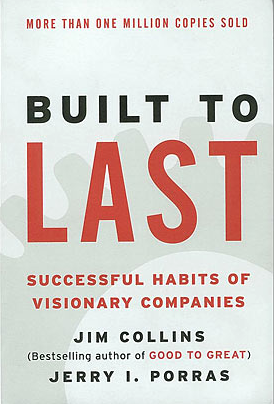
In 1994 Jim Collins and Jerry Porras coauthored “Built to Last: Successful Habits of Visionary Companies,” which was named by Time Magazine as one of the 25 Most Influential Business Management Books of All Time.
Since being published, not all of the “Built to Last” companies have lasted without some challenges. But the advice and lessons learned remain bedrocks of business practices. Below, Collins shares some of the insights gained from the book, which, among other things, dismissed five “myths” about building a successful organization:
- A great idea is needed to start companies
- Visionary organizations need charismatic leaders
- Maximizing profits is the dominate goal with visionary companies
- Visionary companies focus on beating competitors.
- Hiring outsiders as CEO’s is the best way to spark an organization
By Jim Collins
In more than 1,700 years of combined history, we found only four cases in our visionary companies in which an outsider was hired as chief executive—and that in only two of the 18 companies! In contrast, our less successful comparison companies were six times more likely to go outside for a CEO. Our findings simply do not support the widely held belief that companies should hire outsiders to stimulate change and progress.
Indeed, as great companies grow up, we see continuity and order in management tenure and succession. Insiders preserve the core values, understanding them on a gut level in a way that outsiders usually cannot. Yet insiders can also be change agents, building on the core values while moving the company in exciting new directions.
Bob Galvin spent years learning from his father, Paul Galvin, founder of Motorola, before becoming CEO. Bob Galvin then kept Motorola’s core ideology intact and simultaneously revolutionized the company. At the very moment he began that revolution, by moving the company out of television sets and into solid-state electronics, integrated circuits, and cellular communications, Bob Galvin also began succession planning for the next generation of leadership—a full quarter of a century before he would pass the reins—to maintain a lineage of homegrown leaders to preserve Motorola's core values.
At our comparison companies we frequently saw management gaps—often due to egocentric leaders who simply could not conceive of the organization without themselves at the helm. “Commander” Eugene F. MacDonald Jr., the brilliant founder of Zenith, never planned for his succession. Since his death in the late 1950s, Zenith has been plagued by spotty leadership—at times from the outside—that allowed the company to drift from its founding values. Motorola, however, has sailed on into exciting new arenas for the past 30 years, guided by an unbroken string of capable, long-tenured, homegrown leaders. What has Zenith done?
The notion that “founder-entrepreneur types” are constitutionally incapable of building and managing companies is bunk. Consider that the founders of Ford, Hewlett-Packard, Johnson & Johnson, Marriott, Merck, Motorola, Nordstrom, Philip Morris, Procter & Gamble, Sony, Wal-Mart, and Disney remained in the role of chief executive for an average of 37 years each. They were founder-entrepreneur types and manager-builder types. Not only that, their immediate successors—all homegrown insiders—remained in office for 24 years on average. Stability indeed.
BHAGs, Experimentation, and Continuous Improvement
To build a visionary company, you need to counterbalance its fixed core ideology with a relentless drive for progress. While core ideology provides continuity, stability, and cohesion, the drive for progress promotes change, improvement, innovation, and renewal.
One way to bring that drive for progress to life is through BHAGs (short for Big Hairy Audacious Goals). With his very first dime store in 1945, Sam Walton set the BHAG to “make my little Newport store the best, most profitable in Arkansas within five years.” As the company grew, Walton set BHAG after BHAG, including the still-in-place goal to become a $125-billion company by the year 2000. The point is not to find the “right” BHAGs but to create BHAGs so clear, compelling, and imaginative that they fuel progress.
A second way to simulate the drive for progress is to create an environment that encourages people to experiment and learn—to try a lot of stuff and keep what works. 3M began life as a failed mine and could not pay its first president a salary for 11 years. Yet it grew into one of the most innovative companies in history, eventually branching into more than 60,000 new products. In contrast, Norton (3M’s comparison in our study) began life with a revolutionary new grinding wheel that propelled the company to spectacular early growth. Yet Norton became a stodgy old-line company, with no reputation for sustained innovation. 3M’s clock builders created an environment where people were encouraged to try just about anything, and were given 15% of their time to do so.
“Our company has, indeed, stumbled onto some of its new products," an early CEO once noted. "But never forget that you can stumble only if you're moving." Norton, on the other hand, stifled experimentation and discouraged people from working on anything but grinding wheels. "You could work on anything you wanted as long as it was round and had a hole in it," recalled one Norton research scientist.
In a visionary company, continuous improvement is a way of life, not a management fad. The critical question is not “How can we do well?” or “How can we meet the competition?” but “How can we do better tomorrow than we did today?” The challenge is to build for the long term while doing well today.