

MOUNTAIN VIEW, Calif.—More companies, including some of the largest and most innovative when it comes to workspaces, are announcing the kinds of changes employees will see when they return to work.
Among them, Google, which more than a decade ago built a sprawling campus called the Googleplex that featured airy, open offices and whimsical common spaces that set a standard for what an innovative workplace was supposed to look like. It included amenities such as free food and free buses to and from work so that getting to the office, and staying there all day, was easy.
Now, noted the New York Times, the company that “once redefined how an employer treats its workers is trying to redefine the office itself. Google is creating a post-pandemic workplace that will accommodate employees who got used to working from home over the past year and don’t want to be in the office all the time anymore.”
According to the report, Google plans to encourage — but not mandate — that employees be vaccinated when they start returning to the office, probably in September.
Junior High Students Studied
“At first, the interior of Google’s buildings may not appear all that different. But over the next year or so, Google will try out new office designs in millions of square feet of space, or about 10% of its global workspaces,” the New York Times reported. “The plans build on work that began before the coronavirus crisis sent Google’s work force home, when the company asked a diverse group of consultants — including sociologists who study ‘Generation Z’ and how junior high students socialize and learn — to imagine what future workers would want.”
What Google is planning is what the analysis described as “Ikea meets Lego.”
Instead of rows of desks next to cookie-cutter meeting rooms, Google is designing “Team Pods,” each of which is a “blank canvas,” with pod is a blank canvas, with chairs, desks, whiteboards and storage units on casters that can be wheeled into various arrangements, and in some cases rearranged in a matter of hours.
“To deal with an expected blend of remote and office workers, the company is also creating a new meeting room called Campfire, where in-person attendees sit in a circle interspersed with impossible-to-ignore, large vertical displays,” the Times reported. “The displays show the faces of people dialing in by videoconference so virtual participants are on the same footing as those physically present.”
Outdoor Work Areas
In a handful of locations around the world, the report noted, Google is also building outdoor work areas to respond to concerns that coronavirus easily spreads in traditional offices.
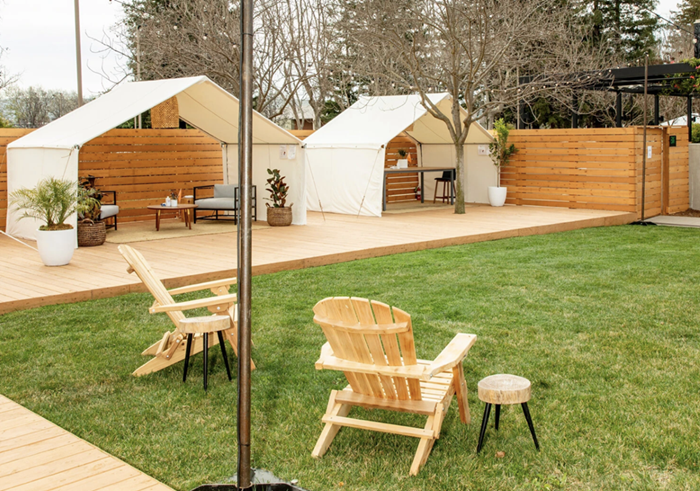
“At its Silicon Valley headquarters, where the weather is pleasant most of the year, it has converted a parking lot and lawn area into ‘Camp Charleston’— a fenced-in mix of grass and wooden deck flooring about the size of four tennis courts with Wi-Fi throughout,” the Times reported. “There are clusters of tables and chairs under open-air tents. In larger teepees, there are meeting areas with the décor of a California nature retreat and state-of-the-art videoconferencing equipment.”
The report went on to note each tent has a camp-themed name such as “kindling,” “s’mores” and “canoe.”
Camp Charleston has been open since March for teams who wanted to get together. Google told the Times it is building outdoor work spaces in London, Los Angeles, Munich, New York and Sydney, Australia, and possibly more locations.
“Employees can return to their permanent desks on a rotation schedule that assigns people to come into the office on a specific day to ensure that no one is there on the same day as their immediate desk neighbors,” according to the Times. “Despite the company’s freewheeling corporate culture, coming into the office regularly had been one of Google’s few enduring rules.”
Other Proposals
Other notes on why Google is making the changes it is and what it has planned:
- As the company’s work force topped 100,000 employees, face-to-face collaboration was often impossible and employees found it harder to focus with so many distractions inside Google’s open offices. The company had outgrown its longtime setup.
- Google has focused on three trends: Work happens anywhere and not just in the office; what employees need from a workplace is changing constantly; and workplaces need to be more than desks and meeting rooms.
- Two of the most rigid elements in an office design are walls and the heating and cooling systems. Google is trying to change that. It is developing an array of different movable walls that can be packed up and shipped flat to offices around the world, the Times reported. It has a prototype of a fabric-based overhead air duct system that attaches with zippers and can be moved over a weekend for different seating arrangements. Google is also trying to end the fight over the office temperature. This system allows every seat to have its own air diffuser to control the direction or amount of air blowing on them.
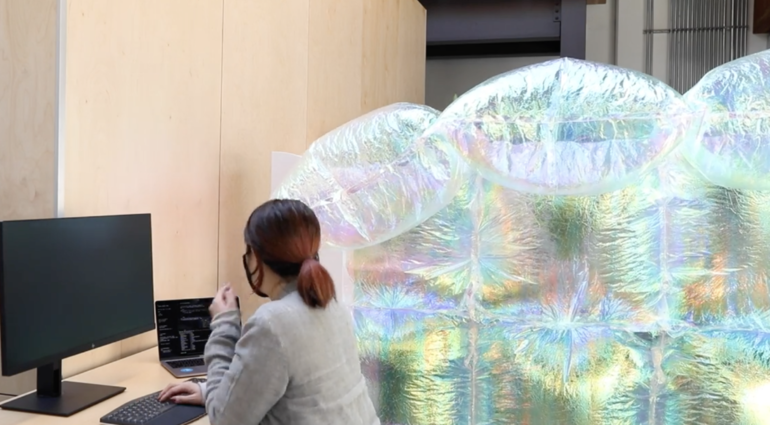
- If a meeting requires privacy, a robot that looks like the innards of a computer on wheels and is equipped with “sensors to detect its surroundings comes over to inflate a translucent, cellophane balloon wall to keep prying eyes away.”
Google has offices in 170 cities and 60 countries around the world, and some of them have already reopened. In Australia, New Zealand, China, Taiwan and Vietnam, Google’s offices have reopened with occupancy allowed to exceed 70%. But the bulk of the 140,000 employees who work for Google and its parent company, Alphabet, are based in the United States, with roughly half of them in the Bay Area.