

WASHINGTON–When many people and organizations talk about “empathy" they often say it''s about walking in another person's shoes. But what it’s really about involves removing your own shoes first , according to one person who shared insights around building organizations and processes that successfully incorporate women’s viewpoints and experiences.
Banafsheh Ghassemi, CEO and founder of Tangerine Lab, a human experience design firm that applies the power of design and systems thinking to a wide range of organizational and human challenges, offered her perspective during a Q&A as part of a Global Women’s Leadership Network breakfast held in conjunction with CUNA’s GAC.
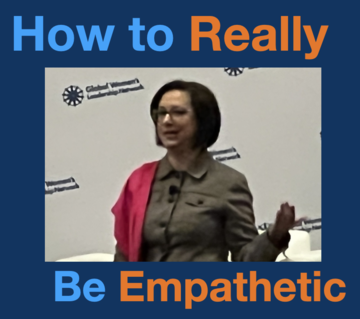
Ghassemi was born in Iran but had to flee that country with her family and move to the U.K. after the government was overthrown. Her father was placed on a most wanted list, the family lost its savings and became “stateless.” With an uncle as a sponsor, the family eventually made it to the United States.
Ghassemi shared her story and more during a Q&A that was moderated by Elissa McCarter LaBorde, president and CEO of the World Council of Unions.
Here is a look at what was discussed:
McCarter Laborde: Tell us about your life and career, which has been powerful.
Ghassemi: I don’t know if it’s powerful, but it has had a lot of bends and curves and the punchline is don’t plan your life to much. Life happens. I wanted to be a physicist but I went to engineering school. Two early mentors got me published in my 20s and they gave me a lot of space and mentorship, which to this day I appreciate. I got into operations logistics. It bored me into tears, but that’s where they put engineers.
I ended up in an elective class that worked with World Bank and we had to come up with a project. I had read about women in Gambia who were rice growers who needed access to capital.
What do I know about any of this? I cooked up a scheme to do something with women in Gambia and this story got to my dean. She was intrigued by this concept of access to capital for women in far-off places. She made a deal with me: ‘How about you work on this for the course of your elective work. I will give you a full-time fellowship and a scholarship and then you can teach us what you learn. I call it the scam of all time.
That was my first foray into international development. I came out of graduate school and the dean took me to an event where I met the head of Academy of Sciences in Turkmenistan. I was invited to go there to teach a summer class to women. They have many women farmers, and it’s not uncommon to see Ph.D.’s there in the rice fields. A civil war broke out and we had to go into hiding to teach.
By fluke, I found day job in tech in the wireless industry. We began working in that organization on human-centered design and how to create customer experiences specifically for objects in tech. I learned we can apply this process to not just building things but also customer experiences holistically. To this day that is really what I do.
I really wanted to be working on the things I started on in my career: human center design, women empowerment, financial inclusion. I’m now working with a lot of companies and organizations around things like hunger, health care access, financial inclusion, and economic development work
McCarter Laborde: Can you describe what is human centered design and provide an example in financial services and where it has been applied?
Ghassemi: It basically means designing solutions where the human you are designing for sits at the center of the designing process. This is very different from how it is often done. The word that is really prominent in our work is empathy. We hear it a lot. But it’s somewhat misunderstood. Empathy is often defined as walking in someone’s else’s shoes. But you cannot walk in someone else’s shoes until you take off your own. That means you cannot have judgement. When you are in financial industry you really have to understand the whole of the person before you can design any products or help them financially.
I challenge you to get to know people beyond your direct line to people. It requires a five-year- old’s beginner’s mind. Other people don’t make decisions like you do or like the person next to them does. Human-centered design also has other components; it’s also iterative, getting feedback from the people you are designing for. You put them in the center of the process.
McCarter Laborde: How can human-centered design at an financial institution?
Ghassemi: I worked on one recent project with a microfinance organization that had four subsidiaries and which is considered extremely progressive. They hired me to create a blueprint of what their capabilities are to show to investors. We did workshops on empathy to draw out people’s experiences. What they found out was their customers didn’t know them. They use them, but don’t know them. The grand scheme of things they delivered wasn’t very well known. (Customers) were just using the basics and didn’t see them as a partner for life.
McCarter Laborde: I hear this term of women-centered design. What is your view?
(Ghassemi shared the story of NASA’s planned all-women spacewalk which had to be delayed at the last minute after it was discovered the International Space Station did not have enough space suits that fit women.) “The most basic aspect of this flight was not planned. This happens a lot. Women-centricity is built into my work. It’s really, really easy to walk into a situation where you become so focused on what you want to do with women and how it relates to the organization and then forget other parts of life.
McCarter Laborde: How do we get the momentum?
Ghassemi: I challenge you to spend a respectable amount of time in the life of your members. Not just surveys and focus groups, but actually visit them. Spend one hour a month and meet up with your members for how they live and how they work.
As an organization you have to organize yourself to include women of different backgrounds, or create a product advisory that is dedicated to women and their lives.