

ORLANDO, Fla.–Ensuring a meeting is “enjoyable” is simple, according to one person: it just isn’t easy.
Doug Olsen, a former high school principal and school district superintendent who also has experience in being part of an IPO and who now is pastor a church with 9,000 congregants, knows what it’s like to sit through meetings. So, he’s made it his work to layout a roadmap to making meetings more effective.
Speaking to the CUNA CFO Council annual meeting here, Olsen called meetings an “art form,” the canvas for which is an agenda. He is not a critic of the meetings concept; indeed, he said they are critical to the success of organizations. But in addition to requiring an agenda, he said meetings are hierarchical and “relational.”
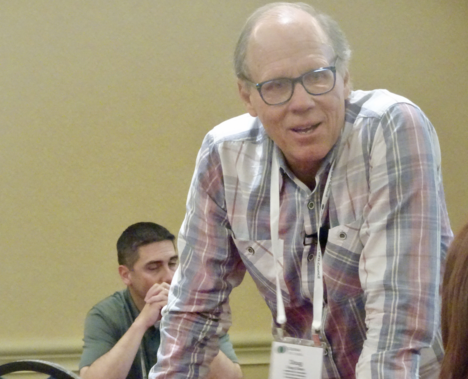
Doug Olsen, speaking to CUNA CFO Council meeting.
“I think this is the most common thing people forget about meetings,” he said. “Everyone has their own personality and expectations; we forget others aren’t here for a social time, even though it’s a social gathering.”
Olsen calls the process of holding effective meetings is “agenda-sizing,” and he has established several steps to be followed to make a meeting effective. Meetings, he said, require advance planning, recognition of group dynamics, the setting of expectations and the sharing of results.
“Results is the thing we forget about,” he said. “But this is where the decision-making and action points take place.”
Advance Preparation
The foundation for agenda-sizing is to be prepared, according to Olsen.
“Meetings fail when facilitators do not realize the value of preparation and the consequences of being unprepared,” he said. “If you don’t have time to prepare for all your meetings, cut down on the meetings. When you are not prepared for one meeting, it affects the next one.”
He compared preparing for a meeting to preparing for a physical workout, beginning with motivation, a commitment from the heart, a willingness to be disciplined, and even more willingness to work through the process.
He recommends a three-day process around meetings, including reminding people of the meeting to be held and providing an agenda one day ahead of time; the exercise of the meeting itself on day two, and a “cool down” the following day in which results are shared that act as a “bridge” to the next meeting.
When he is the meeting facilitator, Olsen said he is always the first to arrive and the last to leave.
Group Dynamics.
“Meetings are relational,” he said. “If you are discussing a strategy at a meeting, don’t forget that every strategy begins with a relationship. We are relational people. One of the greatest problems with meetings is the failure to recognize that a meeting is a social setting that is made up of individual and group dynamics.”
At every meeting, he said, there are four personality types:
- Choleric: The Type “A,” the do-er, the leader
- Melancholy. The Artist,” who is emotive, a thinker.
- The Sanguine. The “Talker,” friendly and outgoing.
- Phlegmatic. The “Quiet One.” Low key, worker, dependable.
But people attend meetings for different reasons, he said, including:
- The attender: Attends because required.
- The participant. Attends to participate.
- The Contributor: Attends to engage.
- The Leader: Attends to direct direct/facilitate.
In addition, he has identified four roles people assume within meetings:
- The implementer: Wants to get it done.
- The Analyzer: Wants to think it through
- The Promoter: Wants to “market it.”
- The Supporter: Wants to get their hands on it.
“The key to a successful meeting is to match their temperament and meeting personality with roles and responsibilities,” he said. “If they are a choleric or an implementer, give them opportunity to facilitate something. Just think through what you can do better in your next meeting to better understand who is in your meeting.”
Expectations
Any meeting for which expectations are not shared is doomed to fail, suggested Olsen.
“The realistic setting of expectations is vital to agenda-sizing model,” he said, using the putting together of a puzzle as a metaphor for meetings. “What’s the first thing you do with a puzzle? You look at the picture on the box. That’s what you want to do in a meeting: let people know the expectation.”
The steps to setting meeting expectations are, he said”
- Present a clear picture.
- Frame the meeting.
- Set team expectations.
- Clarify individual expectations.
- “Put it all together.”
The Nitty Gritty
The “nitty gritty” of any meeting is the agenda itself, offered Olsen. “It is both the result of and the next step in the process,” he said.
Olsen believes meeting should be limited to an hour and must start on time (“or people will come later and later to your meetings.”
Other basics of a good meeting, according to Olsen”
- Set clear objectives.
- Set an end time. “Meetings tank when people are concerned with their time.”
- Designate a meeting leader. “It’ doesn’t always have to be you.”
- Meet sparingly. “If there ever is a time when the meeting doesn’t have to happen, cancel it. Otherwise, it just makes the next meeting worse.”
- Create action items.
- Meet with fewer people.
- Bring solutions to the table.
- Always designate a secretary. “As a leader, if you try to take notes you will get distracted.”
Decision Making
“The agenda-sizing process is designed to create a decision-making environment,” said Olsen.
“Decision-making and follow-up are two things critical to every meeting. What does the group need to decide? Do they know? Decision-makers need to know what the decision is. State it in writing, say it verbally, start and end with it. If you don’t need a decision, you really don’t need to meet.”
One “tricky” issue, he cautioned, is deciding a group’s decision-making authority. He breaks down that authority to three types of decision:
- Informed decision. This is where support must be sought from meeting participants; he recognized this be used least.
- Advised decision, in which input is sought. This should be used 95% of the time, he said.
- Consensus decision, which he said can be least effective as it can mean multiple, diverse opinions being shared. “But there are times when a consensus decision is necessary, such as when buy-in is needed to make something work,” said Olsen.
“All of this is simple, it’s just not easy,” said Olsen.
Meetings, he said, should conclude with action steps, which end one meeting and begin the next.
The three action steps:
- Review assignments given during the meeting.
- Clarify the timeline.
- Send follow up reminders.