

SAVANNAH, Ga.–Here’s a certainty: You’re a member of a generation. And here’s what is most likely another certainty: You have assumptions about generations that are probably wrong.
Speaking to the CUES TalentNEXT Conference, LaToya Price, culture and inclusions officer at Visions FCU in New York, offered an overview of mistaken assumptions about generations and how those affect credit unions’ success when it comes to attracting and retaining talent.
In remarks themed, “The Generational Gap in the Workplace: How Psychological Safety Can Bridge the Generation Gap,” Price, who calls herself a “purposeful and intentional people strategist,” addressed numerous issues, beginning with an overview of how generations are defined in the U.S., and then questioning just how many workplace decisions are made based on assumptions and stereotypes associated with those statistics.
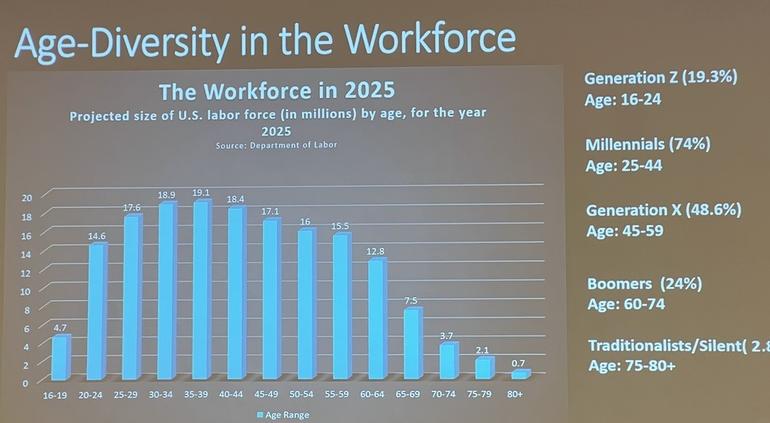
Price noted that for the first time there are now five generations of workers in the workplace, raising numerous questions around the right way to manage those individuals. As Price stressed several times, the focus should be on the individual, not the generation.
For example, she said, after giving her audience a quiz, “A lot of people believe Millennials prefer virtual over in-person. But that’s not the truth. Are we putting all of our eggs in one basket and choosing to do all of our training virtually? It’s something to think about.”
Price ran her audience through each of the five generations in the workplace and offered these thoughts:
The Generations
Traditionalists
These are people 75 and over who are mostly retired. “However, the unretirement rate is accelerating,” said Price. “This generation is re-entering the workforce or not exiting the workforce, and financial considerations are the reasons most often cited.”
Characteristics: Loyal to the organization; strong work ethic.
Baby Boomers
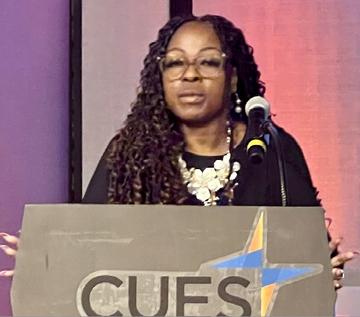
LaToya Price
Baby Boomers have also become part of the so-called “great unretirement.”
Indeed, Price noted teenagers are less likely to have a job than people 65-69. The generation has more than $112 billion in outstanding student loan debt, and more than 16-million Americans 65+ are financially insecure. “Are we thinking about this generation in these terms?” she asked.
Characteristics: Anti-job hopping, dedicated and committed; self-sufficient, competitive and believe authority equates to experience.
Generation X
Price referred to Gen X as the “neglected middle child sandwiched between Boomers and Millennials.
“Only 41% identify with the label Generation X,” she said. “They often get passed over for promotions. Many Gen Xers entered the workforce during or post recession.”
Characteristics: Are independent, flexible and informal, less competitive than other generations, cynical and embrace technology.
Millennials
By 2025 Millennials will represent a substantial portion of the workplace, Price reminded, adding, “Digitization has been instrumental in shaping the lives of Millennials.”
Price said job security, salary, health care benefits, company reputation, and a company’s contributions to the betterment of society are leading factors when Millennials choose a job.
Characteristics: Multitaskers, tech-savvy, team-oriented, instant gratification and recognition, entitled and impatient.
Generation Z
Gen Z has never lived without technology, Price pointed out. The generation is also the most racially diverse.
“Seventy-seven percent of Gen Zers are more likely to apply for a job in companies that value diversity,” Price told the meeting. “Gen Z is on course to being the best educated, and ranks meaningful work just as highly as they rank workplace flexibility.”
Characteristics: Digitally fluent, mindful, embrace change, low attention span, easily distracted and competitive.
Generation Gap (On Dates)
Price showed graphics from three different sources that agree there are five different generations, but as noted above, that disagree on the actual dates of generations.
“Generations are a social construct; it’s not grounded in science,” said Price. “Generations are generalizations about people based on their age. Generations are stereotypes that feed our conscious and unconscious bias. We treat people based on characteristics that are not based in science. The more we can adjust our leadership lens to focus on individual characteristics (the better).”
Thinking in terms of generation only and not individual characteristics can create a self-fulfilling prophecy, according to Price. For example, she said members of Gen Z are often given technology-only tasks, and they often aren’t engaged due to a lack of diversity in what they are being challenged to do.
Psychological Safety
Price shared with the meeting some views on psychological safety, which she said is the ability to take impersonal risks without the fear of consequences.
The four stages of psychological safety, according to Timothy Clark and as cited by Price, include:
- Inclusion Safety. “Members feel safe to belong to the team. They are comfortable being present and do not feel excluded.”
- Learner Safety. Members are able to learn through asking questions.
- Contributor Safety. Members feel safe to contribute their own ideas without fear or embarrassment or ridicule.
- Challenger Safety. Members can question others.
The Necessary Behaviors
The leadership behaviors that build and maintain psychological safety, according to Price, are those that:
- Acknowledge and celebrate diversity (intersectionality, too)
- Emphasize shared values
- Choose curiosity over judgment. “You may think you know a generation, but you don’t know that person.”
- Make communication essential
- Require feedback. If feedback is really ongoing, Price said, “A termination should never be a surprise and a resignation should never be a surprise.”
- Cultivate Trust. “Trust and psychological safety are two different things. Trust is the confidence that allows me to be me, and psychological safety is having confidence that I can show up as me and not be chastised or criticized.”
- Connection over task. Intergenerational management requires interpersonal relationships.
Are You Being Gouged for Bank-Like Subscription Fees for Old News? Here’s a CU-Like Way to Fix That
The biggest, best and freshest news reporting in credit unions remains free! Each morning CUToday.info delivers its daily Fresh Today news update offering the latest headlines and breaking news right to your email, with the easy-to-read headlines format allowing you to click on the stories that interest you most in order to learn more. So stop paying those bank-fee-like subscription prices from other so-called “news”” publications!
If you haven’t yet signed up for the new email solution on which CUToday.info has partnered with ResponseGenius, you can do so here. Signing up requires less than one minute of your time—and it’s free!
Please note that after signing up you may need to go to your Spam/Junk folder and mark the morning headlines email as safe. CUToday.info does not provide its list of readers and emails to outside parties, and we will not be contacting you to sell you an extended warranty or sending you any links so you may cash in on an inheritance you didn’t know was coming.
And did we mention it’s free?