

By Ray Birch
LAKE FOREST, Ill.—Deposits in financial institutions across the nation are shrinking even as rates continue to expand, according to a new report that outlines in greater detail how the deposit war will likely play out in 2023.
Following a CUToday.info report that shows that at the end of March overall deposits within the financial services industry had fallen by $420 billion, year over year, Moebs $ervices has expanded on its findings and offering a forecast for where deposit rates will likely land by the close of the year, which products will be affected the most, and how credit unions need to respond as a result.

“The competition for deposits is at an all-time historical high. As Federal Reserve Chair (Jerome) Powell keeps reducing the supply of money, the price of deposits skyrockets,” said Michael Moebs, chair and economist at Moebs $ervices.
Examples Cited
Moebs cited several examples, including:
- Chase Bank, the largest financial institution in the U.S., is offering 4% on CDs under $100,000 on terms up to six months
- $186-billion Ally Bank is offering 4.15% on money market deposit accounts (MMDAs) for $1 or more
- Walmart is dangling returns up to 5% APY on savings accounts under $100,000
- $29-billion Boeing Employee Credit Union is promoting 4% on checking accounts up to $500
Fed Funds Rate to Rise
“Powell and the FOMC will continue to reduce money supply by selling securities at $95 billion a month probably through the end of 2023,” explained Moebs. “This will drive up the Fed funds rate 50 to 100 basis points by yearend and will increase deposit rates. The battleground will be six-month and 12-month retail and jumbo CDs, both insured and uninsured. FIs will have to pay 5% and a bit more to maintain their market share percentage on these deposit services. This will impact margins. So, FIs need to reduce non-interest expenses and reduce fee prices to increase fee revenue to maintain the bottom line and survival equity positions.”
Moebs defines survival equity, in simple terms, as the amount of the reserve less losses on investments, the FI has to pay depositors off.
Take Advantage of Labor Shortage
“When a price war erupts, no matter with services or products, the winners are those who have low costs of operations. Cost efficiency allows high pricing in deposits,” offered Moebs. “CUs should use the current labor shortage to their advantage. Reduce staff and get body count to $10 million in assets per employee or higher. Discharged staff with the labor market so tight will have an easy time getting a new job, no matter what their age. Also, the reduction in staff allows those remaining to get higher compensation while the bottom line of the CU increases.”
According to Moebs, depositories in June and July have been showing a “mixed bag” of deposit prices, with some deposit types holding their price steady, while other deposit types increase or decrease.
“Uncertainty abounds when money is in decline,” said Moebs. “Yet, deposit rates are increasing to maintain or competitively steal deposits, and a potential recession looms. Depositories strive to keep core deposit prices low to generate profits from the spread.”
What Survey Found
In July, Moebs $ervices surveyed and analyzed the national deposit market and identified 28 financial institutions to watch.

Michael Moebs
“These 28 FIs have 33% of all branches, 53% of all employees, 55% of all assets, 56% of all deposits, and 74% of all consumer checking accounts,” said Moebs. “It ranges from Chase Bank with the most deposits to Walmart with the most checking accounts. These FIs have the resources to dictate deposit prices and terms in every market in the nation.”
What’s Being Offered
Moebs outlined what these 28 financial Institutions offer:
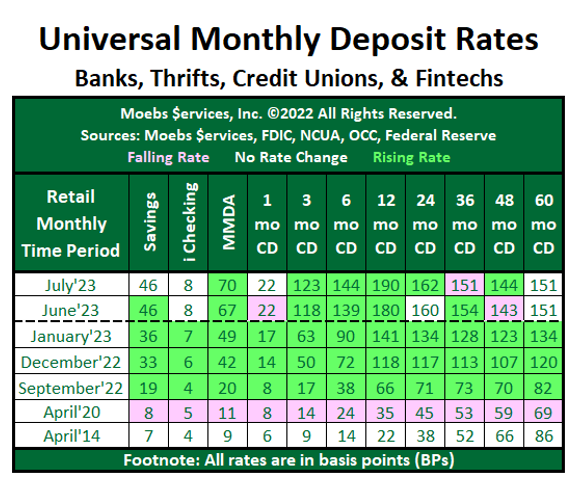
- Interest on checking averages five basis points, but can go up to 4%. Yet, five FIs with 24% of the nation’s checking accounts do not pay any interest on checking
- Savings interest averages 70 BPs with a high of 5%--the universal rate is 46 bps or 25 bps less
- 64% offer MMDAs and pay an average of 70 BPs. Eight of the 28 pay 4% to 5% interest if a monthly average balance of $30,000 is maintained
- The major CD term is 12 months with an average rate of 4.70%. Key features Insured and uninsured rates are the same for CDs; five of the 28 Fis offer the same deposit interest level, but only for a six-month term, and the highest CD rate is not offered for terms greater than 12 months, in almost all cases
What’s Best?
“What’s the best rate? The best deposit price maintains core deposits, capital, profit, and account holders—just enough to keep deposit market share,” said Moebs. “Why? Recession and the national election loom in the next 16 months.”