MONTEREY, Calif.–It may “hurt your head” to think in new ways about how open banking, open data and an “open future” are going to change the operating environment for credit unions, but CU leaders would be wise to embrace the pain, according to one expert. The same person also offered a preview of a “weather report” she said credit unions should pay attention.
Admitting that neither she nor her message are always “terribly likeable,” Dr. Louise Beaumont said she sees some “rich opportunities” ahead for credit unions––although she stressed those opportunities are anything but a “given”–especially given what brand-new research reveals about changes taking place in the “dominant codes of trust.”
It’s the kind of thinking on which credit unions should really be focused, rather than “wasting their time” on bank attacks, she added.
Beaumont is a strategic advisor to SapientRazorfish and co-chair of the techUK Open Bank Working Group, and says she has a particular interest in the intersection between technology, financial services and the public sector.
As Beaumont summed up in remarks to the California and Nevada leagues’ REACH Conference here, “I work with legislators and regulators to create disruption. I work with corporations to help them cope with that disruption. And I work with the startups that are going to exploit disruptions. All that gives me a 360-degree view on what disruption is and what it will take to make it happen.”
First, Beaumont urged credit unions to pay attention to four “interwoven drivers” of change:
Attitudes, Behaviors and, Crucially, Expectations
“Over the last few years our expectations have radically changed about what good service looks like. (Providers) are training us to expect ever-better experiences,” said Beaumont. “It’s incredibly easy, and human beings are engineered to enjoy easy. What that tells you is people are no longer grateful to be eligible for a product. Big dumb products are mass marketed without consideration for the end-customer. Savings accounts. Loans. All those things were created in a way that is standardized, because that is easier to get to the marketplace. These are self-evident truths if we look at how we consume products ourselves. One size fits no one.”
Data
Beaumont said every person is leaving a trail of data, which she called “digital dandruff,” that “could and should” be used to benefit the consumer. It’s the reasoning behind the data standard in her home country, the U.K., according to Beaumont.
“In the U.K., if I create that data, it’s mine. It’s not owned by that organization that happens to house it,” said Beaumont. “I should be able to use it to access the service I intend to service. With data, organizations have done three things: they’ve hidden it, they’ve hoarded it, and they’ve never ever used it. And they try not to lose it.”
To get her audience to rethink what data-sharing really is all about, Beaumont used the example of calling for an Uber, which she said is really about “announcing your desires.”
“You say where you want to go. It’s very seductive,” Beaumont said.
New Competitors
Beaumont said she noticed in doing research ahead of her appearance before the meeting and then in listening to other speakers at the REACH conference that credit unions are focused “verystrongly on those who have the temerity to attack you.”
“They are wasting their money and you are wasting your time,” said Beaumont of the tensions between banks and credit unions. “There are much more fertile things for you to be involved in. Absolutely, they represent a competitive set for you. But don’t obsess with them to the point of denying all the other competitors you have: the neo-banks; the tech titans moving into financial services who are now putting the professional wrappers around it; and Uber, which is now serving the underserved, the people driving the car.”
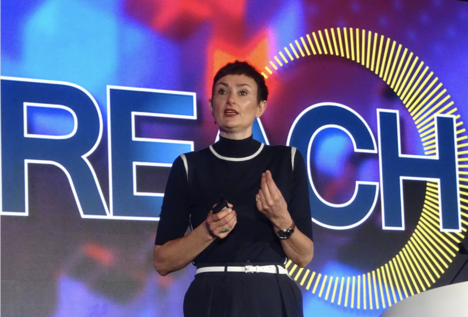
Dr. Louise Beaumont speaking to REACH meeting in Monterey.
Regulation
Regulation, said Beaumont, is the punishment institutions get when they don’t listen to customers, when expectations and behaviors are changing, and when CUs don’t listen to the “roar of data waiting to be used.”
Humans as Daisies
Beaumont urged CU leaders to think of themselves as individual daisies made up of different petals of data.
“This is about achieving hyper-personalized, predictive and preemptive service. Those services can flex and flow around you based on the data you’re willing and ready to share,” said Beaumont. “That’s what makes it so interesting. It gets to this point of trust. If I trust you as a service provider, I will share a petal of data with you. I will tell Uber where I am. The organizations that can persuade a person or a company to share more petals of data with them can provide an ever more hyperpersonalized, predictive and preemptive service.”
Beaumont asked her audience to imagine a world where financial services are “pleasurable”—a comment that drew some laughs from attendees.
“It’s like we think it has to hurt, and it’s just not true,” she said. “Think about your competition. It’s not the people running the attack ads; they’re just idiots wasting money. Your competition is the people running the hyperpersonalized, predictive and preemptive service.”
Beaumont said she doubted most credit unions really are able to deal with their members in a true individual context, and that instead most CUs likely see their members as segments.
“If you understand your customers at the segment level, that’s great, but it’s not the level of granularity that others who are seeking to convert them into their customers, are seeing,” she said.
Rethink This
Beaumont said credit unions should also think in new ways around:
- Brand. “The good ones have very, very, very stretchy brands; great elasticity of brand. You can put the word Amazon pretty much in front of any service: Amazon Marketplace. Amazon Pay. Amazon Fashion. Try that with Wells Fargo. Can your brand stretch to deliver new services delivered in new ways leveraging new data sets? This terrifies the big banks. And not just individual credit union brands, but the credit union movement. Can that stretch?”
- Engagement. “If you have a brand that gives you permission to engage with people, that’s hugely useful. The way the tech titans have chosen to (capture market) is voice. Are you engaging in every way you possibly could?”
- Ecosystem. “If you think about it, incumbent banks are competing for the time and attention of the smallest innovators out there. Do they make it easy for innovators to innovate? Do you make it easy for innovators to innovate in an ecosystem of success, or do you make it hard?”
What Trust Really Is
Credit unions are very fond of thinking of themselves as the most trusted of financial institutions, and perhaps most trusted among all the relationships a member might have. But Beaumont again had some challenges for CUs that have the potential to “hurt the heads” of CU leaders.
“Trust is not a monolithic thing. It’s not a stable, enduring, single definition thing. And it’s not trustworthy. You can’t trust it. You can’t think I’ve got it and I’m done,” said Beaumont. “It’s highly dynamic and in constant flux and, annoyingly, its highly negotiated. It’s not some enduring right you’ve got because you’re the good guys. Not true. I’ve read the research (done by credit unions) and it’s very comforting, but I’m not sure about the methodology.”
Beaumont said she suspects much of the research credit unions conduct includes questions that lead to comfortable answers.
A New Weather Report
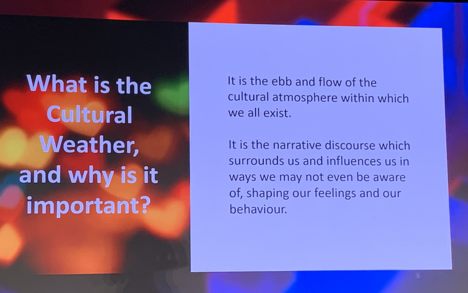
For the first time before a U.S. audience, Beaumont shared the results of The Cultural Weather Trust Report, which seeks to capture the cultural atmosphere within which everyone exists. The Weather Report is based on a compact data set of 297,000 data points, which will increase to more than 500,000 over coming 12 months. The research:
- Includes monthly qualitative research at scale to understand how people discuss the concept of trust and what it means to them in terms of brands and businesses
- Uses this language to trawl publicly available datasets, including social media forums, and reviews in the U.S., U.K. and Australia
- Ingests the websites of the top 500 companies in each country, plus challenger brands, and incorporates a trawl of newsflow
Not a Surprise
“What they found is something that will not surprise you in the slightest. The dominant codes of trust include digital security, telling the truth, treating people well, ethics and leadership, service that works, and doing the right thing,” said Beaumont.
Credit unions have built their businesses on these dominant codes of trust, Beaumont observed, but increasingly CUs need to embrace the “emerging codes” of trust in both members and especially the consumers credit unions are looking to embrace.
The Emerging Codes
The new emerging codes of trust, Beaumont said, include:
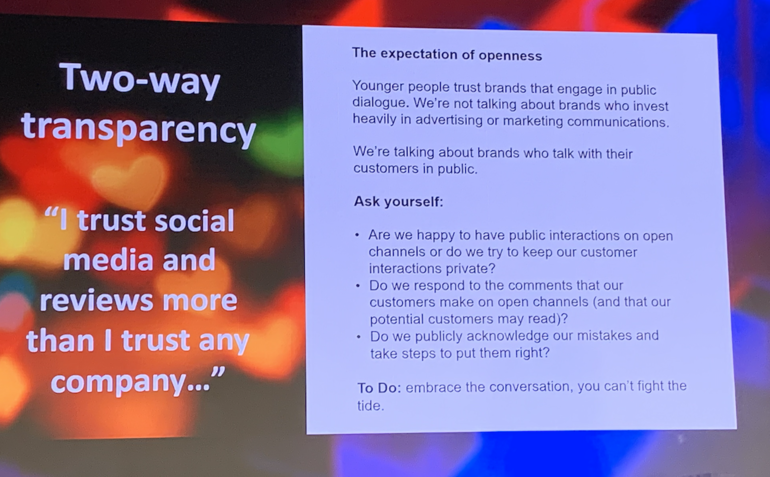
- Two way transparency. “It’s the expectation of openness.”
- My money, my data. “This comes across very, very clearly in the data. The expectation is I own the data.”
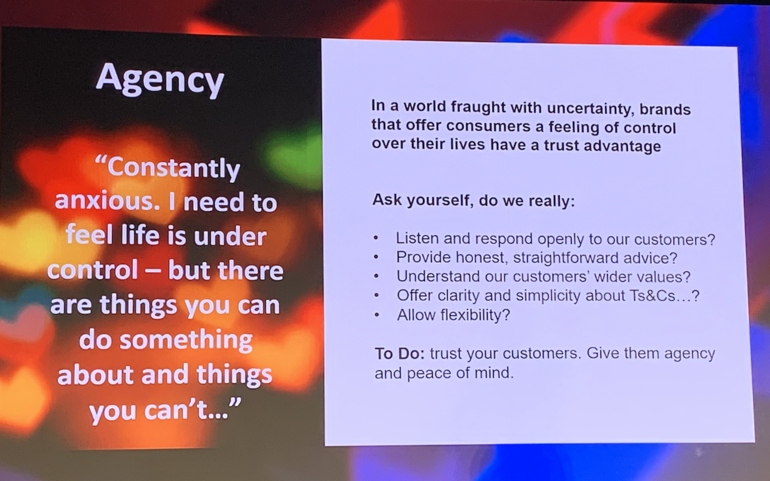
- Agency. “Fundamentally, in a world fraught with uncertainty, organizations that can offer people a sense of certainty have a built-in advantage.”
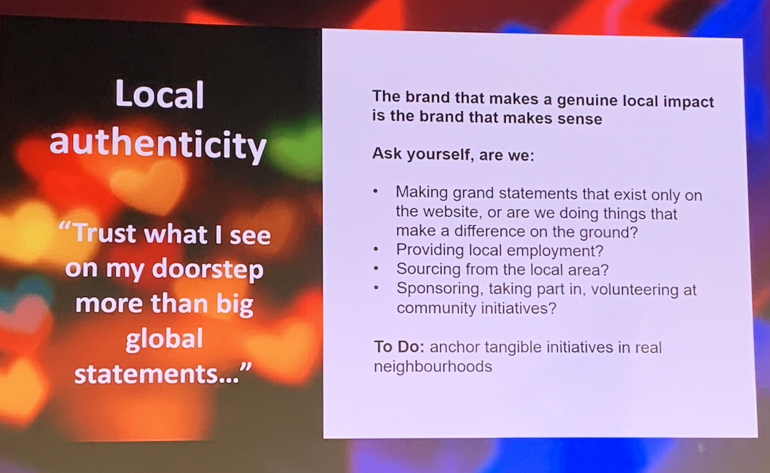
- Local authenticity. “It’s not the brand purpose nonsense. It’s the stuff on the ground that matters to people.”
- Social exchange. “This is quite political in nature and is always a challenge. It’s about organizations recognizing strong political currents and getting in there.”
- A new humanity. “This is an interesting one. There has been a rush to digitalize, and not all of that has gone well and we have this facsimile of humanity leaking out of organizations, and humane humanity is coming back.”
Beaumont “implored” credit unions to take advantage of three of the emerging codes she said are particularly important to credit unions and which are outlined below.
'
'