

ALEXANDRIA, Va.–During a briefing hosted by NCUA related to its 2021 and 2022 budgets, the agency heard questions raised over why its budget continues to increase at a time when the number of CUs is decreasing, concerns state charters are bearing an “inordinate” level of costs related to supervision, and pushback against plans for exams over compliance with consumer protection laws.
And while the three CU trade group reps who offered comment all praised NCUA for holding the budget briefing, NASCUS CEO Lucy Ito wondered what has become of prior input. “I cannot say I can identify the suggestions that have been taken up over the last few years,” she said.

During the budget briefing, NCUA Chairman Rodney Hood and Board Member Todd Harper both offered comment, while representatives of CUNA, NAFCU joined with NASCUS in providing remarks and responding to questions from the NCUA board members.
The state of the NCUA budget for the next two years is somewhat in flux. Current Board Member Todd Harper is likely to be elevated to chairman once the Biden Administration takes office, but as a Democrat he will be in the minority now that Republican nominee Kyle Hauptman’s nomination has been approved by the Senate.
During his comments Harper repeated a point he made at the agency’s November meeting, and that is “the draft budget concerns me, especially in light of the safety and soundness implications that the credit union system may soon face because of the pandemic’s economic fallout, the priorities of the agency related to consumer financial protection and the general transparency of the NCUA budget.”
The trade group reps pushed back on the suggestion potential losses are ahead for the share insurance fund. Similarly, Harper’s call for greater compliance with consumer protection laws received a cool reception.
Hood said he would be willing to create a CFPB-like progrom at NCUA if the Bureau "fully" returns regulation of credit unions to the agency. He said NCUA’s general counsel has advised the CFPB has authority to do so.
The Budget Numbers
The NCUA budget for 2021 is smaller than that of 2020, due almost entirely to examiner travel-related savings due to the pandemic and the resulting virtual exams. The proposed NCUA 2022 budget shows a significant increase over both 2020 and 2021.
The agency has proposed a 2021 operating budget of $315,567,000, a capital budget of $18,845,000, and a share insurance fund administrative budget of $8,098,000, for a total budget of $342,510,000 (down from $347.9 million in 2020). For 2022, NCUA is proposing a budget of $341,766,000, $14,572,000 and $7,880,000, respectively, for a total of $364,218,000.
Harper Raises Concerns Over ‘Higher Risk Profiles
Harper said he is concerned over the economic effects of the pandemic on credit unions, saying NCUA should “plan for the worst and hope for the best.”
During the November board meeting, Harper said credit unions should “brace” for a NCUSIF premium as the insurance fund drops below the required 1.20% equity ratio as a result of losses by credit unions and other factors.
“We already know that credit unions with higher risk profiles will require additional examiner attention and closer supervision next year as the economic effects of the pandemic unfold,” said Harper. “Why, therefore, have we not engaged in a comprehensive board-level discussion about the exam program to address this reality?”
Looking forward, Harper said he believes a return to a 12-month examination cycle is advisable.
“We have a duty to prepare for any economic fallout. We cannot just call on examiners from the state supervisors and the other banking agencies to help us,” Harper said. “They will be preoccupied with handling their own problem institutions. That is why I think we should plan ahead and budget for adequate field staffing needs now.

Todd Harper
“Instead, this draft budget will spend just $175 per million dollars of system assets,” he continued. “Before the last crisis, that figure bottomed out at $210 per million dollars in industry assets. That cutting of fat actually cut into the bone and left the agency flat-footed and ill-prepared for the financial crisis. We should not repeat that mistake.”
Oversight of Consumer Protection Laws
Harper also raised concerns around NCUA’s oversight of consumer financial protection laws, saying the agency does not adequately assess consumer compliance management systems or even basic compliance with consumer financial protection laws in most credit unions.
“To build an effective consumer compliance supervisory program, we need to do more than what the 2021 draft budget envisions,” Harper said. “Adding just one person next year to develop tiered examination procedures up to and including FFIEC-approved examination procedures, lead consumer financial protection compliance reviews conducted at credit unions with higher compliance risk profiles and assist in developing training materials for examiners and credit unions is simply not enough.”
Finally, Harper called for shining a light on the agency’s growing use of “overhires” as a way to keep the public counts of full-time employees relatively flat.”
Update From Agency CFO
NCUA CFO Eugene H. Schied offered a broad overview of the NCUA budget, projections for the budget and more. As CUToday.info has reported, he noted the Operating Budget projects a slight decrease between 2020 and 2021 largely as a result of one-time offsets from 2020 savings and is projected to increase in 2022.
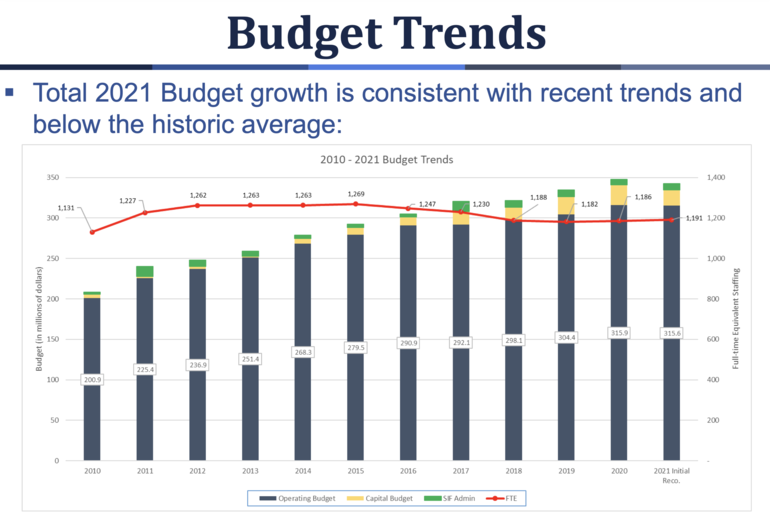
The Capital Budget shows a decrease between 2020 and 2021 due to initial completion of MERIT development in 2020. MERIT will be fully deployed in 2021, Schied said.
He further noted the Share Insurance Fund Administrative Budget shows an increase between 2020 and 2021 largely due to the costs of in-house stress test validation tools.
In 2021 all NCUA examiners – who make up two-thirds of the agency workforce – will be trained to use the new MERIT examination system, Schied said. Later, in response to a question from NCUA Chairman Rodney Hood, Schied said the agency currently has 49 vacancies in its examination force.
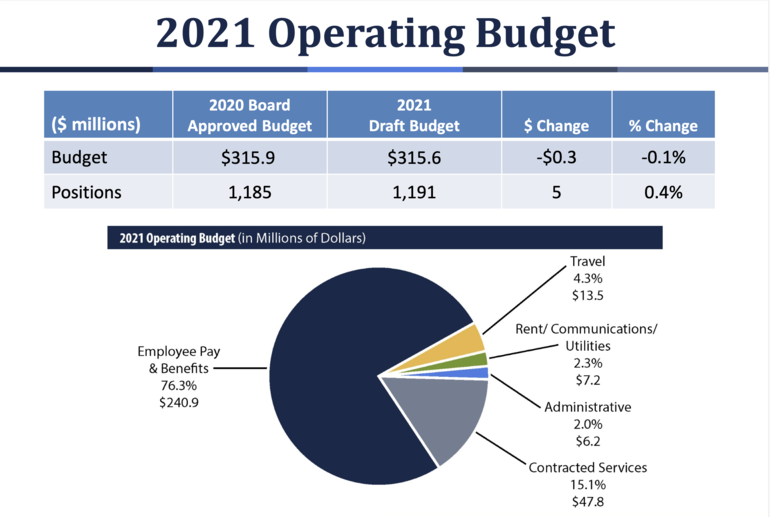
Pay and benefits costs account for over 76% of the NCUA budget, noted Schied, adding that increases in required federal retirement fund contributions account for approximately $2.3 million, or 0.7%, of pay and benefits growth.
Schied reminded increases to employee pay are required by law to “maintain comparability with other federal bank regulatory agencies.”
According to Schied, the agency’s Administrative Services budget will increase in 2021 largely because employee relocations in 2020 were paid for using unspent funds from prior year budgets. The 2021 budget includes $750,000 for employee relocations next year.
The full staff draft of the 2021-22 budget is available here.
CUNA: ‘Immense Capacity’ To Reduce Agency’s Footprint
CUNA’s chief economist, Mike Schenk, applauded the agency for hosting the budget briefing and for the greater transparency in its budget process, but also said the trade group opposes some of the proposals being considered, including one board member’s focus on greater consumer compliance.
“We, once again, find the NCUA’s Budget Justification document to be clear, comprehensive, and well-developed,” said Schenk. “The proposed activities and expenditures described generally align with previously announced and vetted strategic initiatives including the Virtual Examination Project and Enterprise Solution Modernization. It also appropriately responds to changing supervisory priorities especially in light of the COVID-19 crisis.
“The NCUA’s Proposed 2021 Budget reflects a 1.4% decrease in expenditures overall. And the operating budget, which accounts for 92% of agency expenditures, reflects a modest 0.1% decline. This seems reasonable in the context of the current 1.2% year-over-year inflation rate and with the 4% annualized first-half 2020 increase in credit union operating expenses – which is the point of reference for most credit union CEOs,” continued Schenk. “However, as outlined in the Budget Justification document, a good deal of the apparent fiscal restraint reflected in those numbers arises in large part due to the decline in travel-related expenses in 2020, and the expectation that travel will continue to be restricted into 2021.”
Schenk called the budget justification document published by NCUA a “fairly high-level summary that – perhaps by design – omits detail necessary to adequately assess the need and rationalization for each of the individual new positions proposed. We know the duties to be performed – but little about the need for those duties to be performed...As we’ve said in the past, we believe there is immense capacity for NCUA to reduce its footprint, right-size the organization and come out of the resulting transition as a nimbler, stronger, more efficient and more effective regulator.”

Mike Schenk, CUNA
‘Real Concerns’ Over Consumer Protection Exams
Schenk said CUNA has “real concerns around any obvious expansion in consumer protection examination activity,” a priority of Board Member Harper. “Our members believe altering the agency’s risk-focused examination process and substantially increasing examination-related expenditures is simply not warranted. NCUA has provided no supplementary evidence to suggest credit unions’ consumer compliance management has become a risk area warranting an increased expenditure of agency resources. As its mission statement makes clear, the NCUA exists to ensure the safety and soundness of the credit union system, and its examination program should remain focused on that objective. In addition, the agency already has the tools in place to further evaluate a credit union’s consumer compliance program when a need is identified through the risk-focused examination process.”
Additional Notes
Schenk also stated:
- CUNA wants NCUA to commit to reducing the Normal Operating Level of the NCUSIF to a level closer to its 1.30% historic norm. “Collecting premium assessments has never been an issue historically – even in tough times. The need to recast the nature of the NCUSIF – transforming it into a bank-like fund - is simply unwarranted and should be strongly resisted,” Schenk said.
- NCUA should use the COVID -19 Crisis as a reference point for meaningful field of membership reform, as the use of e-channels has made clear face-to-face interaction with members it no longer necessary.
The full CUNA statement is available in CUToday.info’s The Gov here.
NAFCU: Number of CUs Continues to Shrink, But NCUA Budget Continues to Increase
NAFCU Chief Economist and Vice President of Research Curt Long called on NCUA to continue to find ways of adapting to the changing environment and transitioning to new supervision and examination methods that do not result in significant year-over-year budget increases.
NAFCU encourages the NCUA to continue an ongoing, agency-wide commitment to managing its funds in a prudent and transparent way that uses cost savings as a learning opportunity and not a rationale for future budget increases.
Long said NAFCU’s recommendations to improve the efficiency of its budget include:
- Preserving the strength of the NCUSIF and avoiding unnecessary assessments on credit unions
- Continuing to pursue exam modernization efforts andidentify cost-saving opportunities in the transition to primarily virtual exams
- Achieving a reasonable and tailored budget for cybersecurity expenses
- Supporting financial inclusion through the NCUA’s newAdvancing Communities through Credit, Education, Stability, and Support (ACCESS) Initiative with a focus on enhancing field of membership (FOM) and other growthopportunities.
While NCUA has noted its proposed 2021 budget is smaller than the current budget, Long said, “Absent the reductions due to the COVID-19 pandemic, NCUA’s budget continues to increase year over year. The projected budget increases for2022 signify that the agency is headed in the wrong direction with respect to operating an efficient budget.
“…The 2022 estimated Operating Budget balloons to $341.8million, which would represent an increase of $26.2 million, or8.3%, from the 2021 budget should it be approved as proposed,” said Long. “This also represents a 44% increase in only a decade while the credit union industry is on pace to consolidate by 31% over that same timeframe. The 2022budget increase is partly due to a rebound in travel costs,which grow by $10.8 million. But while the pandemic is clearlyresponsible for volatility in the travel budget, non- travel costshave been increasing at a steadily accelerating pace, exceeding5% annual growth in the proposed 2022 budget.”
Other Points of Concern
Other points raised by Long included:
- NAFCU “implores” the agency to conduct a cost-benefitanalysis for each new FTE along with a robust cost-benefit analysis for each new program and initiative within the Operating Budget, with a goal of achieving the types of budgetary efficiencies that will arrest the upward drift in expenditures.
- NAFCU is concerned about growing expenses related to contracted services. This portion of the operating budget continues to see one of the largest percentage increases in 2021, totaling $47.8 million or a 10.3% increase compared to 2020. In 2022, the NCUA proposes to further increase this category of expenditures by 11.8%, said Long.
- “Although the agency continues to point to a decline in the relative size of the NCUA budget compared to the balancesheets at federally insured credit unions, industry assetgrowth alone does not mean the budget is more efficient,” Long said. “Considering the NCUA examines and supervises credit unions, not assets, NAFCU encourages acommitment to evaluating opportunities for cost-savings and budget reductions year-over-year. To clearly demonstrate this commitment to the prudent management of credit union dollars, the NCUA should always engage in cost-benefit analysis as it looks at existing and future programs.”
- Regarding recent NCUA board meetings that featured discussions of expanding the agency’s statutory authoritiesover the SIF, including the ability to charge premiumassessments when the equity ratio exceeds 1.3%, Long said NAFCU opposes such changes as the SIF’s historical record shows that they are unnecessary. Long said NAFCU supports a 1.3% equity ratio and opposes discretionary premiums should the equity ratio fall below 1.3%. If theNCUA is required to charge a premium should the equity ratio fall below 1.2% due to extraordinary share growth, then NAFCU urges the NCUA to implement a lengthy restoration plan.
- Long said the $6 million in surplus 2020 travel funds shouldnot immediately be allocated for travel costs in 2021, and instead should be viewed as an opportunity to determinehow much travel is ideal for examiners and credit unions, reduce costs by cutting travel expenses across the board, and transition to more offsite, virtual examinations as the infrastructure has already been set up because of the COVID-19 pandemic.
- NAFCU supports the advancements in the implementation of the Enterprise Solution Modernization (ESM) program, which includes the replacement of the Automated Integrated Regulatory Examination System (AIRES) with the new MERIT system. Long added that while NAFCU appreciates the Interagency Rule and understands the delicate balance between the agency’s dual roles as aregulator, NAFCU is concerned that NCUA examiners willcontinue to take an overly risk-averse approach to examinations.
- NAFCU is concerned that some of the agency’s proposed investments in cybersecurity improvements, however well-intentioned, may be decoupled from results-based metrics, and may continue to drive costs disproportionately, resulting in yearly budget increases, Long said.
The full NAFCU statement is available in CUToday.info’s The Gov here.
NASCUS: State Charters Bearing an ‘Inordinate Cost’ of Supervision
NASCUS President and CEO Lucy Ito said the group continues to pay close attention to NCUA’s management of its budget, in large part because of the overhead transfer rate (OTR)—which represents funds transferred from the share insurance fund to cover the costs of examining state-chartered CUs–which she said is “inextricably tied to NCUA’s implementation of its budget.”
“As we have stated previously, NASCUS has historically held the position that a regulatory agency is in the best position to know the resources it needs to maintain a safe and sound supervisory program,” said Ito. “Accordingly, we do not typically reflect on specific budgetary elements; however, we are happy to share SSA budgetary practices and we, certainly have a few observations to make with respect to NCUA’s budget justification for 2021-22 mostly with respect to OTR.”

Lucy Ito, NASCUS
In her comments, Ito and NASCUS focused on five issues:
- Significance of the OTR especially in the current economiccontext
- Imbalance and potential inequity resulting from OTRimplementation
- Validation & reconciliation of allocation assumptions vs. actual time allocations
- Revisiting the cost allocation of NCUA’s supervision of CUSOs and third parties
- Treatment of capital expenditures and miscellaneousrevenue
A ‘Departure’
“In a departure from earlier historical practice, for over 20 years, a majority of NCUA’s annual budget has been paid by the OTR, reaching a high of nearly 75% of NCUA’s 2016 budget,” said Ito. “This is significant because FISCUs shoulder an inordinate cost of supervising the safety and soundness of the credit union system. By sheer number of individual credit unions, FISCUs make up only 37% of the total number of FICUs. However, since FISCUs make up 50% of all insured shares, the cost of the OTR is borne equally from the funds of both FISCUs and FCUs, even though there are more FCUs whose examination costs are being charged to the NCUSIF. Put another way, FISCUs pay 50% of the NCUSIF’s costs but represent only 37% of NCUA’s insurance- related work.”
Ito noted that when the current OTR methodology was introduced in 2017, NASCUS acknowledged it was an improvement over the then existing methodology, “albeit an imperfect improvement.”
But NASCUS’ agreement with that compromise is changing, according to Ito. “To be candid, as more NCUA annual budget expenditure categories are allocated to the NCUSIF, the 2017 compromise becomes less tenable for the state system,” Ito said, adding a bit later, “NASCUS continues to find it impossible to figure out why the OTR goes up in one year or goes down in another.”
Thanks for Listening, But…
As for NCUA’s budget briefings, Ito said they are “very much appreciated,” but also added, “…I cannot say that I can identify the suggestions that have been taken up over the last few years. NASCUS is partly to blame in not reaching out to NCUA staff early enough in the next budget cycle to influence significant change. We endeavor to work with NCUA sooner rather than later the next time around.”
The full statement from NASCUS is available in CUToday.info’s The Gov here.