

WASHINGTON–There’s no shortage of attention in credit unions to best practices, but what about “worst practices?”
According to three people, those “worst practices” include not living up to the reasons for the CU tax exemption, the 30-year mortgage, and forgetting about the “soul of the owners,” among other approaches they believe credit unions need to change.
Here’s a look at what each of the four identified as “worst practices in credit unions,” along with ideas on what to do about them, as presented during a panel discussion at the Underground Collision Conference put on by Mitchell Stankovic & Associates:
'Do We Really Prove It Everyday?'
Patsy Van Ouwerkerk, retired CEO of Travis Credit Union
“A recent blog talked about some of the problems that are examples of credit unions coming together around a shared vision, but for the most part we still stand alone. We could do a better job in shared marketing, and really cooperating.
“There are a couple of things that touch on my frustrations. How many boards really talk about how they are using their members’ money? When a member retires, do they take their assets with them. During my career, it was always a challenge to get the marketing team to talk about why people left.
“I think a lot of credit unions have lost their cooperative way and act like banks and don’t treat people like members. We are making loans to people with the highest credit scores. We have become so risk-averse and bent on serving regulators that we really forget that we should be serving everyone who is eligible to join.
We often don’t push back against regulators the way we should. We take their word as gospel.
“With diversity, there are hours are spent in board rooms talking about diversity, putting together a great plan, and yet when we have an opening we appoint someone who looks and acts like we do. At my last credit union we were military CU. When I first arrived, there were nine board members, and only one a woman. When I left, six were women. We needed to change because the community had changed.
“I had lunch recently with a former banker who said ‘Bank profits come from customer financial illiteracy.’ If that is the case, why isn’t every credit union working to eradicate consumer and member illiteracy? Why aren’t we doing more to reach out to them?
“Do we really prove every day that we earn the right to have the tax exemption that we do?”
The Challenge of An Exceptional idea
Jim Blaine, former CEO, State Employees Credit Union, Raleigh, N.C.
“Most of us are uncomfortable with unusual ideas. It’s difficult to deal with something that is unique and exceptional. And my argument to you is credit unions are exceptional and ideal and I want to challenge you to deal with it as an exceptional ideal. I don’t think credit unions recognize what we represent.
“Critics say we are just a not-for-profit bank. If you think about that you realize that nonprofit banks usually need a bailout and there’s a problem. A credit union is the only institution that has nonprofit as part of its mission.
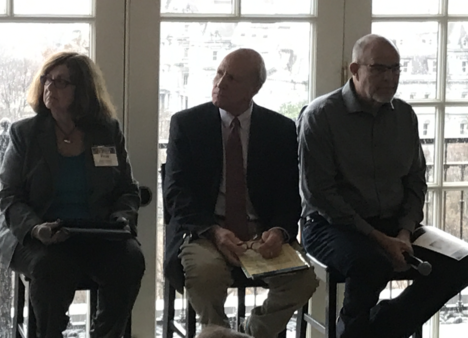
From left, Patsy Van Ouwerkerk, Jim Blaine and Randy Karnes at Underground Collision in Washington.
“Take a pad and draw a box and write in it ‘Member-Owned credit union.’ Now, draw a line between member-owned and credit union and you will start to see part of what the problem is. Suddenly, members are separated from the institution.
“It’s an exceptional ideal that a financial should serve people of modest means. Many of us like to deny that, but I’m sorry, that’s the history of Bergengren and Filene and others.
“There are some things that most of you are doing that mislead the public and perhaps disserve the members.”
Among the products/services/practices Blaine wants to see changed:
The 30-Year Mortgage
“The first thing I’d like you to consider is to work toward the removal of Fannie and Freddie (from your mortgage program). We are the only country left that offers a 30-year, fixed-rate mortgage. It really doesn’t make sense from a consumer standpoint, and as a financial institution you shouldn’t be offering it. When we are complaining about our manufacturing base being exported to other countries, the service base can also be exported. When you sell a mortgage loan for a pittance called an original fee, it ends up in China or Stuttgart or wherever. It takes jobs out of your community, it takes intellectual property out of your community. And it doesn’t allow for any exceptions–Fannie and Freddie tell you exactly how to make that loan.
Indirect Lending
“Indirect auto lending is the same idea. You give up the relationship to your member, you’ve given up the POS, and you can no longer guarantee that your members is getting the best price.”
Tiered Savings
Tiered savings are the other side of the balance sheet. We talk about diversity, but we are staring to divide our members by what they own rather than who they are. They should all come to the credit union as unhyphenated people. Look at the 20/80 rule; 80% of your members don’t have any money. If you would just look at how little it would cost you to pay the 80% the preferred rates and how much you would get out of it, you would see it doesn’t cost anything at all.”
Courtesy Pay
“This is a predatory practice where the financial institution is preying on its members. It penalizes the most-needy of your members. Talk about divisive.”
Risk Based Pricing
“Most of you do risk-based pricing. We are trying to be inclusive but we are setting up barriers for our members. The little black box for credit scores is a fraud. It works on the general basis, not on an individual basis. Now you’re in bed with Equifax–that’s real personal service to let someone else tell you who your members are. Credit scores are algorithms; they work on averages. There is nothing exceptional about being average.”
Governance
“Some credit unions talk about or pay their directors $40,000 a year. The average wage of a worker in North Carolina is $40,000. The average teacher is paid about $50,000. (Being a CU volunteer) is a pretty good second job. We’re told that we need more sophisticated people. It may be that you need to reduce the complexity of the institution.”
Language
“We use terms like ROA and wealth management. Those are banking terms, not credit union not-for-profit terms. We are indistinguishable at best for many of our members from the bank. We fail to distinguish ourselves as exceptional organizations.”
“We don’t practice what we preach. Credit unions are an exceptional idea. Why not do something subversive and start thinking inside that box, rather than out.”
'The Soul of the Owner'
Randy Karnes, CEO, CU*Answers, Grand Rapids, Mich.
“The one thing we have done wrong more than anything else is we have given up on the soul of the owner. If you really think hard about that, you have to ask how much of what you do is geared to the heart of a consumer and not to the heart of an owner. Owners need to be marketed to in a way that they understand why they do things.
“The most sincere thing about a credit union is someone said, ‘I can do that better than the person who is mistreating me. I can build an organization I have pride in.’ The number-one thing people say to me when I say ‘work for the soul of an owner’ is that it’s hard–it’s not conceptual in a way that people will come to you and buy something.
“When I was a young man I fizzled and fizzled until they came and took my car and kicked me out of my house and I wasn’t doing too well. One day I found this credit union thing and they said you can own this thing simply by participating. I wanted to be proud of the thing I owned and how the assets were put in motion and what that led people to do. Pretty soon the agenda was laid out for me. People helping people to me was about building a business and a life that had value and that I took pride in.
“Some people have said, ‘We’re better than a bad deal.’ I don’t think I ever want to own a company where we are just better than a bad deal. It’s time for us to think about this. I am a technology guy. I have a business intelligence team. I looked around and said, ‘How would I get an advantage in data today?’ First thing you do is look at where no one else is working. If you look at the demographics, the most underworked in the credit union business today is the role of the owner. What do they look like? What do they want?
“We all think we’re owners. But there is another side, we are all agents, agents of what are members want. Agency is killing our industry. Agency steals from the heart of an owner based on its own agenda. We need to go back and figure out who are owners are, that they know, ‘I own my financial institution.’
“Be proud of what you own and instill pride in others. No credit union was started without an owner. It takes an owner to defend your existence. You may find out one day that you need someone to vote for you to be successful, and you may find the room is empty. What we’ve done wrong is forget the role of an owner.”