

LAS VEGAS–What would credit union CEO Rip Van Winkle see were he to fall asleep and wake up in 2030? Embedded finance as a fact of life competitor to credit union lending—plus much more—according to a panel here.
That question was at the heart of a session titled “Rip Van Winkle 2030” during Mitchell Stankovic’s Underground Collision meeting here that sought to examine what happens when embedded finance removes credit unions from the member relationships. The entire event was themed “Grim Fairy Tales or Happily Ever After.”
Panelists included Brian Kaas, president, TruStage Ventures; Elissa McCarter-Laborde, president of the World Council of Credit Unions; Ron Araujo, president and CEO, Mission FCU, and George Estrada, principal CUs with Amazon Web Services.
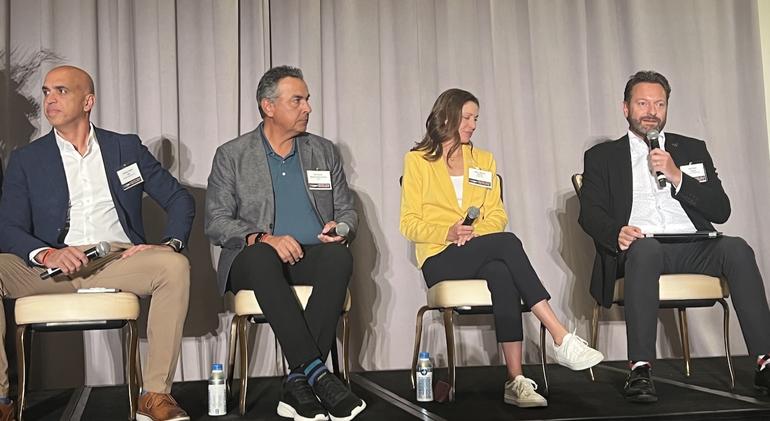
From left, George Estrada, Ron Araujo, Elissa McCarter Laborde, and Brian Kaas.
Here’s a look at what was discussed:
Kaas: How Will Credit Unions Engage in a New Landscape?
“Imagine it’s 2030 and we stumble out onto the (Las Vegas) strip. Republicans are still trying to elect a House Speaker, Taylor Swift and her new party, the Swifties, is the leading candidate for president, and NeuroLink is implanting chips into people’s brains to control their computers. Go into a local branch and traffic is down 75% because AI has done so much with automation. So, how do we engage with members who no longer come into the branch?
And then we see all this new embedded finance, where you have nonfinancial companies in the business of offering financial services, and by 2030 it has proliferated in the landscape. Some estimates are there will be $2 trillion in embedded finance transactions by 2030. Walmart has an online car buying program and they are now the largest auto retailer in the United States, second only to Costco, and they are capturing all the financing of those auto loans. Apple has grown to $250 billion in deposits, surpassing the largest credit union in the United States. The big three automakers follow Tesla’s lead and they are selling directly to consumers and trying to capture all the financing on those vehicles. SoFi partners with TikTok and influencers and has 20% of banking services.
On the Lookout
Sound pretty grim? I think it is probably not that unrealistic for some of that to come true. At TruStage Ventures, we are trying to find and invest in the companies allowing that embedded financial system to occur and to get credit unions embedded in that system. I think that’s going to be critical to the survival of this industry. It can be the way the industry thrives.
Three Questions
There are three questions for credit unions:
- Are we willing and comfortable sitting alongside the brands that are going to become more and more relevant when it comes to embedded finance: the Amazons, the Walmarts, your local merchants?
- Are we willing to collaborate on a level we’ve never done before? To credit unions’ credit, we are great at collaboration. To its detriment, we are great at collaboration. We need to rethink how the industry collaborates. Even the largest credit unions in the country are still not large enough.
- Are we willing to prioritize fintech partnerships to allow us to stay relevant, to deliver the experience members expect, and to be major players in this world of embedded finance?
McCarter-Laborde: How to Reach Those Not Being Reached?
In 2030, looking back, I would argue that embedded finance is the natural evolution of financial services that reach consumers who haven’t really been reached very well by the financial system.
It’s not so much a financial service embedded into another offering; it’s having a financial service that is a frictionless tool that allows someone to maximize the economic value to the service they are trying to have.
If we step back, what credit unions should be looking at globally is how do we create frictionless opportunities using platforms and data and this latest evolution in financial services that allows us to reach members we haven’t really been reaching?
What Survey Reveals
Consider this: I just got WOCCU’s statistical annual survey. There are 404-million people reached through credit unions around the globe. That’s a value of roughly $3.6 trillion. Sixty-percent of those members are in developing countries and emerging markets. Yet if you looked at the estimated SME finance gap, that’s roughly $4.5 trillion. It’s a gap for small business that still exists.
So, we are not reaching the number of small business owners that get consumer financing. Banks don’t really go down there. So why aren’t we identifying and serving markets where we can grow?
What’s Really Being Offered
When I look ahead, my third point would be, we really have to look at what is embedded finance really offering? And that is the ability to reach people who haven’t really been able to make money work for them. That’s what credit unions should be doing,
In 2030, I don’t want to see that shrinking, I want to see that growing, like what we’re seeing in Brazil and the Philippines. They are reaching young people and small business owners.
We can’t ignore the growing immigrant populations in the U.S.
In 2030, hopefully, we will see the U.S credit union industry still leading. If not, it will be following. Ultimately, the right question is how do we create tools to allow people to have a better suite of financial products?
Araujo: ‘We Can Survive, But…’
Who here thinks they will be keeping their doors open in 2030 by continuing to make car loans to people with credit scores of 750? I think a strong case can be made that car ownership is at its peak right now.
But the one thing we do really well is we collaborate. Everything talked about is known, we can survive it. But we have to make these changes. We all have the same goals, but we continue to work at half-measures at what we do. There are ways to tackle everything Brian talked about.
There is nothing that has happened to the credit union industry that has not been gotten done. If we want it done, we will get it done.
The biggest advantage of being on the investment committee at Curql Fund is seeing companies early on in their development. They say, ‘What does this have to look like for you?’ If we take a solution-based approach we can actually thrive during this time when others don’t thrive during this time.
We are a pretty insular group. Credit unions are healthy and thriving. Credit unions have the wherewithal and capital to be very successful if we deploy it properly. We will continue to stub our toes, but you continue to get up and keep moving forward.
Estrada: What Rip Van Winkle is Really All About?
As a technologist, 2030 is grim if we focus too much on the technology. I think that is what we really have to focus on—who is going to own that relationship at the end of the day? The third party that has embedded these financial services? The credit union? That’s where we need to keep our eye on the ball.
I believe there is a happily ever after, but you don’t get there without the grim part, the trial and error, and that is where we are now. Credit unions are trying to find their place, their identity. Young people share the same values as credit unions. What they don’t understand is that message of what credit unions represent. They get caught up in the features, because no one is managing that relationship.
Drinking the Moonshine
At the end of the day, the Rip Van Winkle story is about relevance. Rip Van Winkle is lazy. He drinks moonshine, sleeps for 20 years, comes back and he’s irrelevant. The moral of the story is, Are credit unions going to drink the moonshine, or are they going to push back on the technology? Technology is there to assist us as humans, not the other way around. I want that relationship.
At Amazon we work backwards. We start with the problem and work backward to the technology that will solve it.
Credit unions have come to understand they have to partner with these fintechs. The fintechs have the technology, but credit unions have the relationships.