

MADISON, Wis.–It may be counterintuitive to many in credit unions for whom “service” is defined as in-person, face-to-face interaction, but one expert is cautioning the rapidly approaching future is all about giving members tools for “self-service” as well as understanding there is a new “differentiator” other than service for CUs.
If the cost and sophistication of those tools, including data analytics and biometrics, intimidate many CUs, the same expert, Mark Sievewright, said the cooperative model of credit unions offers an effective means of responding and competing, even if the way most CUs respond to the challenges ahead is to instead merge.

Those predictions and numerous others were shared by Sievewright, who leads the consulting firm that bears his name, during a webinar titled “Digital Transformation Imperatives for CUs” hosted by the World Council of Credit Unions (WOCCU).
“Believe it or not, over the long term we will be judged by how much self-service we will be able to drive,” Sievewright said. “If you can accept the principal that one of the foundations of our industry going forward will be our ability to give members more and more tools or services for members to access their services with us, then we are on the same page.”
5 Macro Trends
Sievewright offered five “macro-trends” for why he said digital transformation is so important to credit unions.
- Accelerating consolidation and the drive for scale.Sievewright cited an earlier mention in the webinar of the types of pooling of resources taking place in credit unions, often in other countries, and observed, “Very often, this is manifested in merger rather than pooling of resources. I think there are tremendous opportunities to think holistically and pool resources for innovation.”
- Unprecedented advances in technology (and adoption) and innovation. Sievewright said CUs should prepare themselves for change to occur even faster than it is taking place now. “This is the slowest pace of change you are going to see for the rest of your lives,” he stated.
- Changes in consumer behaviors and expectations.“Technology is reshaping not only the industry, but in how consumers access and use financial services,” said Sievewright. “Consumers demand greater convenience, simplicity, speed, empathy and personalization. Member experience is the new differentiator in our industry. Experience goes beyond service. It really tries to encapsulate all aspects of how consumers lead their financial lives.”

Mark Sievewright
- New waves of competition from large-scale incumbents and new entrants. “Incumbents have adopted high tech, high touch strategies while new entrants are driving the delivery of ‘digital first’ experiences,” he said. “They focus exclusively on removing the friction that typically exists in how consumers access their financial lives. The global fintech community is really gaining momentum in terms of consumer adoption of fintech solutions.”
- Demographic shifts and the rise of digital natives. “There are unprecedented global demographic shifts that will have significant implications for member retention and acquisition, as well as talent management,” said Sievewright. “A lot of new entrants almost demand a digital first experience. We’re not ready to close branches, they remain important, but over the long, long term we will find many more consumers will have a digital first experience with their credit union or bank.”
Sievewright noted COVID-19 has accelerated an industry pivot to digital-first and an increased focus on touchless interactions and payments.
What to Expect Going Forward
Sievewright told credit unions from around the world participating in the webinar that when he works with credit unions he emphasizes five strategic imperatives (see graphic, below).
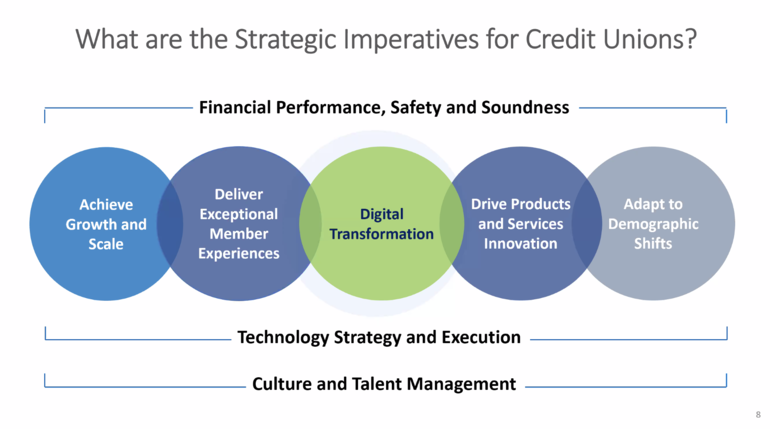
“If I take digital transformation out of this, the rest really becomes difficult to achieve and the level of innovation we are able to achieve becomes substantially reduced,” he said.
But what is digital transformation, which is frequently discussed in credit unions? Sievewright’s definition: “Digital transformation is about reimagining how you bring together people, technology, data and business process to create value and maintain a competitive advantage in a digital first world.”
Again, Sievewright emphasized a point he made several times in his remarks: “We don’t have to do this individually. We have the opportunity to collaborate and work with some tremendous technology companies and credit union-owned companies.”
Sievewright also clarified that digital transformation isn’t a cure-all, end-all. “Digital transformation does not address bad business processes,” he said. “Improving business processes can have as much of an impact as introducing new technology.”
At the heart of digital transformation, said Sievewright, is having a digital mindset.
“It’s not enough to have great technology. It’s really important that the mindset of employees and management and the culture of an organization supports digital transformation,” he emphasized.
What to Be Doing
According to Sievewright, here’s what credit unions should not just be prepared for but actively engaged in:
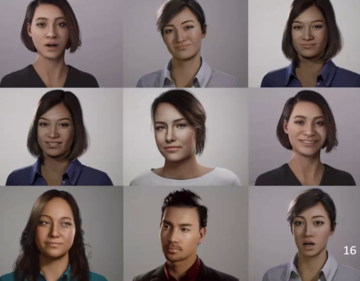
Avatars used by one Australian bank.
- Data analytics. “We shouldn’t think of data only as a way to market more products or to get the right products to the right members, which is incredibly important, of course. We should think about how to use analytics to improve service delivery. We’re now seeing evidence that AI is sitting behind the service capabilities of financial institutions,” said Sievewright, showing an example of avatars customers of one Australian Bank created when interacting with the bank, “almost as if it were human” (see graphic, at right).
- Biometric technology will have an even more meaningful role in lives. He noted people have become accustomed to using fingerprints and/or facial IDs to open devices. Over time, biometrics will expand into payments, said Sievewright, noting in China, “smile to pay” is already in place. In Northern Europe, in pre-COVID days, using the palm of the hand to make payments was growing in popularity. “Post COVID-19, I can see us moving to more biometric-based payment capabilities,” said Sievewright
Offering a where he believes the financial services landscape is moving, Sievewright said most FIs are currently in their traditional position with multiple siloes. “But as we move forward in time we start to move into immersive, frictionless experiences and we provide more intelligence in how we interact with them and allow them to interact with us,” he said.
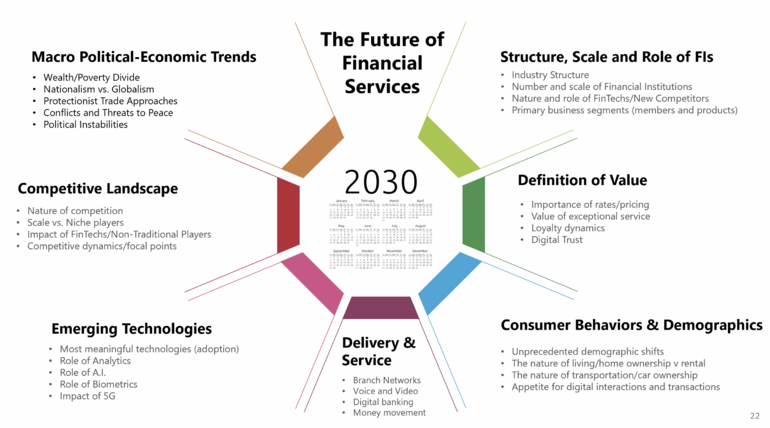
6 Components of Preparation
How can credit unions prepare for the rapidly evolving marketplace? According to Sievewright, the six components of preparation are:
- Culture and mindset (the credit union must have a member-first mindset)
- Organization and talent. “People make the difference, and we have to make sure we have the right kind of people organized optimally”
- Data
- Data Analytics. Sievewright said data and data analytics are going to be the “linchpins for how we do business”
- Efficiency and Effectiveness. “Here’s where the cooperative model really comes into play. Our ability to generate another dollar of revenue tomorrow at a lower cost than today is going to be an incredibly important factor for us”
- Financial Strength & Scale. “Nothing happens without strong capital, but I would argue that credit unions that can organize themselves around this operating model will see financial strength as an outcome”