

By Ray Birch
LAKE FOREST, Ill.—There are 12 “key” overdraft pricing features that financial institutions must pay attention to, and the ways a bank or credit union uses—or does not use—these features has a big effect on OD revenue, according to one expert.
“These 12 key features we have identified can serve as a guideline for credit unions and banks to consider as they craft their overdraft programs in a time when this service has national attention,” said Michael Moebs, economist and CEO at Moebs $ervices, adding that risk is simply part of the equation when pricing OD programs.
Moebs emphasized the importance of overdraft income for FIs, particularly credit unions.
“Fee revenue, or service charges on deposits, is 14.7% of bank net income, 5.6% for thrifts, but 52.1% for credit unions,” said Moebs. “It is a main source of profitability for all FIs at 25.4%. Overdrafts are the leading source of fee revenue.”
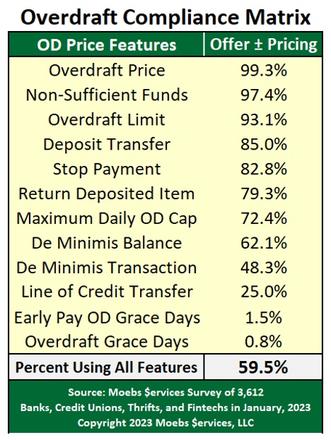
Moebs shared his company’s OD “Compliance Matrix,” which outlines the 12 key overdraft pricing features (see chart), adding that each OD feature can be fundamental to the bottom line. Moebs shared details on these features, and then advice on how to best use and price them. Moebs pointed out three out of five FIs (59.5%) use all features.
The Dozen Factors
According to Moebs, those dozen factors include:
Overdraft Price. “This comes is in two forms,” Moebs reminded. “A charge per transaction or a charge per end of day balance. Led by Walmart at $15 and Bank of America at $10, OD transaction charges have fallen dramatically in the past two years. The single end of day balance charge can be consumer friendly. The cost of friendliness is why over 99% of all FIs use OD transactions,” Moebs explained.
Non-Sufficient Funds. “Some FI’s have recently eliminated charging for NSF transactions to alleviate political pressure,” he said. “Traditionally penalty pricing, FIs who are looking to attract consumers with higher balances and focus on deeper relationships are moving away from charging NSF fees.”
Limits. “Limits are part of volume and impact usage,” stated Moebs. “Yet, most FIs are terrified of ODs since it is unsecured credit. Since 1998, limits have increased marginally from $500 to $600. For those depositories whose OD fees are more than 25% of net income, basic limits try to mirror median monthly mortgage and auto payments, which currently are about $1,600. This is not a discretionary decision, but analytical, to gain the most profit, as our company’s data show. This is purely an economic compliance issue. Remember the Fed and the CFPB consider overdrafts a credit but not a loan. Do not make limits subject to Truth-In-Lending to avoid regulatory conflict.”
Deposit Transfer. “This provides an automatic movement of funds to offset the negative balance. This service reduces volume of OD transactions, yet can be helpful if the user maintains sufficient balances to offset fewer ODs,” Moebs told CUToday.info. “The charge is often eliminated if the user moves the funds themselves. This is a very economic compliance service. Because of the stimulus funds OD revenue is down since consumers had money in checking to avoid ODs.”
Stop Payments. “These are mainly credit and debit card reversals with less than 7% being paper checks. Used by almost all FIs, this is seen as acceptable by consumers if the price is reasonable. Consider volume when pricing this service.”
Return Deposited Item. “The CFPB has turned this into a political issue. Check the volume of RDI’s and ask is this worth the charge? Think political compliance,” said Moebs.

Michael Moebs
Maximum Daily OD Cap. “This is definitely socially acceptable compliance, akin to one price fits all at sporting events, national parks, and skiing,” Moebs said. “The trick for FIs is to establish not only an acceptable cap but a low enough price.”
De Minimis Balance. “This allows for the consumer to be overdrawn by a small grace amount before charged a fee,” reminded Moebs. “This feature will reduce overdraft revenue, but provides a buffer for reconciliation errors and free low balance overdrafts. This is a very consumer friendly service increasing user value and providing good social compliance.”
De Minimis Transactions. “These deal with the amount of a transaction instead of the user’s account balance. So, by this logic, a Starbucks latte, no matter if the user’s balance is currently overdrawn, is spared from incurring an overdraft fee,” noted Moebs. “This service is used by high-volume transaction users and drives volume while maintaining profitability.”
Line of Credit Transfer. “This is a service that has seen its day. ODs have become a way of life for more than 20% of Americans,” according to Moebs. “By regulatory definition, ODs are credit but not a loan. If Truth In Lending is used to fund an overdraft, use a credit card not an OD line of credit. Seventy-five percent of FIs find the best solution is to avoid this service. This is a political compliance issue.”
Early Pay Day. “As we know, this service provides the users access to funds one or two days in advance of their payroll direct deposit. This is a form of OD grace,” noted Moebs. “Usage can be high. FIs using this service are not focused on consumer checking profitability, but rely on multiple services per user.”
Overdraft Grace Day. “This is used to promote OD volume and provides the user an extra day or two to bring their overdrawn account balance positive before an OD fee is charged. This can be a very effective when priced correctly with the other overdraft compliance features,” Moebs said.
A Lesson from Automobile Industry
According to Moebs, ultimately, all these key features deal with risk, including the primary factors integrated into overdraft compliance pricing: profit, social, political, price, volume, and economic.
“Overdrafts are quite complex. Choosing the right combination of overdraft features is both a science and an art,” said Moebs. “Know the market by constantly researching. Yet, understanding overdrafting has become part of American financial culture and this is the behavioral—or art—part of the OD equation. The automobile has gone from just having a handle to open the door and no locks to now needing a small remote device to open, close and lock the doors electronically—even your mobile phone now. Overdraft mirror autos, going from almost seen as evil behavior to becoming an integral part of every checking account.”