

LAS VEGAS—Do credit unions have an untapped $391-billion lending market opportunity?
New research would suggest that is the case, and an initiative is being launched aimed at penetrating that potentially huge new source of loans, with the additional benefit that it wouldn’t just be good for credit unions, but their members, as well.
CU Direct and the Filene Research Institute are now sharing the results of research the two organizations have conducted on the point-of-sale (POS) financing market. CU Direct already has a POS solution in the market called OnSpot, but it is seeking to enhance both the product and especially credit union understanding and penetration of a market often referred to as “on-the-spot financing,” and which includes mom-and-pop and regional retailers, dental and medical practices, and more.

George Hofheimer speaking to CU Direct's DRIVE 15 meeting.
That research found what George Hofheimer of Filene called “ a real Blue Ocean Opportunity for credit unions that, if tapped correctly, could really generate a lot of loan growth for you.”
The on-the-spot financing market is one in which credit unions are not very active, which is one reason the research was conducted. It is also being used to enhance OnSpot.
Hofheimer said finding data and other research on the POS market was difficult to come by. It arrived at its findings by combing through Wall Street analyst reports, doing consumer surveys with more than 1,100 people, interviewing providers such as small businesses and medical practices, doing credit union interviews and expert interviews, and creating some business modeling tools for the CU Direct team.
In general, the way the POS market works is that a consumer purchases an item for $1,000, for example, and takes the financing option, which is often 0% for 12 months. The financing vendor approves the deal and pays the retailer $900. The financing vendor generates revenue from more than just the cut it takes from the retailer; interest rates on loans not repaid within 12 months can be sky high, and the interest is retroactive.
The POS market is dominated by three players: Synchrony Financial, Citi, and Wells Fargo, which hold about 95% of the POS marketplace.
“Yields on these loans are upwards of 20%,” said Hofheimer. “When you see this kind of domination, you know there is a market opportunity. This is a marketplace where credit unions can come in and be category killers.”
What The Research Found
When it comes to what all parties want out of the POS lending process, Hofheimer said the research found:
- Consumers want quick access to credit, cheap promotional financing, and the purchase.
- The financing agent want loan generation, higher yields and new markets.
- Providers of all kinds, including doctors and dentists want sales. “They want no barriers to the sale, and want to strengthen the customer relationship,” he said. “They also want the financing agent to help with their marketing.”
To arrive at a figure for the size of the retail POS market Filene took annual consumer spending, about $11 trillion, and then broke that out by durable goods of more than $500 (excluding automobiles), as well as several other variables. It arrived at $391-billion.
“Consumers have tons of options to pay for these things, but this is a good number to start with,” he said.
In researching the marketplace, one indicator Hofheimer said shows how “ripe” the market is is the number of unique start-ups that have also sought to, or are seeking to, get into the POS space. Among the new players is Affirm, founded by a PayPal co-founder.
“What it does is it operates on top of an FDIC charter, which allows it to lend money, and its proposition is if you have an online store and you want to offer your consumers a longer payback, here’s a few lines of code for your online shopping cart and we’ll help facilitate that.” Affirm charges interest rates to consumers of between 10% and 30% interest.
Another startup Hofheimer called “absolutely fascinating” is Pay it Simple, which uses the consumer’s regular credit card for the payments, and takes a fee off the provider, so the 0% financing is free to the consumer. It organizes 12 debits to the account over the annual basis. Merchant can get the entire receivable in first month, but at a high fee.
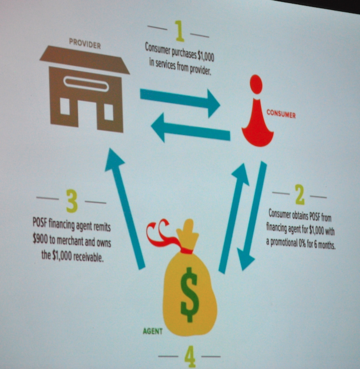
A look at the POS purchase/finance triangle.
Most recently, another player in the space, Springstone Financial, was acquired by Lending Club.
“There is a clear market space for credit unions, because of the pricing model that OnSpot offers is quite unique and quite opportunistic, I think,” said Hofheimer.
The 'Job' of POS
In doing consumer research, Hofhiemer said it’s important to remember the “job” that POS financing delivers. “Consumers don’t know, or necessarily care, about the details,” he said. “In our consumer research we asked people about their level of satisfaction with their POS financing, and most said they hadn’t thought about it. But in probing deeper we were able to identify a few things. They just want it quick, they want the cash, they want the product.”
As Hofheimer noted, consumers have a lot of options to choose from at POS, including credit cards, savings, already established lines of credit.
“From the providers’ perspective, they are running a small business and don’t have time to deal with an ‘almost’ solution and are protective of their customers/patients. They need it ready to go from day one out of the box,” said Hofheimer.
But Hofheimer also stressed another point: Providers do need a lot of training amd materials to explain what 0% promotional financing means, and the fact that if the borrower doesn’t pay it back on time the interest is retroactive. Not providing that training and information can mean bad press and litigation.
The Market Opportunity
How does a credit union jump into POS financing?
“Product design is absolutely key,” said Hofheimer. “It has to be absolutely instantaneous at the point of sale. We found from this research that the financing part is often still done over the telephone. It feels uncomfortable; you have to call a third party call center, give your Social Security number. That’s pretty common with some of the bigger providers.”
A second issue, he said, is that most of the competitors in the space offer open-ended loans, said Hofheimer. “There is an opportunity to create a long-term credit card relationship with that consumer once they pay off that promotional POS financing. There is a differentiated opportunity here that can really be a platform for growth in meeting the needs of consumers.”
“You have to offer a promotional period; if not, it’s not competitive. Consumers are looking for that shortcut,” continued Hofheimer. “Another expectation is that it has to be on-the-spot financing. You can’t tell them to ‘Go home and go to a website.’
From a provider perspective the OnSpot model is very attractive, Hofheimer said, because it has fixed costs. The provider also needs quick receivables, as cash flow is king. “And it has to be multichannel, as with everything in consumer finance. So would be great if you could do face to face with a tablet or, even better, with a mobile phone.”
'A Completely Different Market'
Credit unions must recognize “this is a completely different market,” stressed Hofheimer. “And that means credit unions will need to consider underwriting changes.”
Synchrony Financial’s delinquency rate is 4.26% (versus .94 at CUs), but it is still seeing a 25% yield on those loans.
“When you’re thinking about underwriting in this market you will need to consider some changes to your policies,” said Hofheimer, urging credit unions to look to private label credit card loan portfolio approval rates for insights into the market.
In entering the market, Hofhiemer urged CUs to accentuate the pricing differences with big finance companies.
The big competitors, not surprisingly, tend to focus on the Big Box retailers, and realistically credit unions don’t have many opportunities to get into those, he said, adding that the real opportunities are with the regional providers and the local providers. “Not surprisingly, they are not being well-served,” he said.
Vertical markets that are “particularly ripe” were identified in the research, but vertical markets are completely “idiosyncratic,” Hofheimer said. The research has identified five key parameters to determine which vertical market makes sense for a CU, and includes financing categories such as musical instruments, eyeglasses, home improvement, home furnishings, dental, electronics, heating/air conditions, health care, etc..
“As you look at this market the most successful credit unions initially are going to be the ones that have a strong commercial relationship already,” said Hofheimer. “Then you look at the POS competition in the market. But be realistic. POS financing, even though a good-sized market and credit unions are well-positioned, it won’t serve all of your loan growth goals. It’s just another arrow in your quiver.
The research is available at: http://Bit.ly/cudirect.