

By Ray Birch
LAKE FOREST, Ill.—After offering average deposit rates priced higher than banks for 16 consecutive years, credit unions have lost that advantage, according to new data.
The latest deposit study from Moebs $ervices reveals that banks, on average, now have the highest deposit rates. Banks are leveraging their advantage in non-interest expenses to offer the higher rates, the analysis shows.
“Overall, the banks are flexing their muscles with not just credit unions, but also with thrifts and fintechs,” said Michael Moebs, economist and chair of Moebs $ervices. “The bank view is they own the deposit markets nationally. The numbers prove this. So, if banks continue to show higher deposit rates, the competition will have to match them or lose share.”
Moebs said if the scenario holds, it obviously is a good new/bad news market.
“If this price differential stays the same, it is a good thing for banks and bad thing for CUs,” he said. “To match the banks credit unions must look to make non-interest expense cuts to offset raising interest paid on deposits.”
Inside the Numbers
Moebs data ending Q4 2023 show that for three-month and six-month CDs, banks are paying an average of 4.65% and 4.7%, respectively, while CUs are paying 3.11% and 3.48%. On checking, banks average .50%, while the average dividend at credit unions is .45%.
Moebs reiterated a point he has stressed in previous CUToday.info reports.
“The banks are more efficient than the credit unions,” he said. “Even with paying taxes, the banks’ overall non-interest expenses are less than the CUs. This is a war of attrition, and the FI that is the strongest—most efficient—will win. But the question is, will banks continue to pay higher?”
What Review Reveals
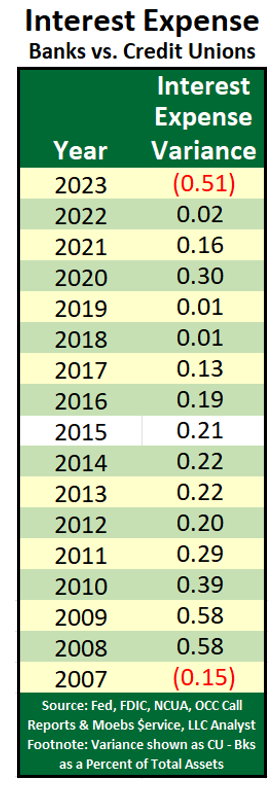
Moebs data (see chart) reveal that during the 16-year run when credit unions were paying higher deposit rates on average, the interest expense costs variance—between banks and CUs—favored cooperatives.

Michael Moebs
“Meaning, their interest expense was lower than banks then,” Moebs emphasized. “What the CUs paid as their cost of deposits, or interest expense, was lower. Yet the difference, or variance, kept falling. Banks were chipping away by gradually paying more for deposits. Then COVID came and when it ended the banks were ready to throw a heavy punch. Is it a knockout punch?”
Moebs pointed out the latest data show banks are at $23.7 trillion in assets, or 91.2% of total assets. Credit union assets stand at $2.3 trillion, or 8.8% of total assets.
“This size of variance—three times the difference—has not been seen since 2007,” Moebs stated. “Credit unions need to pay attention here.”
‘Rate is Not the Complete Response’
Moebs said that many financial institutions—banks and credit unions—have gotten very marketing savvy by keeping their rates competitive and not losing deposits, but actually paying lower than top of market, thus saving on interest expense.
“So, rate is not the complete response to cost of funds,” reminded Moebs. “What is actually paid is the ultimate answer. A few times a year when I go into the grocery store there will be an overall special if I buy a basket of groceries. For example, recently I bought $400 of total groceries, which got me a $10 credit. I thought I hit the Lotto jackpot. This is why the total cost of deposits, as represented by interest expense actually paid, is important to track, too.”