

By Ray Birch
LAKE FOREST, Ill.–Is the much anticipated, long-predicted cashless society coming into view? It’s getting closer. New data show that for the first time in U.S. history debit card transactions have exceeded cash transactions as the number-one payment method.
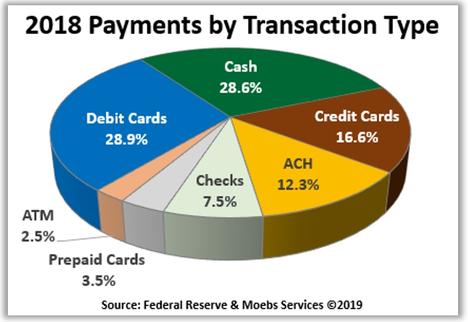
According to data compiled by Moebs $ervices, debit card transactions represented 28.9% of all transactions vs. 28.6% of transactions being done in cash during 2018, according to the company’s analysis of Federal Reserve Bank and regulators’ payments data.
“This is a milestone in payments,” said Michael Moebs, economist and CEO at Moebs $ervices. “And the use of debit card within a mobile device is growing more than the plastic card. Our study raises an important question—as coin, currency, and check use fade, what will replace how payments are made?”
Plastic for Everyone–Almost
There are almost as many Americans as there are checking accounts–more than 300 million each, said Moebs, noting that debit card, credit cards, and prepaid cards constitute 49% of all payments.
“Smartphones are replacing plastic cards quickly. We are seeing a revolution in how people pay for goods and services, similar to how cars replaced horses,” said Moebs, indicating consumers are finally beginning to turn to mobile payments in larger numbers.
As CUToday.info has extensively reported, consumers have been slow to adopt mobile payments, lagging far behind original projections.
“In life, kings do not rule anymore. The payment revolution is following suit as no transaction medium will rule,” said Moebs. “In the payment system money movement is the game, and this game is ruled by the Federal Reserve.”
A Forecast for Checking
Moebs is forecasting checking accounts will soon be entirely electronic, but will nonetheless remain the core mechanism driving financial transactions.
“Contrast debit cards and credit cards. Debit cards have only a transaction mode, while credit cards have both a transaction mode and a loan mode,” said Moebs. “Prepaid cards can be a one-time transfer of the value of money, like a gift card, or a reloadable prepaid card (RPC) functioning like a checking account. However, the Federal Reserve requires the RPC to be a checking account to track this money.”

Michael Moebs
Ultimately, the value of money currently is driven by plastic cards, posited Moebs.
“Only ACH transactions represent another growing payment channel. Cash, in the form of coin and currency, paper checks, and ATM channels are diminishing to very minor roles,” he said. “The almost exclusive players of money payments are the Treasury, the Fed, VISA, Mastercard, Discover and AMEX.”
Questions Raised
As the payment “revolution” moves quickly away from coin, currency and checks, the Moebs Payment Study suggests consequences and raises questions:
- As cash and check fade into plastic cards, plastic cards will fade into mobile devices and their apps.
- Is the Fed prepared to handle monetary policy with no coin, currency and checks?
- Does the U.S. Treasury have a plan to phase out the Mint who produces coin and currency?
- Why are there so few players in the payment system?
Stories for the Grandkids
“When cars were replacing horses, the Fed was created by Congress, so I would still give first graders a reasonable amount of cash to learn about money as it exists now. They will someday tell their grandkids of a payment system that no longer exists,” said Moebs.