

LAS VEGAS–It’s a given that credit unions must partner with fintechs on not just the offerings that keep them relevant and competitive, but also on the “cool things.” Yet as a discussion here made clear, the CU/fintech partnerships are often a landscape in which both parties misunderstand each other, where smaller CUs reportedly get “shafted” on contracts, where regulators are seeking to balance oversight without being restrictive, among other complications.
All of those issues and more were the focus of one session during the Fintech Meetup event, with NCUA Vice Chairman Kyle Hauptman and Curql President and CEO Nick Evens responding to questions posed to them about credit unions and fintech.
The discussion was moderated by Frank Gargano, a reporter with American Banker.
Here is what was discussed:
Q: There has been an exponential increase in credit unions and fintech partnerships. What factors have you seen in the market that have given rise to this?
Hauptman: I often say I don't want to see credit unions become Blockbuster Video because they're regulator wouldn't let them compete.
The fintech versus traditional finance argument fight is going to happen to some extent, but one way to lower the temperature is to let the traditional finance folks do what the fintechs do and then we don't have to have this argument.
From our perspective, the main thing is we're very cognizant that credit unions are only 10% of the size of banks. Anyone who's left-handed knows that the 10% isn't who gets catered to, it's the 90% of the market. That 10% of the market cannot be difficult to work with (if they want to survive).
Evens: We’re grateful all three NCUA board members have said collaboration with fintech is a must for survival. The growth has a lot to do with money; there has been an exponential growth in number of dollars flowing into fintech. Our fund has $252 million.
Even though the CUSO rule is somewhat burdensome on these fintechs, we can get through that conversation in five minutes and they are starting to realize that. The credit unions recognize that to compete with the big banks they need fintech. There is the need for transformative technology in the market.
Q: Compared to big banks and regional banks, credit unions have a much smaller share. What really looks like a competitive edge from the credit union standpoint?
Hauptman: It’s service. Because of the common bond, in some ways it is easier to run a bank. Because of the common bond you’re sometimes limited to serving Ukrainian Americans or Disney employees. There's some commonality and that in theory should give you a little bit of a head start on the surface. But you have to provide service; you provide the human to help you with your issues. If you're not providing excellent service as a small institution, then there is no point.
Evens: What used to be an integration of six or nine months or a year, those days are vastly changing. From the competition standpoint, the fintechs coming into the space are being very helpful in getting us to be more relevant and compete against the big banks.
The collaboration aspect inside credit unions is huge and it’s one of our competitive advantages. We have 68 investors in our fund. We were borne out of Members Development Corp., and they have 80 credit unions in their network, all collaborating around R&D. This is an aspect of credit unions that is different from what you see in banks.
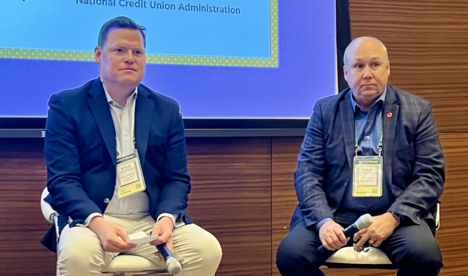
Kyle Hauptman, left, and Nick Evens at Fintech Meetup event in Las Vegas.
Q: What about the (eligible obligations proposal) that is in the works at NCUA to allow credit unions to purchase more loans from fintechs?
Hauptman: Credit unions have a good thing, which is field of membership, and they have a difficult thing, which is still field of membership. Membership is a positive but also a restriction. You've got to make it easy to get the things that fit within that because you're dealing naturally with a smaller universe of loans to buy or sell than a normal financial institution.
Evens: The eligible obligations rule will help credit unions manage their balance sheet a little better, and should help manage risk and liquidity, both of which are top of mind right now.
Hauptman: With one strip mall loan a credit union can use up its entire (member business lending) cap. You then have to turn down everyone else and you have all your eggs in one basket. I would prefer to be able to spread the risk with smaller loans.
Q: There is a natural competition between fintechs and credit unions looking to cater to the same consumers. Where do you see CUs falling behind?
Evens: I don’t know if I would use the phrase ‘falling behind,’ but I would say maybe they're not as up to date as a lot of the current players in the market. It’s that whole disintermediation thing and fintechs going after the consumer and going ultimately after members and trying to switch them away from credit unions--and banks for that matter.
I'll answer that a little differently. Here's the issue that we face at Curql almost every day. We'll have a fintech call us up and say, ‘I'd love to partner with credit unions. I love credit unions. I'm a member of a credit union.’ We get through the whole ‘How do you want to partner, what's the definition of partner?’ and they will say, ‘Well, I want to get my foot in the door and start building my products and services. Then I’m going to build my direct-to-consumer model shortly thereafter,’ and that's when I say, ‘Bad idea.’ That's not the right answer because that's like letting the fox in the hen house, for lack of better term.
We’re not going to turn you over to credit unions and let them give you their entire membership data and their entire membership list and then say that you're going to go direct to consumer. Usually, those conversations are short and I don't hear from those companies again.
We are working with fintechs that are saying, ‘I only want to build my product for credit unions and community banks.’
Hauptman: Credit unions are smaller and they tend to buy, not build. They don’t have 10 floors in a skyscraper of development teams to make stuff. The big banks make their own stuff all the time and that is an advantage.
In Congress and probably state legislatures, too, a group comes in and (points to) let’s say, Quicken Loans, which is an originator with no branches, which isn't subject to CRA and all the capital standards, and they say ‘Let us do that and, if not, please regulate the hell out of those guys.’ It’s a rational thought.
But in the long run we're going to lose. because if…there is a business model it's going to happen eventually.
Evens: Credit unions and community banks just don’t have the bandwidth. What we’re saying is if you are going to build your services on the backs of credit unions, how about we have a little equity in that? That’s a new concept in the credit union industry. That’s what we’re trying to accomplish at Curql.
Q: Instead of looking at it as credit unions falling behind, what competitive advantage do they have?
Hauptman: What they have is people. Credit unions come to the table with a network of bricklayers or Methodists or Disney employees. Usually, a startup has cool thing but needs consumers. Credit unions have consumers but need a cool thing.
Evens: The other thing that's evolving quickly is there are credit unions that are running incubators now. They're saying, ‘Hey we need this technology, we need that technology, here's a young, cool fintech, let's bring them on in and give them access to our core and give them access to our OS and let them develop that product and we'll incubate them. Then we'll either spin them out or we'll be a part of their sales process to other credit unions and community banks.’
Hauptman: Some have said some credit unions get really tough terms from fintechs, that there are these nice credit union people in a basement and they are up against a venture capital-backed fintech and they sign up and get shafted.
There’s a perception out there that in some cases VC-backed fintech kind of scalps nice credit union people on the terms of the deal.
Evens It’s very hard to go it alone. Fintech entrepreneurs have gotten very sophisticated. They know how to negotiate with big players, so now they're in sitting in front of a CFO or CEO of a smaller credit union and these folks don't have the experience to negotiate those kind of things.
That’s one of the reasons when we formed Curql. We said we're going to hire professionals to do that due diligence and that negotiation. There is a level of sophistication that's entering credit unions, but we say every day it's very hard to go in alone from an investing perspective. There are certain aspects of the negotiation and certain details around the negotiations that need to be at a higher level of sophistication.
Q: What about CUSOs?
Evens: I was just at a breakfast with some folks forming a new CUSO. It’s going to be quite sophisticated. They were asking about how they can partner with fintechs on certain things. If you take $1 from a credit union or another CUSO, you are a CUSO. We watch that closely. That’s the nature of the beast. CUSOs have a collaborative model. It’s a collaboration of people, other credit unions, and other CUSOs to form a product or service that can be taken out to market.
Q: From an eagle’s eye view, how do these discussions begin and what topics get thrown around?
Evens: The whole thing is about risk. Integration risk. Reputation risk. Credit unions are going to look at that first and foremost. The credit union isn’t going to give out any data until all of that is evaluated and the contract is signed. Nobody wants to be that credit union where all of a sudden there is a breach because of a bad integration.
Q: As a contract is being signed, there must be a looming thought in the back of the mind of a credit union of is this the right decision for me? How can both sides of that work to assuage those doubts?
Evens: The model we built is we are the outsourced eyes and ears around fintech for the credit union space for the folks who have invested in Curql. They have placed their confidence in us to have those conversations. We evaluate entire sectors. We are evaluating collections right now because of what could happen in the economy. We’re evaluating KYC and fraud. We are the ones who will ultimately bring the selected few we think will check most of the boxes for our credit unions.
Q: So that fintechs don’t run afoul of the regulator, what are some thoughts, some guiding stars to keep in mind?
Hauptman: This is not a credit union conference, but I purposely try to go to these to learn. I’m never going to know it as well as the startups and the founders do, but I try to learn the terms and have a little knowledge.
We are trying to get innovators to do our employee training and to do webinar on here's what we're doing.
The main thing is responsible innovation. Examiners are just out there doing their jobs; almost all the work is being done remotely by examiners working alone or staying at La Quinta Inns. They just don't want to look bad and they want to get a promotion, so cut to the chase on why this thing is useful, because people get nervous, like all of us, when you're not familiar with the terminology.
I don't think you need to geek out on the tech. Instead, you need to say something (to the examiner) like, ‘This adds 9% income’ or ‘This shortens this time.’ Cut to the chase on that actual concrete benefits are, because when you're talking to Mr. Examiner or Ms. Examiner, they do not want to get fired or demoted.
Show them the partner fintech is not going to hurt their career; as a matter of fact, it's going to help because we're going to be (healthier as a result).
Evens: As far as fintech relationships go, we have good ongoing conversations with NCUA about being as compliant as humanly possible. We have a portal to which all of our 68 credit unions have access. We put our due diligence in there, the financials of our fintechs. It’s consistent. We make sure we’re sharing information not just with NCUA but with state examiners. We are trying to show we want to work with them and be as transparent as humanly possible, and hopefully that helps the entire system.
Q: What can credit unions do as well as fintechs to shore up defenses against risks?
Evens: One of the complaints we hear from fintechs a lot is that it takes too long for credit unions (to make decisions). It's because most of the credit unions, at least the ones we deal with, have a risk person, have a compliance person, and they're putting these fintechs through the ringer around security, such as with SOC 2.
All of those things are incredibly expensive to the fintech; that's just a fact of life these days. You’re not hearing a lot of issues around security breaches and things like that for that reason. (The credit unions have) lived through it and so these folks are not going to put their jobs on the line.