

WASHINGTON–The Federal Credit Union Act turns 85 today–but only thanks to a late reprieve. And while much has changed from the days when loans were capped at $50 and regulatory oversight was provided by the Department of Agriculture, other things have remained remarkably consistent, including opposition from bank groups.
Signed into law on this date in 1934 by President Franklin Delano Roosevelt as the Great Depression gripped the country, the Fedeal Credit Union Act followed by 25 years the creation of the first credit union in the country, St. Mary’s Bank in Manchester, N.H., as well as creation of the first enabling legislation, the Massachusetts Credit Union Act, both in 1909.
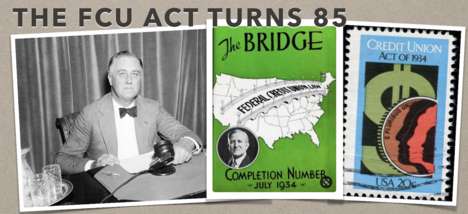
The Massachusetts law would become a model for the federal legislation as well as other state acts. To mark the 85thanniversary, NCUA is hosting a small reception at its headquarters today.
The federal legislation was championed in the Senate by Sen. Morris Sheppard, a Texas Democrat who was long a strong proponent of credit unions and rural lending programs. CU pioneer Roy Bergengren had met with Shepard on numerous occasions and lobbied for a "federal credit union law that would be a sort of blanket insurance policy for all our state laws, giving us an alternative method of organization.”(Sheppard had also authored the 18thAmendment, becoming known as the Father of National Prohibition.)
In the House, support was led by Congressman Wright Patman, another Texan after whom Wright Patman Congressional FCU is named.
Bills Introduced
In 1933, working with the then Credit Union National Extension Bureau (created by Ed Filene and Roy Bergengren in 1921), which would change its name to the Credit Union National Association at its famous meeting in Estes Park, Colo. later that year, Sheppard introduced three bills designed to set up a federal credit union system:
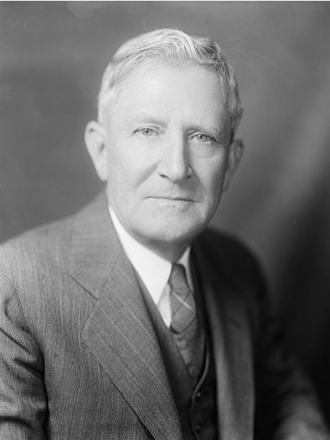
Sen. Morris Sheppard
- S. 1639, which was to establish a system of federal credit unions and statewide central credit unions under federal supervision
- S. 1640, which was an amendment to the Federal Reserve Act under which Federal Reserve banks would be permitted to receive deposits from credit unions
- S. 1641, which would authorize the postal savings system to accept credit union deposits
On March 27, 1934, S. 1639 was voted favorably out of committee, with one amendment, a deletion of the provision exempting federal credit unions (but not their members) from all federal taxation except taxes upon real property.
Looking for a Home
“Meanwhile, it was imperative to find an agency to administer the Act,” according to “The Federal Credit Union System: A Legislative History,” written by John T. Croteau in 1956. “The Federal Reserve Board and the Treasury Department, logical agencies for the purpose, did not believe that they should administer such an act. The Farm Credit Administration expressed an interest in the bill, however, and a group from the agency, with help from other officials, secured Presidential endorsement.”
Sheppard introduced amendments that placed FCUs under the jurisdiction of the Banks for Cooperatives, within the Farm Credit Administration, and the amendments were accepted.
According to the Legislative History of FCUs, to secure presidential approval, it was necessary to delete from the bill provisions that would have provided for the incorporation of statewide central CUs.
“The legislation as passed by the House was in the form of an amendment, which struck out the entire Senate bill after the enacting clause and substituted a redrafted bill,” Croteau wrote. “In the revision, control was taken from the Banks for Cooperatives, and a Federal credit union section was set up in a separate unit in the Farm Credit Administration.”
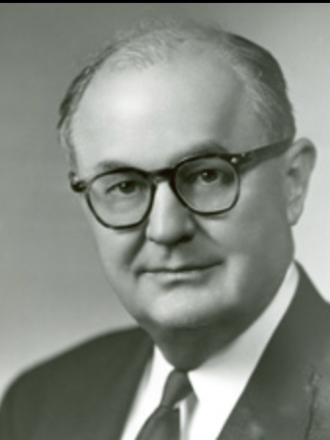
Rep Wright Patman
The legislation came close to not passing. But according to the historical account, on June 14, in the final minutes of the 73rd Congress and under pressur from Bergengren, Alabama constituents and President Roosevelt, House Banking Committee Chairman Henry Steagall walked onto the House floor at 7:15 p.m. and asked the full House to consider, by unanimous consent, a Senate-approved, House-amended federal credit union bill.
The Law is Signed
It was signed by the President on June 26, 1934, and became Public Law No. 467. The federal tax exemption was included in the final legislation.
Less than four months later, on Oct. 1, 1934, Morris Sheppard Federal Credit Union in Texarkana, Texas, became the first federally chartered credit union.
At the behest of Bergengren, Claude Orchard, an Omaha executive at Armour & Company, was appointed as the first federal credit union regulator. He would lead what would eventually be called the Federal Credit Union Division for 19 years.
The FCU Act would be passed with language that is often quoted today, frequently by banking groups objecting to the fields of membership and members served by credit unions.
A federal credit union was defined as “a cooperative association organized…for the purpose of promoting thrift among its members and creating a source of credit for provident or productive purposes.”
Other Provisions of the Act
Other provisions in the FCU Act:
- The FCU Act set out the method by which seven or more people were needed to form a federal credit union.
- Examination fees were designed, “as far as is practical,” so that in each case the fee to be paid “shall equal the expense of such examination.”
- Those loans for “provident and productive purposes” were not to exceed two years in length, at an interest rate “not exceeding 1 per centum per month on unpaid balances.”
- Loans to directors and officers of the credit union were not to exceed that person’s holdings in the FCU.
- Loans were limited to $50.
Other sections of the Act provided for a standard set of bylaws, required an annual meeting to be held in January, established the “one-man, one-vote” principle; established a credit committee and supervisory committee, as well as a board of directors, and provided $50,000 annually for federal administration of credit unions.
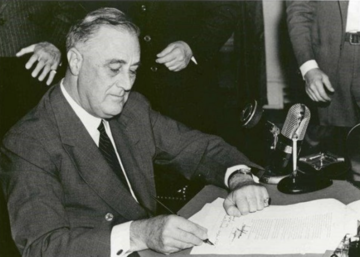
President Franklin D. Roosevelt signs the Federal Credit Union Act.
One Word, Many Interpretations
One section of the law would in the decades that followed become a source of litigation, congressional debate, a loss in the Supreme Court and new legislation in Congress that would pass by a landslide margin, although it came with a caveat that credit unions continue to fight.
Section 9 of the FCU Act limited federal credit union membership to “groups having a common bond of occupation or association, or to groups within a well-defined neighborhood, community or rural district.”
The letter “s” in the word “groups” would lead to millions of dollars being spent, heated exchanges and extensive congressional lobbying after NCUA in the 1980s under Chairman Ed Callahan began to interpret the FCU Act as meaning multiple groups with different associational bonds could belong to a federal credit union.
That led to a lawsuit against the then AT&T Family FCU in North Carolina (that was followed by multiple lawsuits in other states against other credit unions) that finally culminated in February of 1998 with the Supreme Court ruling against NCUA’s interpretation. (Ironically, the former AT&T Family, now called Truliant FCU, has just filed a lawsuit against a bank over a trademark on its name.) Later that same year, credit unions would rally Congress to pass the Credit Union Membership Access Act (while swallowing a cap on member business loans that had been inserted by the banking industry).
In the years that followed during the Depression and through the 1950s, credit unions would begin to spread across the country, often the result of a missionary-like zeal of a few people whose names are now considered iconic in the U.S. credit union community.
No Failures During Depression
An oft-cited fact about credit unions is that none failed during the Great Depression, even as banks all around the country were closing. During the World War II years, the situation was somewhat different. From May of 1942 to July of 1948, credit unions were under the jurisdiction of the FDIC, and by the late 1940s the FDIC was reporting a loss of approximately $200,000 a year due to “credit union activities.” The costs were for administration; credit union deposits were not insured by any entity, including the FDIC.
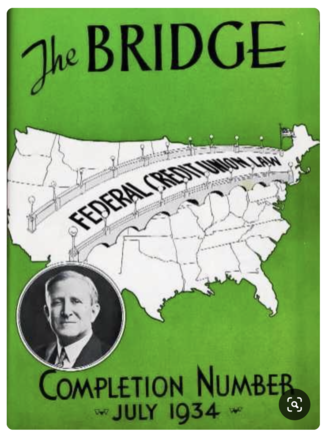
CUNA's newsletter announces signing of Act in 1934.
At the same time, CUNA “indicated that it wanted something more than an impartial supervisory and examination service,” according to the legislative history of CUs.
By the 1950s, as the economy began to roar back after the war, credit unions grew and spread along with the rising tide.
One Thing is Consistent
Despite all the ebb and flow, one thing has remained unchanged: from the 1930s on, bank groups were raising various objections to credit unions, and in the mid-1940s, a letter from the American Bankers Association objected to an increase in the unsecured loan limit and also to the “tax-exempt status of Federal credit unions.” The letter was read into the Congressional Record.”
In 1948, credit union activities were placed in the Federal Security Agency and then placed in the Social Security Administration.
Over the following decades credit unions would continue to grow. In 1953, the Bureau of Federal Credit Unions moved to the new Department of Health, Education and Welfare, and over the next 17 years the Bureau would be self-sufficient, financed by fees on federal credit unions.
Creation of NCUA
In 1970, Congress created the National Credit Union Administration as an independent agency to charter and supervise federal credit unions. That same year, the National Credit Union Share Insurance Fund was also formed, insuring share deposits at federally insured credit unions up to $20,000. Until that point, credit unions had operated without federal deposit insurance.
Lieutenant General Herman Nickerson, Jr. was named the first Administrator of NCUA in 1970, a year that closed with 12,977 federal credit unions representing $8.8 billion in assets and nearly 12 million members.
In 1979, Congress updated the FCU Act to replace the single Administrator with the three-member board known to credit unions today. The first NCUA Board consisted of former NCUA Administrator and newly appointed Chairman Lawrence Connell (1979-1981), Dr. Harold A. Black (1979-1981), and Vice Chairman P.A. Mack, Jr. (1979-1987).
An extended report on the creation and history of the FCU Act through 1956 can be found here.