

By Ray Birch
LAKE FOREST, Ill.—The current “chaotic” state of deposit pricing could lead to increased fees for consumers, right at the same time Washington and financial regulators are zeroing in on those charges, one economist is suggesting.
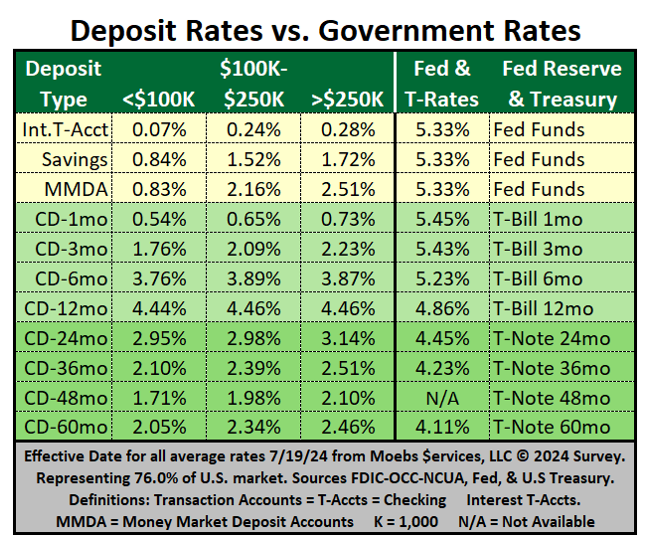
“Half of the financial institutions raise and half of them lower deposit rates, while the marketplace wants lower bond yields, thus lower deposit rates,” said Michael Moebs, economist and chair of Moebs $ervices, which just completed its latest deposit survey. “Deposit rates are chaotic.”
It’s a rollercoaster of pricing not seen since the Great Recession, and also during COVID, stated Moebs.

Moebs said his company’s study shows just as many financial institutions have been raising rates as have been dropping them.
“Deposit rates are in disarray. A consistent direction is needed soon,” said Moebs.
Three Trends
Moebs pointed out three deposit types that are moving in line with Treasury rates:
- One-month CD, which saw three rate increases during Q1
- 12-month CDs, which also saw three rate increases during Q1
- 24-month CDs, which saw three falling rates during Q1
‘Adrift in Pricing’

Michael Moebs
“Depositories are adrift to find their own deposit price,” explained Moebs. “This means paying higher rates on deposits. Something has to give. With the full bailout by the Fed and Treasury in Silicon Valley Bank, the riskless saver is going beyond deposit insurance and owning U.S. Treasury bills, notes and bonds. Depositories, to maintain and increase their growth, must pay more for their deposits. This will put pressure on revenue rates for loans and investments, as well as higher fees to supplement the overall loss in net interest margin.”
Moebs pointed out rate pricing today is “tricky.”
“It is a combination of yield, price, money, term and type—meaning transaction, savings, term account or CDs,” he said.
Adding to the Confusion
What is adding to pricing confusion, according to Moebs, is inverted bond yield curves.
“Bond prices and yields are heavily correlated to deposit rates and vice versa,” Moebs said. “The first time inverted yield curves were recognized was in World War I and the Great Influenza which followed. The Fed had just started in 1914 and did not have the data to identify the inversion. An inversion typically happens when the marketplace is uncertain or pessimistic about economic growth and anticipates the Fed to cut short-term rates.”
A ‘Fool’s Game’
Trying to estimate bond and deposit rates is a “fool’s game,” according to Moebs.
“There was a Nobel Prize in economics given to a professor at the University of Chicago for his work in defining term interest rates. The result was accuracy diminishes greatly beyond six months,” Moebs said. “So, the question of depositories is what term deposit—CD—and what rate for this term is best?”
Moebs reminded that recent economic developments would seem to indicate the Fed is prepared to reduce the federal funds rate, citing recent comments from the Federal Reserve Chairman Jerome Powell.
“CDs were near extinction at year end 2020, at $1.8 trillion,” pointed out Moebs. “Liquidity dominated then. According to the latest data, CDs have doubled to $3.9 trillion, which is still less than 20% of all insured savings. So, liquidity is still an issue.”
A Prediction
Moebs predicted FIs may begin avoiding certificates to dodge being stuck with paying high rates into 2025. He recommended paying more for core savings rates but instituting tiers to earn the higher rate.
“This allows paying less for the cost of funds or deposits if Fed Chair Powell keeps lowering rates,” said Moebs. “And it will keep deposits at the FI.”