

WAIKOLOA, Hawaii–They remain an enormous component of credit unions, but they are also often largely invisible. So CUToday.info asked, “What do credit union board members have to say about why they volunteer their time, their roles, where they see challenges, and what might lie ahead?
CUToday.info recently sat down with five CU board members from different parts of the country during Rochdale Paragon’s Volunteer Leadership Institute here. Participating were:
- Mike Angel, CFE FCU, Lake Mary, Fla., $1.6-billion in assets. On the board for 26 years
- Bob David, Sikorsky Financial CU, Stratford, Conn., $716 million in assets. On the board for 10 years
- Phil Meserve, SAFE Credit Union, Folsom, Calif., $2.4 billion in assets. On the board for 27 years
- Layla Gjertsen, TwinStar Credit Union, Lacy, Wash., $1.1 billion in assets. On the board for nine years (following terms on the ALCO and the Supervisory Committee)
- Ted Gajewski, Campco CU, Gillette, Wyo., $98 million in assets. On the board for 10 years
Below is a look at how the roundtable of volunteer board members responded to questions posed by CUToday.info.
CUToday.info: How did you come to be involved as a credit union board member?
Angel: A former teacher, Angel’s story is among the most extraordinary in credit unions. He was turned down by his credit union’s nominating committee when he sought to run for a board seat, and then had the more than 2,000 petitions he gathered later turned away by the credit union. A federal judge finally ordered that he be permitted to run for a board seat, and he was elected.
David: David was formerly a member of the local school board, and had also owned several businesses when he was approached about serving on the board.
Meserve: While in the Air Force, Meserve served as a senior financial officer and as the liaison on base between the military and financial institutions serving that base, including a credit union. He joined the board at SAFE CU upon retirement.
Gjertsen: Gjertsen was working as a city finance director when the local county finance director, who was a credit union ALCO member, moved to a similar position with the state and left the ALCO. Gjertsen said she initially knew nothing about the CU and only vaguely that she was a member. She eventually moved from the ALCO to the Supervisory Committee and then to the board.
Gajewski: Working in the radio business in Casper, Wyo., Gajewski handled all of Campco Credit Union’s advertising business and eventually took over its marketing, which he handled for four years. Currently the chairman after joining the board 10 years ago, Gajewski continues to handle the CU’s marketing and advertising.
CUToday.info: Why did you get involved and is it worth it?
Angel: I had been a teacher and I really wanted to help teachers. And it’s absolutely, 100% worth it.

Volunteer Leadership Institute in Waikoloa, Hawaii.
David: When I can no longer help the members, I will be done…One thing our credit union has done a lot with is financial literacy. We have five high school branches and we conduct Reality Fairs. Anytime you can be a part of that and put something toward the future of America, that’s pretty neat.
Angel: Since we are teachers and the school district holds our pay without paying interest, I have been (advocating for) a CD that teachers could add to every payday.
Gjertsen: I’m a Rotarian, and part of that is a commitment to the community.
Meserve: It makes me happy to be able to continue to make a contribution after 30 years in the Air Force.
Gajewski: I think it pays back in the long run for me to be involved.
CUToday.info: How has being on a board/board duties changed in the time you’ve been on the board?
David: The social responsibilities of the board have changed. We all saw the crisis of 10 years ago. To borrow from Hebrew National, “We answer to a higher authority.” We have a Noah’s Ark board; it’s very diverse, but what we all share is good values. The kids in the high schools know about Sikorsky Financial. The (school branches) cost us money, but it’s great stuff.
Gjertsen: We’ve seen a significant change in our philosophy and how we approach things. We were a teachers credit union, and the board was always made up of board superintendents. We went from one SEG, or country, to two counties, and our board is so much more diversified now. If someone leaves the board, we ask ourselves what do we not have? The board used to look for superintendents like themselves; now we look for diversity. It might be a skill set or a lifestyle. We have morphed into something bigger.
We also have a responsibility from regulators to be financially literate and to know a balance sheet and an income statement. For me, as a city finance director, the biggest hill I’ve had to mount in credit unions is that the asset is the liability and the liability is the asset.
CUToday.info: Is there a particular issue/area of knowledge where you are concerned over not knowing enough?
Gjertsen: We do board and individual assessments, and we’re then able to take that and apply it to individual and group training because we know what we need to bone up on.
David: We still need to find ways to gently remove board members who are not able to keep up and contribute.
Gajewski: We had a really big challenge with technology. When I started with the board we had one woman who had been there for 45 years; she was 88 years old. They were really totally hands-off on technology. We hired a new CEO and he said we had to do something about that. We send all our board members to training and spend a lot of money on it.
Meserve: The key is the training. All of our board members go to five meetings annually, including the planning meeting.
Gjertsen: Thirty minutes before all of our board meetings members of the management team make presentations on various subjects.
Meserve: Cybersecurity is a concern.
David: That’s true. For us it’s ‘Trust, but verify.’ We are very serious about that. We have met with the Department of Homeland Security, for example. We have a technology committee made up of both board members and staff members.
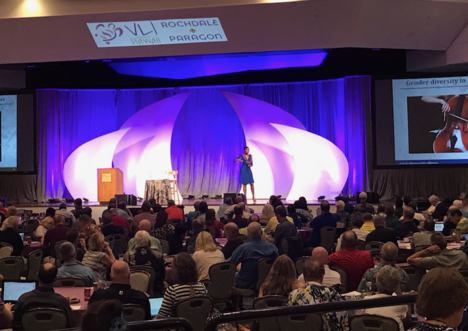
A session during Volunteer Leadership Institute.
Gjertsen: You have to invest in technology if you want to stay with the competition; you have no choice. For Millennials, it’s an expectation.
David: I’d like to launch a Text Help Desk.
Gajewski: We use an external firm to conduct a (tech) audit. We want them to second guess our IT team. We pay people to hack us.
CUToday.info What do you hope to get out of meetings like this?
Gjertsen: For me talking to other people, other board members, is invaluable.
Angel: I sat with (NASCUS CEO Lucy Ito) and was able to talk about why we can’t compete against payday lenders; the 18% APR cap (for FCUs) doesn’t work. I just wanted to plant the seed.
Gjertsen: I want to steal as much as I can from the others here. We also had a member call us who was angry that the board was going to Hawaii. We had to explain why we go and why there is value in going to Hawaii. We’ve never had that happen before.
CUToday.info: What else concerns you as boards?
Gjertsen: I think the biggest problems are in front of us. We don’t know what’s going to happen with the incoming administration. Do we have to educate them about credit unions and hike the Hill? There is also going to be turnover at NCUA, and that’s going to be huge. We just don’t know what’s going to happen.
David: There is a lot of uncertainty around what this new administration means; there’s a lot of angst.
Gajewski: Remember that we didn’t know about Obama, either.
Gjertsen: Changes to the Affordable Care Act are going to affect us.
Meserve: Every new administration has a lot of unknowns.
CUToday.info: Do you feel you should be compensated (no one on the panel interviewed by CUToday.info receives any remuneration):
Gjertsen: That part scares me.
Angel: It changes the dynamic.
David: Our founders in New Hampshire did not have that in mind. It’s a slippery slope.
CUToday.info: How do you ensure that as board members you are hearing the viewpoint of younger members, including Millennials?
Meserve: We go to the local universities and to their business schools and ask for students who could serve in pro tem positions. They are grads of the MBA program, and we have members age 26, 32 and 40. That has been very, very effective. They have all the rights and privileges of board members, they just can’t vote. We had been going through a big issue with governance, and one of them had served on a non-profit board and she brought new input and things we had not thought of. We also disbanded our Supervisory Committee, an idea that began with a pro tem board member.
Gajewski: We have (staff) people who speak to business classes, and we bring in high school and college students for jobs. That has really helped us to advance with technology.
David: We have branches in the high schools where we use interns. We have really listened to them, and they pushed us into mobile.
Angel: At the University of Central Florida we sponsor the CFE Arena. Our staff does so much work there with the college. We have the (UCF) mascot on our cards, which give back to the school.
CUToday.info: Are you concerned about the future of credit unions?
Angel: I worry about the future of banking as much as I worry about the future of credit unions. Technology is the delivery channel. Ten years from now is a big unknown. But if we don’t evolve, we dissolve.
David: I think we’ll be here in 10 years. But I think it’s eat or be eaten. A lot of these $3 million and $8 million credit unions will be gone. When these CEOs retire, these small credit unions go away. In my time on the board we have gone from $400 million to $800 million in assets. You have got to be willing to spend money and you have to do it in the right way.
Gjertsen: It’s not just the technology (hurting small credit unions); it’s the compliance costs.
CUToday.info: Do you think people understand what credit unions are?
Angel: The general public has no idea.
Gjertsen: We are the best-kept secret out there.
Meserve: I remember when the California league spent millions of dollars on advertising, and it hardly moved the needle.
Gjertsen: I recently had a city administrator, who is a pretty smart person, ask why I was involved with the credit union. He said, ‘They’re not insured by the FDIC.’
The best marketing remains word of mouth. But there is a lot of misunderstanding. Marketing is not education.