

WASHINGTON–For many credit union leaders, this Halloween will include the kinds of mask-related discussions with employees many had never anticipated—including how to handle conflicts with members who resist mask-wearing, social distancing and branch capacity limits. One organization is offering some training and strategies for effectively defusing such situations.
The National Retail Federation has teamed up with the Crisis Prevention Institute, a company focused on reducing workplace violence, to help retail workers learn how to prevent and de-escalate consumer disputes that emerge from pandemic restrictions.
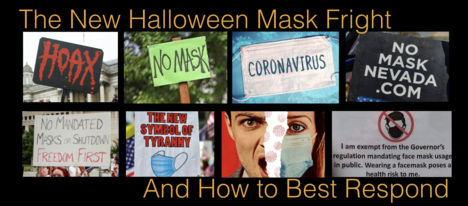
According to the organization, the training puts a spotlight on the unexpected challenges that front-line workers have been forced to grapple with during the pandemic. Most credit unions joined with other retailers in being among the first to require masks and social distancing in branches/stores, but some members/shoppers have flouted the rules, putting employees in uncomfortable and sometimes frightening positions. Altercations with belligerent customers have regularly gone viral on social media this year and have even led to violence, as the New York Times reported.
In the online training, “one of the major scenarios is around an employee asking a customer to wear a mask, and he reacts,” explained Adam Lukoskie, vice president of the NRF Foundation, the National Retail Federation’s nonprofit arm. “There’s another scenario where a mother and child are there and are upset this gentleman is not wearing a mask so then the employee has to help make peace.”
Susan Driscoll, president of the Crisis Prevention Institute, said the online training program and accompanying Covid-19 Customer Conflict Prevention credential are “really focused on how to engage your thinking brain over your emotional brain.”
‘Practical Advice’
The training teaches employees how to recognize what stage of a crisis a consumer may be in, and what they can do to defuse the situation, she said, adding, “It is very practical.” For example, she said, if a consumer is very distressed, the program offers tips on “how to verbally and nonverbally communicate empathy and support” while wearing a mask.
“When someone is defensive and losing their rationality, you give them a choice or set a limit,” said Driscoll. “Say, ‘Would you like to get out of the line and talk this through, or would you like to talk to a manager?’ Giving them a choice puts them back in control, and you get them out of the way and out of the line from customers and help de-escalate the crisis.”
Driscoll said inquiries to the Crisis Prevention Institute for de-escalation information have doubled since the pandemic started.
The National Retail Federation said it did not have data on disputes at retailers, but its research showed that consumers wanted to know what measures retailers were taking to ensure their safety in stores, according to Bill Thorne, executive director of the NRF Foundation.
How to Handle 4 Stages
According to the NRF, tense situations related to refusals to wear masks can be fully or partly averted by learning the four stages of the CPI Crisis Development Model. The model represents a series of recognizable behavior levels an individual might experience during a crisis moment and the related staff attitudes and approaches used to de-escalate behavior, the NRF said.
The four stages include:
Anxiety
Sign to Look For: Consumers exhibiting anxiety might demonstrate outward behavior including fidgeting, crossed arms or pacing, signaling agitation.
“The employee response in this stage should be supportive. Early intervention is essential, and requires a supportive, nonjudgmental approach,” the NRF said. “Acknowledge the customer’s concerns and give them an opportunity to vent before asking them to do something they might not like (e.g., wear a mask).”
Defensive
Sign to Look For: If the consumer is not placated by the supportive response, they might become defensive. They might yell or refuse to comply with a request, indicating they are protecting themselves from a real or perceived challenge, the NRF said.
“At this stage, the associate should be direct, providing clear instruction with reasonable choices — ‘setting limits,’” the CPI model recommends. “For example, associates can ask the defensive customer to step aside and offer to let them discuss the problem with a manager. Remain calm and consistent, and don’t be afraid to ask for help.”
Risk Behavior
What to Look For: If the customer begins displaying risk behavior, it means their distress level has risen and they might pose a threat to themselves or others by aggressively invading someone’s space or physically assaulting them, the NRF said.
“The store associate should immediately implement safety interventions by asking for help — either from a co-worker, a supervisor or security,” the organization explained. “Divert the person to an area with fewer customers to prevent other people from escalating as well, and to keep everyone safe.”
Tension Reduction
How to Respond: Once the crisis has faded, the customer and associate will experience tension reduction. A person’s physical and emotional energy decreases, and they regain a sense of calm, according to the CPI model.
“Now is the time to engage in therapeutic rapport. The threat is over and the employee can address the physical or emotional needs of everyone involved by listening, offering support, demonstrating empathy and avoiding blame,” the CPI model states. “That includes everyone affected by the crisis, which could be co-workers and other customers, in addition to the customer directly engaged.”
For more info, visit the Foundation’s RISE Up COVID-19 training page.