

By Ray Birch
LAKE FOREST, Ill.—Smaller credit unions, which worked hard in 2020 to help small businesses survive the pandemic, have nonetheless been losing business loan balances, a new report reveals. But some smaller institutions have gotten “creative” and have built their book of business.

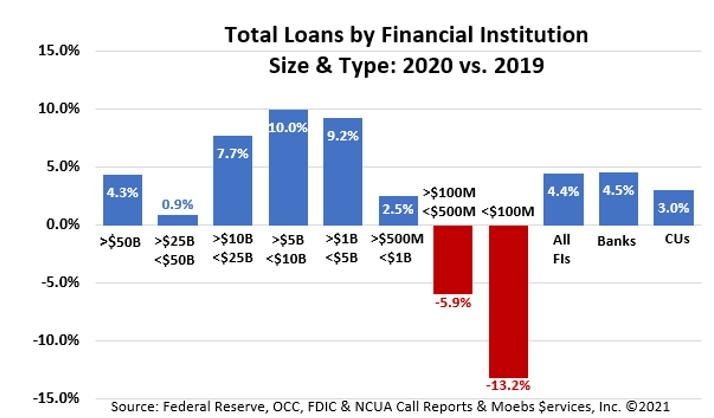
A study from Moebs $ervices shows banks and credit unions with less than $500 million in assets lost a significant portion of their overall loan balances in 2020, and a noticeable contributing factor was business loans.
Overall loan balances were down 13.2% in 2020 over 2019 among financial institutions with assets less than $100 million. The same balances were down 5.9% among FIs $100 million to $500 million assets.
The larger institutions last year, particularly the big banks, added to their overall loan balances and to their commercial coffers as well, the report shows.
Why are smaller institutions losing loans to much larger competitors?
Michael Moebs, economist and CEO at Moebs $ervices, cites a few causes, from Paycheck Protection Program loans to a marked reduction in in-person meetings to growing pressure from big banks to squeeze out the little guy to the death of many of those small businesses.
Three-Million Closures
Moebs $ervices noted three-million small businesses closed last year, many a result of the pandemic.
“The reality is the small lender, defined as community banks and credit unions less than $500 million in assets, are being squeezed out by the largest financial institutions,” stated Moebs.
As CUToday.info has extensively reported, many small credit unions are losing members and not growing while the large CUs account for the majority of the industry’s overall success.
Moebs said the SBA’s PPP program is an example of how small financial institutions are being caught in the “squeeze play.”
“To do a $50,000 or less PPP forgiveness loan, the lender gets 1%, or $500, and the SBA does the funding,” noted Moebs. “Main Street FIs cannot pay the rent for $500. So commercial loans are being channeled to the federal government at a much greater level through larger financial institutions that gladly take this business—so they can get more of the business loan market for loans greater than $50,000 and charge higher rates as private loans after COVID passes.”
CUToday.info reports have indicated the profitability of the PPP loans was mixed among CUs, with some stating the forgivable loans generated significant revenue to other lenders saying they participated more out of duty to the community.
Experts have stated profitability of PPP loans often depends on how efficient the FI manages not only the application and funding process, but the forgiveness aspect of the loan as well.
From Lunch Tabs to Zoom Gabs
For his part, Moebs contends larger financial institutions are doing a better job than the small guys at meeting with small businesses during the health crisis.
“The business relationship at Main Street FIs that used to be cultivated with lunches and dinners is now being done on Zoom with financial institutions on Wall Street,” stated Moebs. “What is at stake here are the more than 70% of new jobs created by small business according to the Federal Reserve Bank’s own analysis.”
Moebs pointed out Main Street lenders lost 4.8% of business loans from 2018 to 2019.
“This trend continued from 2019 to 2020 with the loss growing by 45% to 6.98% of all loans for FIs less than $500 million,” he said. “This is further seen by the shrinking of loan allowances and provisions, even adjusted for accounting changes required by the regulators as well as generally accepted accounting standards.”
Moebs further pointed out capital fell for Main Street banks and credit unions from $124 billion in 2018 to $114.8 billion in 2020, a decline of 7.4%.
“In this same period of time, 820 Main Street banks and credit unions were sold or merged,” Moebs said. “More importantly over 25,000 Main Street financial institution employees lost their jobs with only about 20,000 retaining jobs with Wall Street FIs who took them over.”

Michael Moebs
Getting Creative
Moebs said some Main Street banks and credit unions are getting innovative with pricing and relationship pricing tactics, adding he sees signs the negative trend for small shops may reverse.
“Led by some very creative credit union and bank executives, fees are being used to buy down loan rates. In addition, Main Street FIs are considering both the owners and workers of small businesses to service the entire relationship of business and consumer needs,” he said, adding that fortunes could smile on smaller banks and CUs when the health crisis ends. “By incorporating the entire relationship with a holistic approach, the innovative Main Street lenders can offer lower prices yet maintain revenue. It is easier to say yes and harder to say no to people you see every day at the grocery stores, gas stations and carpool line at school—something Wall Street FIs find difficult to do.”