MADISON, Wis.–Regardless of when you were born, if you wish to successfully lead a credit union or any organization it’s important you become a member of “Generation Flux,” according to one person, who has shared five lessons learned from some of the most successful business leaders in the country.
Speaking to a CUNA Mutual Discovery Series webinar, Robert Safian, a journalist and strategic advisor who oversaw Fast Company magazine and other publications and who also hosts the podcast “Masters of Scale: Rapid Response,” told credit unions during the webinar that was subtitled “Succeeding in an Age of Chaos” that to him the term “Generation Flux” means two things:
- “It refers to an era we're living through now, a time of rapid, high-velocity change that shows little sign of slowing down.”
- “It also refers to a group of people, the kinds of people who are best-positioned to thrive in this kind of environment of change."

Anyone Can Join
According to Safian, any person or organization can become a member of Generation Flux, as the key attribute is a mindset, a willingness and an ability to be adaptable to all of these changes, even if unprepared for the speed of those changes.

Robert Safian
Safian, who emphasized he is not a statistician or demographer or economist, said the strategies he shares are based on his work as a journalist and the interviews he had conducted with numerous innovative business leaders who have had to respond—and fast—to the flux in their respective verticals.
Throughout his presentation Safian shared excerpts from people featured in his podcast, including an interview with Gen. Stanley McChrystal, who oversaw during his career U.S. operations in Iraq and Afghanistan and who is an expert in anti-terrorism. McChrystal is now a private consultant and much in demand for his insights on responding to unpredictable and ambiguous environments.
“What Stan is saying is that this is a defining moment right how. How prepared are we really for the world of the future and how do we get ourselves prepared for that if we don't embrace the reality of our current environment?” shared Safian. “As Stan says, we run the risk of getting crushed. But if we (can embrace the change), we can be one of those who steam ahead.”
Safian then shared his five lessons:
Lesson #1: Chaos Will Rule
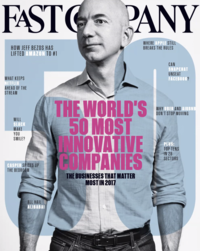
Jeff Bezos in a cover story written by Robert Safian.
Safian drew this lesson from an interview he conducted with an expert on chaos theory. During the interview that person shared thoughts around five-day weather forecasts and the question of why those forecasts are often as wrong as they are right. The explanation is that given the tremendous number of variables at work in a weather forecast, “predicting the weather it is tremendously, tremendously complicated, and other times it's actually quite simple.”
Even predicting the weather two hours out can be chaotic, Safian added.
“My argument to all of you is that we are in the ‘next two hours’,” he said. “Things are changing that fast. We were in the next-two-hours era even before COVID, but since then the chaos has only accelerated and deepened. Now, chaos can be scary but it also creates opportunities if we can embrace the reality of the situation. Jeff Bezos uses a phrase at Amazon that ‘It’s always Day One.’ Today is the beginning. Don't anchor on the past, focus on how we can make the future better for Amazon. Nostalgia for the past, while natural and expected, often isn't really helpful.”
Lesson #2: Speed Matters
Safian shared an interview he conducted with Verizon CEO Hans Vestberg, who oversaw the transition of 115,000 people into remote positions at the same time demand for Verizon's services were surging at the outset of the pandemic.
“We all had to deal with it, but what Hans and other leaders I've talked to at organizations big and small all began talking about right after that is ‘how do we maintain that speed?’” Safian shared. “How do we make that adaptability and that pace the norm, because we want to get more done faster.”

GM CEO Mary Barra.
In addition, Safian played a clip from an interview with Mary Barra, CEO of General Motors, on how the company pivoted quickly to produce ventilators in response to COVID by retrofitting one of its plants. That involved retraining approximately 1,000 people in a very short time. It wasn’t long before GM was producing tens of thousands of ventilators.
“The ventilator project gave Mary a model for GM's future and she eagerly grabbed hold of it,” Safian said, noting GM wants to carry forward that ability to “execute with constant urgency.”
Today, GM talks about being “ventilator fast.”
Barra said a key lesson has been learning to empower people as way to move faster.
“It is true we can move faster than we think we can if we make speed a priority,” Safian told the webinar audience. “We don't get caught up in excuses and politics and posturing, and while that definitely falls on top leadership, it also falls on each of us. This mindset is a defining feature of Generation Flux. Are we open to embracing the new?”
Lesson #3: Create Your Own Trajectory
For his third lesson, Safian drew upon an interview with Ellen J. Kullman, the former CEO of Dupont who now leads the Silicon Valley startup Carbon3D.
“You have to focus on what you can control. You change what happened,” Kullman said. “What you can do is change how you react to it. What can you do to improve your company, your situation.”

Safian said Kullman’s emphasis isn’t on shutting herself off from opportunities, but instead creating her own trajectory.
“You have to write your own story,” Kullman said. “Don’t play the hand you’ve been dealt, play the hand you want.”
Safian called creating one’s own trajectory a “hallmark of Generation Flux.
“There are incredible opportunities out there for us if we open our eyes to them because we can create our own trajectory,” he added.
Lesson #4: Listen & Learn
“One of the most dominant topics in my interviews with business leaders is about curiosity and openness and the imperative for communication and what that can do for you,” said Safian.

For this example he pointed to an interview with Sumit Singh, CEO of Chewy.com, which saw its business suddenly surge as the pandemic set in.
“They needed to hire more customer service help desperately and he was getting a lot of pressure to say, ‘Hey, let's just add virtual agents. Let’s just add some more of these chatbots to take care of this, to handle these customer calls,” Safian said. “But he didn't want to do that. He wanted to make enhanced customer care a priority and an essential focus. It was something he could control, it was a trajectory that he could control. So, he added more customer care agents. He didn't take the cheaper, faster route of going to all virtual agents and it turned out that his customer care agents brought him a key insight.”
That key insight was that many customers could not take their pets to the veterinarian during the COVID shutdown. In response, Chewy.com launched a pet tele-health service and also began selling pet pharmaceuticals.
“By listening, the company found a whole new area of business, a whole new trajectory for itself,” said Safian. “The lesson around listening and learning is about helping each other, leaning on each other and learning from each other. It’s about the things in the places where you can go faster and you can create your own trajectory.
“In this environment listening and helping each other is important for other, more fundamental reasons as well, as stress is high for all of us. Everyone is under pressure in new ways,” said Safian.
Crate & Barrel Example
He cited a lesson from an interview with the CEO of Crate & Barrel, Janet Hayes, during whch she shared how conversations and listening can help to break bad habits and patterns. It also provides the opportunity to hear when someone else is stressed and needs help or just a break.
“We need to be honest with ourselves and our team about how we're feeling and how we're doing and that creates a better and more productive and more sustainable long-term work environment,” said Safian. “But I also love how this is not a downer. The truth is it can be an inspiration that is what being part of a team, what listening and learning can do for us all together as a group.”
Lesson # 5: Stand for Something
Safian asked his audience a question often asked of credit unions: Why does your business exist?
“Having a clear purpose is like a superpower for a business in an age of chaos, because when you don't quite know what to do or you don't quite know how to act, you can go back to that mission and that purpose and say, ‘This is what I stand for’,” said Safian. “That's the filter for me to make these decisions. In the credit union business you have this; you are helping people with their financial security. We can get so caught up sometimes in the other details and metrics that we forget this big picture and that's too bad, because it undercuts things for us.

“Again, this is a great way to generate engagement with your team internally and that's also a filter for deciding what to do and what not to do when questions are looming and conditions are swirling around,” Safian added.
Safian related how Brian Chesky, CEO of Airbnb, said what every organization must know is the difference between business-based decisions and principles-based decisions.
“You can’t predict the outcome, so you can’t make a business decision. In a crisis you have to make a principles-based decision,” Safian quoted Chesky as saying.
Five Questions
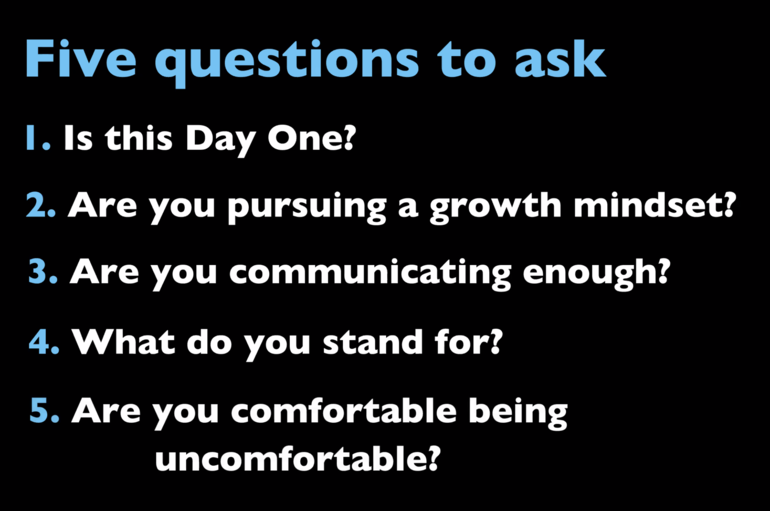
Finally, Safian said he has developed five questions he believes every business person should be asking themselves regularly. Those five questions are shown below.