

WASHINGTON–There are a number of myths and misconceptions around the current elections and voter trends, but one isn’t in doubt: women remain unlikely to be involved in politics, and young people are strongly turned off by what they’ve seen and don’t see elective office as an effective way to bring about change.
Those insights and others were shared by Jennifer Lawless, a professor in the School of Public Affairs at American University in Washington, co-author of a book examining attitudes of the young toward politics, and herself a former political candidate. Her remarks were offered during a breakfast hosted by the Filene Research Institute in conjunction with CUNA’s GAC.
Lawless began with addressing what she said are some “myths and misconception” around the elections, as well as an effort to “put things in context, especially around women and young people.”
Those included:
Fact: In every presidential election since 1980, women have been more likely than men to support the democratic candidate, but it isn’t always true. Lawless said the gender gap is really about the difference in support women give one candidate over another. “The Democrats need women to win, but the Republicans do not,” Lawless said.
Fact: Women don’t vote as a bloc and they never have. “It’s kind of silly to assume that just because they are women means they are going to support Hillary Clinton,” said Lawless. “Lots of factors play a role. And among women there is a lot of variation among age. Hillary (Clinton) getting about 70% of support of women over 50. It’s only among the 18-30 year olds where she is losing to Bernie Sanders, and she is doing better among women than any other candidate. It’s a fun media story that women won’t support women.”
Fact. Bernie Sanders is no Barack Obama. The media, said Lawless, want everyone to believe 2016 as another example of 2008. She noted that Bernie Sanders is “so uncool he’s become cool.”
Voter Turnout Not The Same
“It’s true he’s doing much better than Clinton among young people. But what’s also true is young people not turning out at the same rate as they did in 2008, so this is far from the Obama revolution.”
Fact: The campaign tactics being seen on the Republican side of the aisle are going to turn young people off to politics. That’s true, said Lawless, “but the irony is it will hurt the Democrat candidate more than the Republican, because young people are more likely to vote Democrat. It’s likely that by the time we get to general election the histrionics and vitriol will turn them off.
Fact: The “Yes We Can” (Obama) voters of 2008 no longer feel that way. “There has been a lot written about how bad Congress is. It’s not a great time to be a sitting member of Congress and running for Congress. Sanders, (Marco) Rubio, (Ted) Cruz and Clinton have all sat in this particular institution and are traditional establishment candidates.”
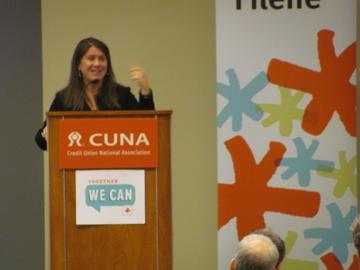
Jennifer Lawless speaking to credit unions.
So where do all those facts “leave us,” asked Lawless.
“In a place where people disillusioned with politics and politicians and people want fresh faces and new blood—and in a place where we are likely to have pretty unfulfilled dreams after 2016,” Lawless answered. “Getting new blood means not having the status quo persist and having more women involved in the political system—only 19% of Congress is female, six of the states have women as governors, and 25% of statewide legislators and elected officials are female. We have more than 500,000 elected positions in this country and people are supposed to run for those offices.”
But many are not, especially young people and women, observed Lawless, who described herself as a cheerful pessimist.
Women Win As Often As Men, But...
“The good news is when women run for office they are just as likely to win their elections as men. But when well-situated people are asked would you consider running for office, women are significantly less likely to say they would run. So we end up with twice as many men and women elected officials.”
Lawless noted that research shows well-qualified women often don’t think of themselves as qualified for office; men who aren’t qualified often see themselves as good candidates.”
Citing research that was the basis for the book “Running from Office,” which Lawless co-authored and which is featured in CUToday.info’s The Corner this week here. Lawless said a survey of 4,200 high school and college students asked if they would consider running for office in the future. The result: 89% had already decided unequivocally that they would never run for office. Ninety percent said they could never see a situation where this is a good idea.
“We found the reason these young people don’t want to think about a career in politics isn’t that they are tuned out; it’s they are very aware and don’t want to be a part of it,” said Lawless, who ran unsuccessfully for a House seat in Rhode Island in 2006. “They only see fighting, gridlock, hyper-partisanship and making sure the other side gets nothing done as a normal course of business. They feel if they want to make the world a better place electoral politics is not the place to do it. And yet the good news is that when asked about their life goals, making the world a better place ranked highly. It’s not a generation not interested in contributing, it’s a generation that thinks electoral politics isn’t the way to do it.”
The only way to change that, said Lawless, is to convince young people that the “2016 election cycle is not what politics is like.”
“When elected officials make all those accusations, when they shut down government, what happens are long-term generational implications,” said Lawless. “We would be better off encouraging younger people to not only run for office but to get involved. If we don’t stop doing that we are just going to see the 2016 election cycle again and again.”
What Can Be Done?
What can be done? Lawless cited two of the five recommendations that are made in her book:
- Link political knowledge to college applications. Lawless noted that when college admissions officers thought volunteering was a good thing, suddenly volunteering among the young took off. “It’s possible to get into even the best universities and have no idea how a bill becomes law or the political system works,” said Lawless. “So we could link knowledge to the college application.”
- Create a “Go Run” app. Noting there are 500,000 elected positions but no clearinghouse for info on how to run for these positions, Lawless added it can be hard to figure out even when the election is local. “We envision an app where you type in your address and you get a list of every elected position available to you, along with election dates. We make it very difficult now to think about how to get involved.”