

WASHINGTON—NCUA Chairman Kyle Hauptman told House lawmakers Tuesday the agency is committed to maintaining a “right-sized” regulatory framework that promotes safety and soundness without stifling innovation—a message delivered at a time when speculation continues in Washington about whether the Trump Administration may seek to consolidate federal financial regulators.
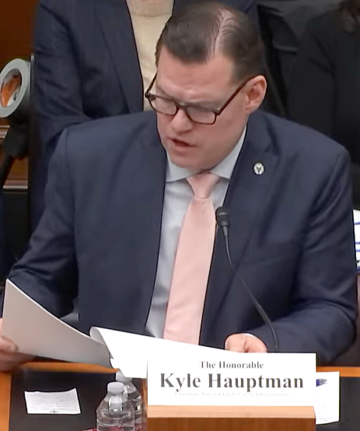
In prepared remarks before the House Financial Services Committee’s oversight hearing with federal regulators, the chairman and lone NCUA board member repeatedly emphasized the importance of preserving NCUA’s distinct role, noting that the agency’s combined responsibilities as regulator, insurer, and provider of emergency liquidity make it fundamentally different from banking regulators. The semi-annual testimony from regulators Tuesday was postponed during the government shutdown.
“For credit unions, we are the OCC, the FDIC, and the Federal Reserve all in one,” Hauptman said. “NCUA’s incentives are aligned with the success of the credit unions we regulate.”
Hauptman framed the credit union system as rooted in a mission that differs sharply from shareholder-driven banks. The credit union model, he said, remains “a grassroots effort” designed to provide affordable financial services and expand access to underserved communities.
That unique cooperative structure, along with statutory limits on interest rates, business lending, and investment authority, requires a regulator that understands the system’s constraints and purpose, he explained.
“Credit unions are uniquely focused on their member-owners,” he said. “They do not have shareholders.”
Warning Against Overregulation And ‘Regulation By Enforcement’
Hauptman stressed that excessive regulation carries its own dangers—particularly as credit unions try to innovate and keep up with fast-moving technology and rising member expectations.
“Overregulation can stifle innovation and growth in a way that could threaten the viability of the credit union system,” he said, stressing the need for transparency and consistency in examinations.
Hauptman highlighted NCUA’s newly published policy that explicitly bars regulation by enforcement, along with a companion statement reinforcing the agency’s commitment to apply requirements fairly and predictably.
Hauptman also spotlighted the role of the Central Liquidity Facility (CLF), describing it as an essential backstop that can provide credit unions with emergency liquidity during periods of stress. His remarks come as lawmakers continue debating whether to restore expired pandemic-era enhancements that broadened CLF access.
Questions From HFSC
Hauptman fielded few questions compared to his counterparts at the nearly four-hour hearing: the Federal Reserve’s Michelle Bowman, FDIC’s Travis Hill, and OCC’s Jonathan Gould. Reps spent a great deal of time asking the banking regulators questions about safety and soundness—given the banking crisis sparked by the collapse of Silicon Valley Bank—debanking, survival of community banks, reputation risk, Operation Chokepoint and others.
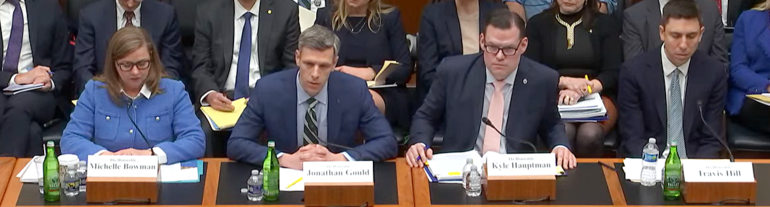
During questioning, the Committee was supportive of the Community Development Financial Institutions Fund.
Hauptman fielded questions on the Genius Act and stablecoins, the Bank Secrecy Act, regulator independence, the Central Liquidity Facility, and volunteer board members getting reimbursed for childcare costs.
When asked about BSA compliance, Hauptman said, “I can definitely tell you that the least enjoyed part of running a small institution is complying with BSA/AML in general. When you ask why a small institution merged with another or sold out to another it is frequently the very first thing that you hear. And these are patriotic Americans who want to fight crime just as much as anybody else. But that burden is significant.”
Hauptman had strong remarks when asked to address the topic of regulation by enforcement.
“Regulation by enforcement, in my opinion, there's not one person in this room that would tolerate it,” Hauptman said. “There has to be a speed limit first and then a speeding ticket after…Simply defined, no enforcement should ever set policy.”