

LAKE FOREST, Ill.—A new study shows credit union deposit account service charge revenue is greater than it was in 2007, but that since the Great Recession banks have yet to make a comeback in the same category.
The study of nearly 12,000 federally insured financial institutions’ Call Report data also reveals another divide between large and smaller CUs.
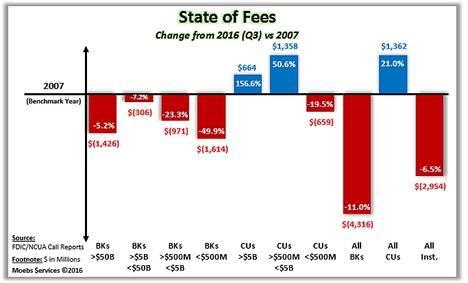
The Moebs $ervices Service Charge Study shows that overall, FI service charges on deposit accounts revenue collectively is still 6.5% less than it was in 2007.
While banks and thrifts have not come back from the peak levels of service charge revenue in 2007, larger credit unions, those greater than $500 million in assets, have shown an enormous increase in service charge revenue, according to Michael Moebs, CEO and economist at Moebs $ervices.
“So much so, it offsets the shortfall of the smaller credit unions, those under $500 million in assets, which have yet to come back to their 2007 levels,” said Moebs (see chart).
Benchmark Year
Moebs said the importance of using 2007 as a benchmark year is to get a grasp of where the industry was before the recession hit in 2008. Currently, total service charges on deposit accounts among all FIs is nearly $3 billion behind what it was nine years ago.
“There are two major reasons for this,” noted Moebs. “First, roughly 75% of service charges on deposit accounts comes from overdrafts – this has been very consistent for years before and during the Great Recession. Secondly, the American consumer has been ‘warehousing’ money in their checking accounts due to the prolonged economic uncertainty since 2008. Consumer checking balances are at an all-time high. Higher checking balances reduce fees in both overdrafts and balance requirements to avoid a fee.”
Moebs said the main components of service charges on deposit accounts are overdrafts, NSFs, monthly maintenance fees, and transaction usage fees.

Michael Moebs, Moebs $ervices
The same data show there is not an asset category of the banking industry that has returned to pre-Great Recession levels (see chart). Banks between $5 billion in assets to $50 billion come the closest. For all banks, total service charges on deposit accounts is down 11% or about $4.3 billion.
For credit unions, only those under $500 million in assets have not recovered, signaling again a divide among the industry and that the larger credit unions account for most of the asset and membership growth. These smaller CUs are down 19.5%, or $659 million in service charge revenue, Moebs explained.
More Checking Growth At Big CUs
This same CU asset group raised its overdraft fee from $25 to $29 over the past three years, while the banks in this asset size have kept their overdraft fee at $25, explained Moebs, who said that raising overdraft price can cause an FI to lose revenue. Moebs $ervices’ studies have shown that lowering overdraft price increases OD volume and revenue.
Moebs noted that the larger credit unions have gained more checking accounts than the smaller CUs, largely through more free checking offerings, and at the same time have also lowered overdraft price.
“The large credit unions, especially those greater than $5 billion in assets, which have grown service charge revenue the most of any FI (see chart), have done two things to help their service charge on deposit accounts grow by leaps and bounds,” said Moebs. “These larger credit union’s offer free checking at the highest rate (82.4%) of any other size group or type of institution. Along with that, they are charging the second-lowest overdraft fee at $27.50 per item. Credit unions have seemed to pick up the customers that banks don’t want,” pointed out Moebs.
Moebs predicts that service charge revenue will grow in 2017 due to the consumer’s need for short-term financing and the financial institutions need to return to revenue levels from nine years ago.