

By Ray Birch
LAKE FOREST, Ill.–As the coronavirus significantly changes Americans’ everyday lives and with it credit unions’ balance sheets and shrinking net interest margins, CUs can preserve the bottom by driving greater volume and taking other steps—including one often-overlooked ratio, according to one expert.
That volume will be driven by offering the best deals to consumers to get them shopping at their credit unions—via their PCs or phones—and by lowering fees to drive more business and therefore income, asserts Michael Moebs, economist and CEO at Moebs $ervices.
“The coronavirus is wreaking havoc on the global economy. The markets are in a state of shock with great volatility,” Moebs said. “The Federal Reserve has done its best to calm this economic perfect storm. What about the individual bank, credit union and thrift? What is each depository’s financial fate?”
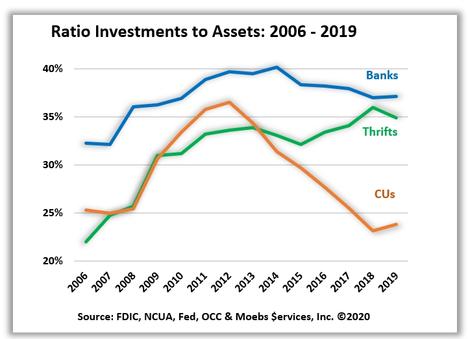
To help determine that fate, Moebs said lessons learned from the Great Recession provide clues about what to expect at each institution. And the data that should be most closely looked at, he said, is an often unused ratio: investments to assets (ITA).
“The Great Recession started with the fall of Lehman Brothers on September 15, 2008. While technically ending in the second quarter of 2009, this credit crisis did not end for credit unions until 2012, banks in 2014 and the surviving 775 thrifts in 2018,” said Moebs.
The thrift ITA went from 22% to 36%, or a 64% increase in the overall ratio. The increase in investment ratios and the ITA are: 44% for CUs and 25% for banks.
A Clear Sign
“This ITA ratio also is reflective of loan activity,” explained Moebs. “The loans-to-assets ratio was falling as more depositories did less and less lending in the respective periods and put more into investments.”
The effects of a rise in more investments and fewer loans during the credit crisis was shown clearly by measuring what happened to the net interest margin (NIM) for each depository group, stated Moebs.
“The sharpest decline in NIM was for thrifts which plunged from 2.55% to 0.84%, or 67%. The number of thrifts fell from 1,279 to 746 today,” Moebs said. “The next drop for NIM was banks falling from 2.65% to 1.17%, dropping 56%. The number of banks decreased from 7,412 to 4,440 now.”
The softest tumble in NIM was among CUs, noted Moebs, going from 2.78% to 1.89%, or a 32% decline. CUs lost 3,187 institutions from 2006 until today.
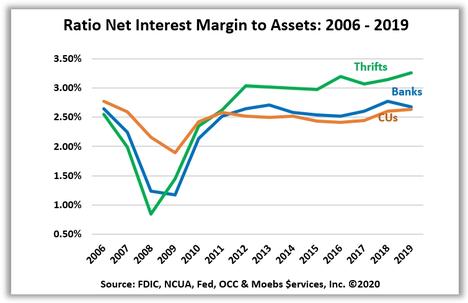
“Whether a credit crisis or pandemic, financial turmoil shrinks depositories by causing economic dilemmas for consumers and small businesses. Investments increased while loans declined and net interest margin dwindled,” Moebs said. “It is important to recognize going forward in 2020 the pandemic is not a credit crisis as we experienced in the Great Recession. The distinction is the pandemic has a predictable time frame. Financial institutions have stronger capital positions and are much more liquid today.”
Avoiding a Credit Crisis
But people are dying from this disease, striking fear into everyone, Moebs said.
“It is important this does not turn into a credit crisis. The Fed is using more monetary tools than ever in its history and the White House and Congress are putting in place fiscal measures to help those whose jobs and livelihoods are negatively impacted,” observed Moebs.
What should credit unions expect with the economic downturn from COVID-19?
“This economic perfect storm will be short lived. Definitely not like the Great Recession and full recovery will be very quick,” Moebs predicted. “The bond market will be the best barometer of rate prices which will return to lower levels than pre-pandemic with a rate structure more in line with the yield curve for all terms. The result of this will be an increase in investments about 1% to 4% of assets, which had already started in 2019 as the presidential election approaches. The net interest margin will fall about 10%-20%, or 25 to 50 basis points.”
As the Fed pumps more money into the economy deposits will grow, noted Moebs.
“This will offset the net interest margin decline and help the bottom line. However, the bottom line can fall as a percent of assets. So, to maintain the bottom line, two areas can assist: fees and non-interest expenses,” said Moebs.
No Time to Increase Fees

Michael Moebs
Moebs stressed it is not the time to increase fees to make more revenue.
“The consumer and businesses are too sensitized to the stock market price volatility. It is a period to lower fees, which will expand volume and produce more revenue. This will please members.”
Moebs believes the best strategy during the pandemic is to offer top-of-market pricing to drive greater consumer value and therefore volume.
“For example, consumers will leave their homes to go to essential places like the grocery, pharmacy and gas station,” said Moebs. “If I find out my favorite grocery store is selling milk for $1 a gallon? You bet I’m going there, and while I’m there I will buy other things.”
CUs, too, should lower fees.
“Yes, more volume with lower fees. This seems strange but it works,” said Moebs. “For example, dropping the overdraft fee to $15 (half the median price of $30) drives greater usage of the service and the credit union makes more revenue. We have seen this work over and over again.”
Rethinking Checking Pricing
Also, the monthly checking maintenance fee for going under a prescribed balance should be suspended, or reduced, while the coronavirus is happening, Moebs said.
“As an example, if you normally charge $5 for falling under a $500 minimum on checking, suspend the $5 for a couple of months. Member behavior is such that checking balances will increase offsetting the small loss of revenue. Most important the member will say to others, ‘Let me tell you what my credit union did.’ This is invaluable value.”
Moebs emphasized, too, fee waivers and refunds should be watched closely.
“Expenses need to be curtailed as much as possible,” said Moebs. “Since the Great Recession era, banks have reduced the number of employees by 1.6% and thrifts by 42.0%, while CUs have increased by 38.3%. Thrifts have incurred the largest consolidation of all depositories and have maintained the best bottom line of all financial institutions. In summary, all depositories will experience a change in assets, growth in deposits, and decline in net interest margin, but can keep the bottom line in order with emphasis on value, fee revenue and expense control.”
This is just one strategy to help credit unions battle the economic impact of the coronavirus. Do you have a strategy that will work? Let CUToday.info know. Send your thoughts to Ray Birch (Ray@cutoday.info).