

By Ray Birch
LAKE FOREST, Ill.—While the East has the highest median overdraft charges, the western half of the U.S. has some of the highest overdraft limits, with one state averaging $1,000.
Those are findings are from the latest Moebs $ervices overdraft report, which also found that FIs in 23 states have not changed their OD limits since 1998, or 23 years. The study surveyed over 3,000 financial institutions at yearend 2021.
The report has been released at the same time there has been huge flux in the overdraft market, with the nation’s largest banks either eliminating overdraft fees or sharply reducing them, a move a number of credit unions have copied.
“The bellwether states are California, Florida, Washington, Colorado and Connecticut,” said Michael Moebs, economist, and CEO at Moebs $ervices, who described those states as home to financial institutions that understand higher limits benefit consumers and the bottom line. “And none are in the Midwest.”
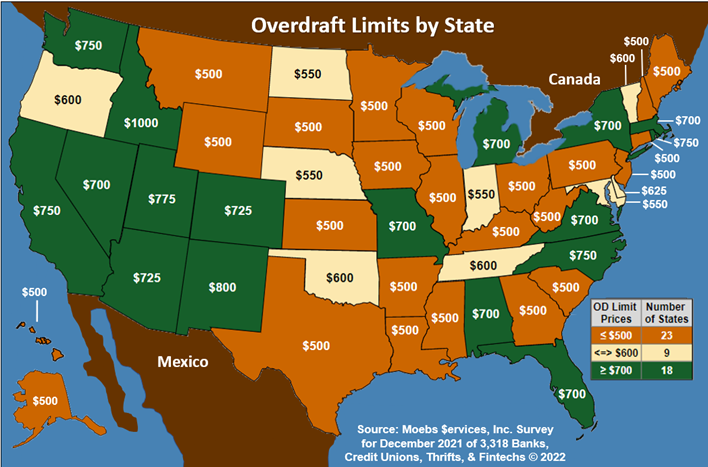
Of the 24 states west of the Mississippi River, nine (38%) have high limits (green, see chart). East of the Mississippi are 26 states, with eight green (31%).
A Regional Comparison
Moebs noted that difference is not statistically significant, and said greater differences appear from a regional view of the data, noting the western region has the highest percentage of states with high limits (eight out of 13 states, or 62%). The eastern region is next (three out of nine states, or 33%), the southern region ranks third (four out of 16 states, or 25%) and the Midwest region is last (two out of 12 states, or 17%).
A regional snapshot of those FIs that have not moved limits for 24 years, according to Moebs.
- East: five states out of nine (56%)
- Midwest: seven states out of 12 (58%)
- South: eight out of 16 (50%)
- West: four out of 13 (31%)
“We have surveyed depositories since 1983,” said Moebs. “And the only financial service not changing is the limit on overdrafts.”
Moebs has long contended the data show consumers can benefit with a lower OD price, and all banks, credit unions, thrifts, and fintechs would see higher net revenue if OD limits were raised.
A $10,000 Limit
“This is not unprecedented, at least one depository in the West has a limit of $10,000, along with one of the lowest OD prices in the nation, less than Walmart, and is more profitable than 90% of all financial institutions.”
Moebs pointed out that overdrafts are unsecured credit, and unsecured credit is “not welcomed” by financial institutions.
“Thus, overdrafts as unsecured credit, yet not a loan, makes leaders of depositories reluctant to change limits for fear of losses,” said Moebs.
According to the Moebs survey there are FIs in Miami, Los Angeles, and Las Vegas with some of the highest overdraft limits in the nation that maintain losses of less than 5%.
“These cities are known for high OD activity and still manage to succeed with limits well beyond the national median,” noted Moebs.
What Depositories Can Do

Michael Moebs
How can depositories change their OD limits safety?
“Depositories can start to change their OD limits by, first, recognizing the overdraft business has changed dramatically. OD limits are now for making an error, not playing the payment system to extend payday and be penalized,” explained Moebs. “Second, the average consumer is still having a hard time making ends meet while working from home and also dealing with inflation. Making one or more auto payments, as well as mortgage or rent costs, are not easy tasks for most Americans. Third, banks, credit unions, thrifts and fintechs must recognize the days of limiting errors with $500 limits or less and charging $30 per overdraft are over. Limits need to reflect the financial hardship COVID and inflation have pressed upon the average American and help all transaction account users meet these difficult times with lower OD fees.”
Moebs said it is time to “do what Idaho does” and offer overdraft limits of at least a $1,000.
“Match Idaho’s limits and charge Utah OD prices of $25 or less,” said Moebs. “Even consider offering $5,000 overdraft limits like Bank of America, along with BOA’s OD price of $10. The bottom line is customers and members will be better off, and financial institutions will still make the same amount of net revenue. If smartly done FIs can make much more net revenue—and the survey data prove it.”