

By Ray Birch
LAKE FOREST, Ill.—Credit unions have long battled big banks for checking business, but new data show CUs must pay attention to another major player—Walmart.
A new report from Moebs $ervices reveals Walmart has been steadily building its checking business, including from among CU members and would-be members, and now claims the largest number of checking accounts among fintechs and FIs in the nation.

“Walmart has close to 100 million checking accounts. Credit unions need to be ready—Walmart is coming! Walmart is coming!” said Michael Moebs, economist and CEO at Moebs $ervices.
The Moebs Checking Study also shows 30 FIs and fintechs hold more than 70% of the nation’s checking business. The report measures checking account share by number of consumer checking accounts.
“The new study shows just who are the major checking players in the U.S.—the Million+ Checking Club,” said Moebs.
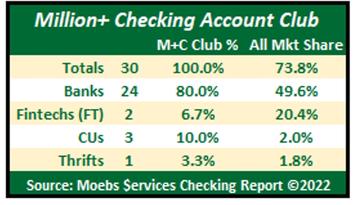
The group is comprised of 30 financial institutions with one-million or more consumer checking accounts, representing 73.8% of the entire checking market.
Walmart leads the way in checking market share at 18.2%. Bank of America is second at 12.7%. Credit unions are represented in the Million+ Checking Club with Virginia-based Navy FCU, North Carolina-based State Employees CU and Washington-based BECU. Combined, fintechs hold more than one hundred million checking accounts, claiming over 20% of the entire consumer checking market.
The study also reveals that just four of the 30 depositories in the Million+ Checking Club, or only 13% of the members, make money on checking.
“Walmart makes money on checking,” said Moebs. “They do not use checking as a loss leader, yet checking brings customers to Walmart to buy groceries and more.”
The Movers & Shakers
Moebs pointed out the group is a mix of too-big-to fail banks along with regional banks and large community banks, credit unions, thrifts, and fintechs.
“The Million+ Checking Club are the movers and shakers of checking,” said Moebs. “In the past only the very largest banks in assets showed up, dominated by Bank of America, Wells Fargo, and Chase. Yet these three represent less than 30% of the entire consumer checking market. The study reveals the real checking market in the United States today.”
Moebs said the Million+ Checking Club offers insights into which pricing and design features work and don’t work.
“Reducing the price of the OD to $10 works for Bank of America, but not for many others in the Million+ Checking Clubs,” noted Moebs, who added Walmart’s $15 OD charge is what many FIs should mirror.

Michael Moebs
Overdraft Policies
The report also reveals that seven depositories, or 23%, do not charge for overdrafts or NSFs—yet, the median OD price for the Club is $35. Thirteen percent, or four depositories, do not charge for stop payments or return of deposited items. Twelve depositories, or 40%, do not charge for internal transfers to cover an overdraft. The average OD limit is about $1,000—and limits have recently, dramatically changed, noted Moebs. Also, 36%, or 11 depositories, provide a one-day grace period—yet six, 20%, do not limit daily OD charges.
Measuring the number of consumer checking accounts was not an easy task, according to Moebs.
“The first step is to compile a comprehensive list of all depositories in the United States along with fintechs, which are mainly uncharted,” he explained. “Institutions are categorized and sorted to exclude investment banks, bankers’ banks, industrial banks, credit card banks, foreign banks, and corporate credit unions, etc. The Moebs Checking Study identifies all depositories and fintechs only offering consumer checking services.”
Give Me Your Tired, Your Poor...
While total checking accounts are reported, each institution was analyzed to identify which accounts are commercial and which are consumer. Other measures sorted out dormant, inactive and unpurged accounts, Moebs said, adding an algorithm was developed with the help of leading depository technology firms.
“The average checking account balance at Walmart is $23. Walmart opens its doors to the poor, huddled masses yearning for free checking,” said Moebs.