

By Ray Birch
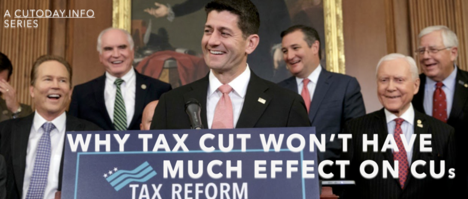
WASHINGTON—Don’t expect the tax bill next year to have a big impact on the economy, consumer behavior, and therefore credit unions, says one economist.
While credit unions and their trade groups largely focused on celebrating the preservation of the CU tax exemption in the tax reform bill recently signed by the president, CUToday.info has launched a series examining how it will have–or not have– implications in a number of other ways.
Mike Schenk, CUNA’s vice president of economics and statistics, told CUToday.info that the trade association believes the new tax bill favors wealthier Americans and corporations, who Schenk does not expect to reinvest much of their savings into the economy.
“We don’t think there will be a really big economic effect from the tax bill,” said Schenk.
Schenk’s forecast contrasts somewhat with that of economist Michael Moebs, as CUToday.info reported here.
Different Behaviors
When Americans receive tax cuts, Schenk said, a few things typically happen.
“We see a few different behaviors people engage in,” he said. “One is that they will spend the money, which is what policymakers want them to do. Or, they will pay down debt. Others will save the money—sit on it and do nothing.”
The majority of wealthy Americans are expected to do little with their new tax benefits, said Schenk.

Mike Schenk
“The people most likely to spend it are people who don’t earn much in first place, but again most of the tax breaks in this bill go to higher-income individuals. Using historical norms, you have to conclude this bill won’t be a big shot in the arm to the economy,” Schenk said.
While the corporate tax rate has been cut to 21% from 35%, Schenk said what he has heard from corporate CEOs is that they will not reinvest the savings into growth—such as building greater production capacity. Instead, Schenk expects most corporations will use the tax cut to buyback their stock, which will simply mean more dividends for relatively wealthy shareholders.
“CEOs do not appear to be excited about running out and building more capacity in the absence of a big increase in consumer demand,” he said. “The idea of if you build it they will come does not seem to resonate with corporate CEOs now.”
25 BPs In GDP
Schenk said that initial estimates, with which he agrees, indicate the tax bill will result in about an additional 25 basis points in GDP.
“So, we talking about the economy maybe growing at 2.5% this year and 2.75% next year,” he said.
But if Schenk and may other popular forecasts are wrong, and most consumers see their tax cuts as a windfall and run out and spend, especially on big-ticket items such cars, there will be a flip side to all that growth.
“The inflation pressure would be strong, especially since we are at full employment,” Schenk said. “That would compel the Federal Reserve to be more fully engaged than they are, leading to higher rate hikes and hikes that come sooner. But that is if we are wrong, and I think we will be right.”
Schenk said the tax bill will have little impact on CUNA’s upcoming economic forecast and credit unions.
“We are scheduled to have our fourth quarter forecast meeting here soon, and when we do I am guessing our current forecast will not change much,” said Schenk. “Prior to the passage of this bill, we were thinking that credit union results in 2018 would be much like 2017,” he said. “We are now in the fourth consecutive year of double-digit gains in credit union lending, and our current guess for next year is we won’t see double-digit loan growth but close, say 9.5%.”
Lending Boost?
The tax cut could bump up the outlook for lending slightly, Schenk said.
“So credit unions might come closer to double-digit loan growth next year,” said Schenk. “Overall the tax bill just further supports our outlook that the country will continue to enjoy modest economic growth at least over the next two years. That is good news.”
Other stories in the series