

MADISON, Wis.–Small credit unions can “thrive,” according to a CEO who has turned around a once-struggling small CU, but it requires a willingness to take some risks, do things differently (in this case, very differently), challenge the board and even challenge one’s self as a leader. And the regulators probably aren't going to like it, either.
Yet doing all of that has paid off for the $45-million Northpark Community Credit Union in Lebanon, Ind., which has focused on a particular market niche, closed all its branches to go completely virtual, changed its board focus and taken a new approach to hiring.
All of that and more was shared by the credit union’s CEO, Carma Parrish, during a webinar that was part of CUNA Mutual’s Discovery Series.
Parrish’s insights and experiences are shared here as part II in a two-part series drawing from the webinar, which was titled, “Thriving Smaller Credit Unions: The Value of a Puzzle-Solving Mindset.”
The webinar was hosted by Taylor Nelms, senior director of custom research at Filene, which partnered with CUNA Mutual on conducting the research that has led to the findings related to the “mindset” that has helped some small CUs to thrive. Part I features more details on those findings and can be found here.
The five puzzle pieces identified by Filene and CUNA Mutual in the research are Identity, Strategy, Balance Sheet, Market and Stakeholders.

Market
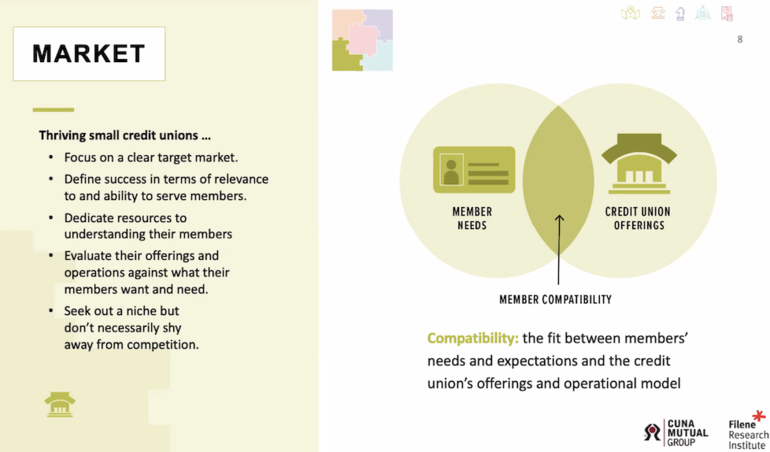
Market, said Nelms, is about understanding members and community to identify market gaps and focus in on a particular market niche, prioritizing member needs and really iteratively evaluating those member needs against what they offer the CU’s own operation.

Taylor Nelms
Credit unions that are successful in the market puzzle piece are dedicated to understanding what Filene calls “member compatibility,” the fit between “what members need and expect and what the credit union offers,” according to Nelms.
First, some background on Northpark Community, which as CUToday.info has reported here and here, has taken some bold steps under Parrish to turn around its once-troubled operations, including closing all of its branches and going virtual—and that was prior to COVID.
The Lebanon, Ind.-based credit union has approximately 5,000 members and is a CDFI that focuses on the underserved in its Indianapolis-area market.
“We really focus on underbanked individuals,” said Parrish. “Underbanked can mean a lot of things. It's not just low FICO, but right now that is our niche. We're really focused on those individuals that have what we call a ‘colorful credit history,’ so 75% of our loans are (made to members who earn) less than 80% of the state median income. Forty-three percent of our loan portfolio is to borrowers with less than a 640 FICO.”
What’s Been Learned?
Asked by Nelms what Northpark Community has learned about making loans to those borrowers, Parrish said it is that each has a “vastly different” story, and that each loan requires taking time to really learn what got the borrower into the position they are in and to understand where they are trying to go and what they expect.

Carma Parrish
“They have low expectations because they are used to payday loans and predatory lenders,” Parrish said. “One of the things we undervalued for ourselves is that a lot of times they will choose convenience over price, and so we have learned that we cannot be OK with, ‘Well we have a better rate and so you should take our complex application process and be happy with it.’ We have had to really up our game and our technology and what we do to make it convenient and at a good price.”
Identity
Nelms said the research aligns with Parrish’s perspective, which he said makes clear that really understanding what members need can change the way a CU goes about designing its product set and how it delivers those products to members.
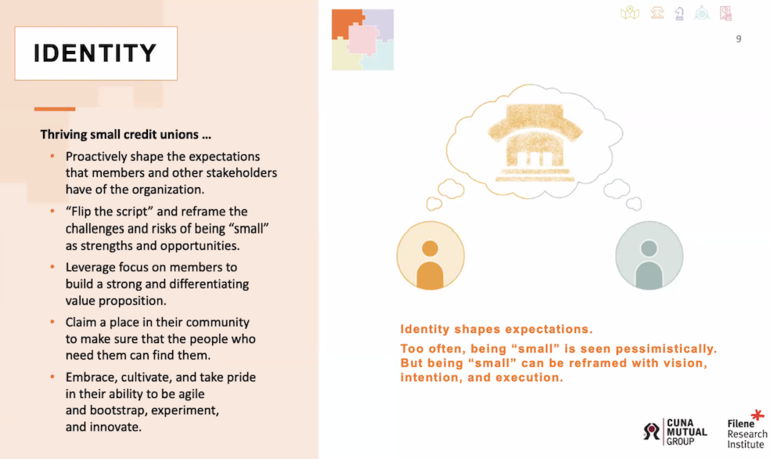
“What we also found is thriving credit unions not only understand their members and have a real clear focus on a particular market or a particular set of members, but they also translate that understanding into an identity for their organization,” Nelms said. “These small credit unions articulate and reinforce a clear organizational identity that aligns with their market and differentiates them from alternatives. Specifically, we found leaders of these credit unions proactively seek to shape expectations about their organization by flipping the script and reframing the challenges and risks of being small as strengths and opportunities.”
In response to a question from Nelms about Northpark Community CU’s identity, Parrish said it’s about being strategic and focused on “trying to look ahead of what's coming.”
Strategy
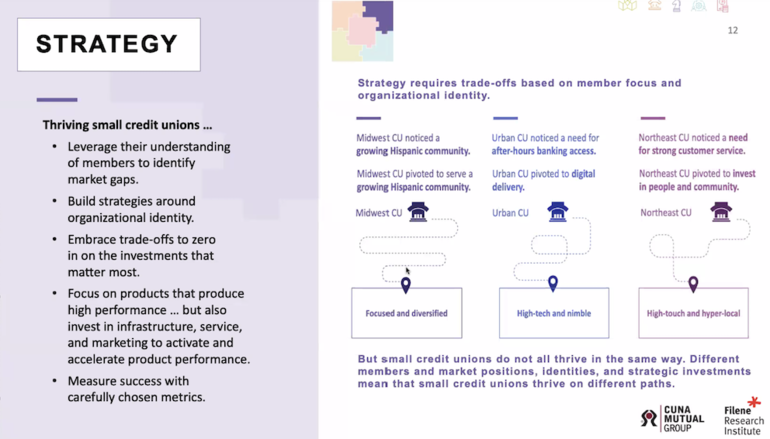
When it comes to strategy, it’s impossible to overlook NCCU’s decision to close its branches and go virtual.
“We look really smart in going virtual before COVID,” observed Parrish. “I did not have a crystal ball on that one. But I did feel like the marketplace was going more and more towards that. We also had a true understanding that individuals who are of lower means don't have time to get off work and come in. They have this stress of coming in and applying for a loan. There are all those factors. When we talked with our Advisory Board members from the community, that was what they said. And that Advisory Board is another way we have been very strategic to really understand our market and who we serve.”
Asked by Nelms what stands out to Northpark Community’s members about the credit union, Parrish said she believes it is that it listens to members’ whole stories.
“One thing that gets lost with AI and automated decisioning of any kind is there isn't someone to listen, and so we're trying to balance that by giving them convenience and quick turnaround, but at the same time truly understanding their goals,” said Parrish.
Similar Findings
Nelms said the Filene/CUNA Mutual research has found similar results.
“What we saw across the industry when it came to smaller credit unions that are growing and thriving and doing right by their members is they often do this even when they don't recognize they're doing it,” he said. “They often do this really successful translation of member needs into an organizational identity that resonates.”
With limited budgets, Nelms observed small CUs must also understand what to say “no” to when it comes to making investments and other decisions in order to say “yes” to other things. In Northpark Community CU’s case, the big “no” has been to physical branches, with the corresponding “yes” to its investment in digital. Nelms asked Parrish about the trade-offs that had to be made.
“Like all, small community credit unions, a large percentage of your stack is behind the teller line and if you have a branch with doors open, no matter how many people walk in that branch you have to have at least two tellers, or people who can jump on the teller line to assist a member,” Parish said.
Responding to the ‘Crickets’
Shortly after she was named CEO, Parrish recalled sitting in her office looking at the teller line while also facing the likelihood she would need to find a new job, because regulators had said that in 60 days it was likely they would be forcing a merger.
“It was kind of like I had my hand forced,” she said. “I needed to find income somewhere and I really looked at the teller line (and I thought), ‘This is ridiculous. There’s crickets and every time someone did come in it was to do stupid things like cash a check. That doesn't generate income.
“So, I really felt like I needed to reallocate my existing resources so that we could have income-generating actions, and I couldn't do that with tellers that were stuck behind the teller line waiting to take a check,” Parrish continued. “It just didn't work. It was, ‘OK, I need to get the tellers off the line doing other things.’ In order to do that I need the members to stop coming in. In order to get the members to stop coming in they need to be able to do that same transaction virtually. In order to do that, I need my tellers to be motivated to teach them how to do it virtually and convince them because, let's face it, our members trust our tellers more than they trust anyone else in the institution.
“Then they can be freed up to go out and do community work and other income-generating activities. So, that's how that strategy came to be and I won't go into all of the weeds of the rest of it, but that's why and immediately we started to see an increase in our direct loan volume because of the efforts.”
Why the Low-Income Market?
But why has Northpark Community CU focused on the low-FICO and underbanked market? According to Parrish, her own personal history played a role, as she had to file for bankruptcy due to debts related to her son’s medical bills.
“I had another CEO say, ‘I will help you with your next loan. You are obviously a good risk and you have to pay it forward’,” Parrish explained. “He also introduced me to (loan guru) Rex Johnson and rest is history. Mathematically, it makes sense to serve individuals with colorful credit as long as you get paid on that risk. The yield on our average loan is over 8%.”
Good for the Heart, Good for the Credit Union
Even after delinquencies are backed out, the yield is still 6.9%, Parrish said, adding, “That’s good for members, the heart and the credit union. That’s what credit unions were originally about and somewhere along the line we lost sight of that.”
In follow up to Nelms’ earlier question about where the CU has had to say “no,” serving the lower income community is one such example, Parrish said.
“We did have members self-select out. We did have board members self-select out. I still have a board member who asks, ‘Why can't you just open the branch one day a week?’” she said. “No, we can't and so you just have to stand for what you believe in and plant your flag and stand firm. And in choosing to serve the underbanked you have to stand firm with examiners. I literally had a call (this week) with an examiner questioning again, ‘Are you sure about this?’ We are seven years in. I was like, ‘Girl, come on, what don't you get about this? I have to constantly have that conversation.”
While its approach has meant an almost 2% charge-off ratio, Parrish said what should be getting the attention is the fact 98% of members are paying, which is why any review of the charge-off ratio must also be accompanied by a look at the CU’s net yield ratio.
“You have to do your work. You have to do the job of running the numbers and quantifying why your strategy works. It's a gut check. Sometimes in a smaller credit union…you're going to take some risk.”
Balance Sheet (And ‘Y’All are Liars’)
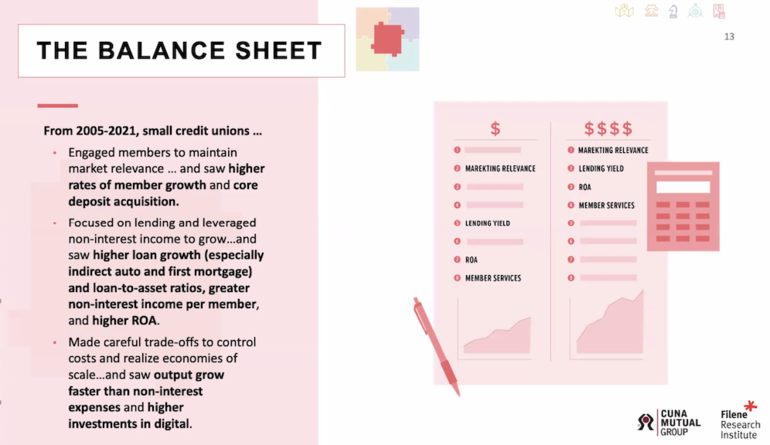
Nelms said the balance sheets of thriving smaller credit unions all look different, but the Filene/CUNA Mutual research had found some “commonalities,” including high levels of member engagement, strong core deposit acquisition, and effective lending focus.
“We also found some commonalities in the economies of scale in the ability to grow output for the credit union faster than expenses,” he said, adding Filene will be publishing an extensive report on its findings.
As she outlined above, Parrish said yield on average loan is her credit union’s number-one KPI.
“I just spoke at a conference and I asked all the attendees—and by the way, I got a list of the attendees and I pulled all their call reports--to raise their hands if they serve the underserved. Everybody raised their hand and I said, ‘Y'all are liars, except for two people in the room’,” Parrish related. “It was because the average yield on average loan in the room was 5% and change. Come on, you know that's not really serving the underserved and so that's why it's so important to us that we use that metric to really prove and drive home our point that we are living out our strategy.”
The second metric, said Parrish, is loan-to-share ratio, as it’s the “bread and butter” driver of net income.
‘Multiplicative’ Factors
Nelms described the loan-to-share ratio and average loan yield as having “multiplicative effects” on the credit union by driving not just ROA and earnings but overall growth. During the webinar, he fielded a question from an audience member who wanted to know about collections, given Northpark Community’s charge-off ratio.
“I joined the credit union in 2015. In 2017 (the Department of Financial Institutions) put a halt on our lending,” Parrish related. “The thing I learned from Rex Johnson is when you do this kind of lending, when the train leaves the station you have to keep going. The charge-offs are going to keep on coming and you are going to get hit by the caboose if you stop. They said, ‘See, we told you, this doesn’t work.’ But I had mathematicians and Ph.D.’s on my board who had done an in-depth study on collections. What we were able to prove in a year and a half is that literally, it was the cause and effect of stopping the lending. As long as you continue and get that yield it will pay for itself on those charge-offs.”
The Track Record
Parrish said NCCU’s track record shows loans that make it 12 months have a 90% chance of paying off.
“Once we were able to mathematically prove that, we were permitted to make the loans again,” Parrish said. “Collections are a continuing challenge, and a 2% charge-off ratio would freak anyone out. But as long as you have the yield you have to be OK with it. We do a lot of deep dive analyses of those charge offs.
“From those charges we can see patterns related to loan type and everything, and it isn't it isn't so much the collection side that is a challenge as it is constantly educating ourselves,” she continued. “The interview is the key. I don't focus so much on the collections. By the point they're not paying you’ve got to go back to the beginning and find out what did we miss in the interview.”
Lots of Opportunity
In response to Parrish’s explanation, Nelms said he wanted to highlight NCCU’s quantification of the balance sheet, as like most small CUs it lacks a lot of resources, yet it is doing lending with a lot of “sophistication.”
“I think that's really important for people to see. There’s a ton of opportunity for smaller credit unions, maybe even more opportunity for smaller credit unions, to be very innovative and serving the underserved by pursuing inclusive lending through alternative underwriting,” he said.
The Stakeholder Approach
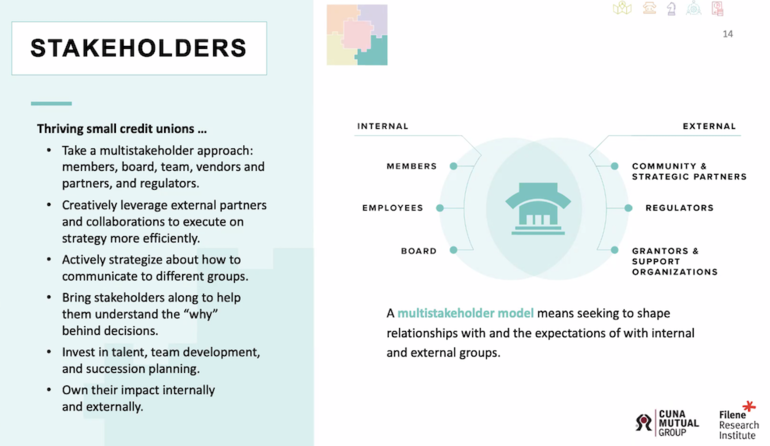
The final piece the Filene/CUNA Mutual research has found when it comes to thriving smaller credit unions, according to Nelms, is the stakeholder piece.
“It’s a multi stakeholder approach to thinking about strategy and communication, one that includes both internal and external stakeholders, members, employees, the board of directors, and many folks outside in the community along with system partners in the credit union industry. And, of course, the regulators and examiners are key stakeholders driving small credit unions,” Nelms said.
All should be leveraged to help a credit union execute a strategy more efficiently, he suggested.
“Thriving small credit unions also communicate proactively with those mini-stakeholders on the why behind their strategy to demonstrate how that strategy enables it to serve the community and grow,” he continued.
Nelms then posed a question around Northpark Community CU’s approach to engaging stakeholders, including its board and governance practices, as well as its employees.
“I just spoke this week to the Kentucky league and we were talking about governance and I was going on about my board and then it dawned on me that not everybody has the luxury of a failing credit union where they can tell the board, ‘Look, y'all are going to do it this way or I'm going to hit the road,” she said. “So, I actually feel sorry for those credit unions when they don’t get to tell the board to take a hike if they don't like it. I had that luxury.
‘Disengaged & Rubber Stamping’
“I said, ‘Look, my predecessor and the two before this person really did the credit union a disservice in how they took what I would almost say was almost to the point of unethical actions.’ I said, ‘I want to build this credit union back up not for me, but for generations to come, and I want to make sure that we protect it.’ So, in order to do that I looked at the board and said, ‘Let's be honest, either you were disengaged or you were rubber-stamping and we need to change that.’ So, we created six pillars that we feel as long as they are balanced and are always looked upon for the safety and soundness of the credit union, and I don't just mean safety and soundness from a risk adverse standpoint, but actually taking risk, too, making sure that is a key component of those pillars. I started to recruit directors that had the skill set that matched that pillar.”
What Happens at Board Meetings
According to Parrish, only a couple of Northpark Community’s board members have a background in finance.
“I have a lawyer. I have an HR leader. I have the whole gamut of skill sets,” she said. “I recruited people who were not necessarily current members of the credit union, but what I love is they know their role is to not get in the weeds of operations. They come to the board and they have a job description as the director of their pillar, and so that’s all the board has to discuss. They vote on the packet before and the entire board meeting is around strategy. Every time we present something and we have guest speakers they will respond as the director of their engagement pillar.
“They see themselves as advisors to management and leadership and so they bring so much of it value to me and our organization,” Parrish continued.
How Employee Roles Have Changed
As noted earlier, since going virtual Northpark Community has grown to 25 employees from 10.
“We’ve recruited from all over,” Parrish said. “I don't steal employees, I identify highly skilled employees who are undervalued at their current employer. So, I have team members from seven different states and my latest one is from Puerto Rico. She's over our operations. That has been great. I see my teammates as my equals in understanding what we're doing and their voice is heard just as much as mine at the table. I spent a lot of my time on how my role has changed. I'm not having to do all of the daily stuff anymore because I've hired high-skill people. I spend most of my time doing leadership training on the KPI's, training on the balance sheet, the income statement, on the board report, and doing deep dives.
Pulling the Levers
“We do this every single Friday and I select who gets to come to that training and if you don't come prepared and if you don't do your homework then you get disinvited, and that includes me,” said Parrish. “So, that has just been a game-changer, because now they are so well equipped to know how their role and what they do or don't do impacts every metric within the credit union. They understand those levers and how when you pull one, there are positive and negative effects.”