


SAN JOSE, Calif.—One credit union CEO says the Federal Reserve’s methods for determining the direction of interest rates is outdated–and has developed his own equation he contends is more accurate.
“When it comes to determining interest rates, the Fed often uses the Phillip’s Curve to justify its decisions,” said Todd Harris, CEO of $2.8-billion Technology Credit Union, who believes if the Fed does not alter its approach it could force a recession.
The Phillips curve is a single-equation econometric model developed by William Phillips that describes a historical inverse relationship between rates of unemployment and corresponding rates of rises in wages that result within an economy.
Harris said many economists today question the relevance of the Philips Curve, arguing it is “outdated already” and will become more “out of sync” as new innovations, such as AI, continue to transform the U.S. economy and workforce.
Harris, who was a CFO for many years prior to his CEO role and was also in charge of forecasting for a major bank early in his career, contends that instead of evaluating the inverse relationship between unemployment and corresponding rates of wage increases within an economy—the basis for the Phillips Curve—the Federal Reserve should evaluate the relationship between employment and inflation. He contends the Phillips Curve, published in a 1958 paper, no longer accurately predicts the rate of inflation.
‘Flawed for a Long Time’
“In my mind, the Phillips curve has been flawed for a long time,” said Harris, who emphasized he has always been interested in the economy and forecasting. “It was a great starting point and it was really relevant for the time the study was applied to. From a certain perspective, one can understand the Fed’s decision to continue using the Philips Curve, given their dual mandate of full employment and price stability—the Philips Curve is a model that includes both.”
However, the “curve” was based on studying unemployment and wage inflation between the years of 1861-1957 in the U.K., “which by today’s standards would be considered a relatively closed economy,” suggested Harris. “As a result, the Philips Curve becomes less relevant with each passing year. It does not take into account the impact of globalization and wage arbitrage, and Internet commerce, which drives the ability to purchase like goods out of market, or factor in the labor force participation rate—impacted by changing demographics and attitudes as well as skill set mismatches. All three of these factors exert an increasing influence on both wages and employment levels in a way that is dynamic and asymmetric over time.”

Todd Harris
‘It’s Obsolete’
Harris said the theory behind the Phillips Curve is the lower the unemployment rate, the higher risk for inflation.
“And I think in a closed economy where you can't outsource offshore, where you don't have a lot of major productivity innovation—whether that be computers or industrial revolutions etc.—you can get away with that because it's a closed circuit,” he said. “Again, my whole premise is what the Phillips Curve was based on is obsolete.”
With Harris’ equation, he changes the “perspective” from evaluating the inverse relationship between unemployment and inflation, to evaluating the relationship between employment and inflation.
“I’ve also redefined the definition of ‘employment,’” said Harris.
The Calculation
To do that, he said he performed the following calculation:
Step 1: Harris takes 100% then subtracts the official (U3) unemployment rate to get to what the current employment rate is.
“For example, if the unemployment rate were 4%, then you would have a 96% current employment rate or ER (100-4=96),” Harris explained.
Step 2: Harris factors in the labor force participation rate (LFPR).
“Basically, unemployment only accounts for the employment status of those who want to work. I want to understand who is working out of those capable of doing so—regardless of whether they choose to or not.
To calculate that, Harris takes the employment rate (ER, which for the example above is 96) and multiplies it by the labor force participation rate to determine the workforce utilization rate (WUR).
‘Crucial Data’
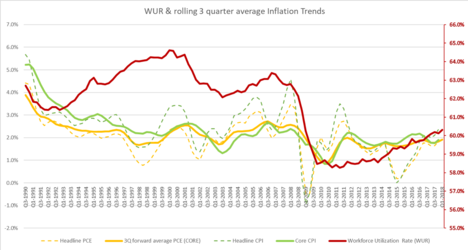
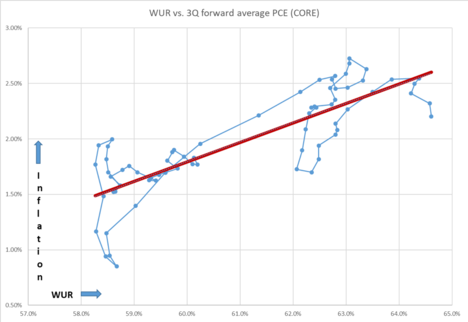
“For my purposes, I define WUR as ‘employment’ and compare the relationship between WUR and the Core PCE (personal consumption expenditures) deflator, the preferred inflation measure of the Fed, to evaluate the appropriateness of or need for Federal fund rate changes,” Harris explained.
“It is crucial to include LFPR to obtain the most accurate representation of employment in today’s economy. The use and availability of social safety nets will change from time to time, impacting the LFPR,” he said. “A population’s workforce will change as generations, of varying size, enter or exit the workforce. And, depending on the size of each generation, this can greatly impact the LFPR.”
An unemployment rate at 5% with a LFPR at 70% is fundamentally different from an unemployment rate at 5% with a LFPR at 60%, Harris noted.
“Despite the same unemployment rate, the economic growth potential with a 60% LFPR is materially weaker than that of a 70% LFPR, all other things being equal,” he said. “The lower the economic potential, the lower the risk of rapid inflationary growth that may cause supply/demand mismatches, all other things being equal. Think of the LFPR as the size of an engine—the smaller the LFPR, the smaller the engine, the smaller the maximum potential output. The Philips Curve, by simply using U3 unemployment, is not capable of capturing the above variables. However WUR is designed to capture these variables.”
Potentially Negative Effects
Harris concluded the Fed’s rate setting in recent years would have had a more negative effect on the economy had rates coming out of the recession been higher. He also feels his formula would have backed the Fed off some of their rate hikes in recent years, but says if their current approach continues, using the Phillips Curve, the Fed may drive up rates too high and force a recession.
“Now that short-term interest rates are nearing normal levels, the Fed is going to need to be much more sensitive to the impact additional hikes will have on economic growth,” he said. “If they become overly concerned with inflation while WUR remains under 62%, there is a very real risk the Fed may overtighten and stall GDP.”
A Better Approach
Harris said he isn’t saying his formula for forecasting and setting rates is necessarily the one the Fed should use, but he does believe his approach is better than the Federal Reserve’s use of the Philips Curve today.
“I don't have it 100% right, but I think I have it better,” Harris said. “The fact is, I am factoring in the labor force participation rate, whereas the Fed’s models using the Phillips Curve don’t. And that's important because the amount of people who are able to work in an economy and are working, the higher that number goes the more productive your economy can be—but also the more inflation risk you have.”