

By Ray Birch
RUTLAND, Vt.—Brian Fogg recalls sitting in a room with his credit union’s board and regulators and being told that his CU was going to be shut down.
Fogg got the news in 1990 just as he was coming on board as CEO of Southwestern Vermont Federal Employees' Credit Union.
“That meeting went until 12:30 in the morning and I was told that the credit union was basically insolvent, and that it was going to be shut down in two weeks. What a way to start a career,” said Fogg about the meeting that was held in the federal building that housed the CU.
As can often be the case with small credit unions, the then SVFECU’s problems stemmed from internal fraud, perpetrated by the former CEO, Gary West.
“My predecessor went away for a while on federal charges,” said Fogg. “That, and extreme incompetence, resulted in problems in every area of the credit union, but particularly in lending. At the time we were a $5-million institution that two months before I got there charged off over $700,000 in loans.”
Avoiding Scrap Heap
But Fogg said the course his credit union would ultimately travel—recovering from nearly landing on the CU scrap heap to grow to $41 million in assets today—illustrates how small credit unions don’t have to die if they don’t want to. Fogg said his credit union came back through hard work, a focus on lending and simply having the will not to lose.
Today, Credit Union of Vermont, with its new name, has almost 12% capital and ROA of 1%.
“I love to win,” said Fogg about the importance of a small CU having the desire to succeed. “I love going forward. I hate to go backward. My father always told me, ‘Son, you are a poor loser.’ I took that as a big compliment. Who wants to be on a sinking ship? So when we got the news we were going to be shut down, we rolled up our sleeves and went to work. We decided this mattered to us.”
Fogg added that when something matters to someone they have a passion for what they do.
“And, I got lucky, too, and hired a few good people,” said Fogg about his current seven-person team.
Effective Lending

The keys to Credit Union of Vermont’s comeback were effective lending and collections.
“The first thing I had to do was get lending and collections in order and we recovered hundreds of thousands of dollars in previously charged-off loans,” explained Fogg. “That went straight to capital.”
The CU had to also establish new policies and procedures and set up internal controls, which Fogg said were not in place.
“We had issues with our investments, too, which had some unrealized losses—there were a lot of issues to straighten out,” Fogg said. “But we did that, and we began generating solid income and gradually we came back.”
In 2003, when the credit union had grown to $13 million in assets and had returned to a solid capital position, Fogg wanted to move out of the basement of the Post Office here. Located in a federal building, and following the Oklahoma City bombing and 911, Fogg said getting to the credit union was not simple for members.
Members had to sign in, provide a photo ID to armed security, go through X-ray machines and then down through a single elevator to the credit union.
“We bought a 15,000-square-foot building in one of the most heavily trafficked areas of town,” said Fogg, noting the CU today has expanded its field of membership beyond postal and federal employees to include state, country, municipal and school employees as well. “We rented out the top floor, which has helped cover our operating costs.”
Free Of Charge
But one of the most important aspects of the new location did not cost a dime, said Fogg. Credit Union of Vermont did not install a drive through. The CEO stressed that has been key to the credit union’s continued success—success that has landed the credit union at the top of Callahan & Associates’ Return of the Member scoring system (Return to Savers 99.42%, Return to Borrowers 99.71%, Member Service Usage 99.91%) for CUs with less than $100 million in assets.
“My mantra is loans drive everything,” said Fogg. “We provide services, but you have to be conscious of what pays the bills—what is your meat-and-potatoes business. For us, that is lending. We are not about fees.”
CU of Vermont grew loans by 6.17% in 2015, 3% in 2014, 11.25% in 2013, 6.65% in 2012, 9.48% in 2010, and 11.66% in 2009.
“We continue to grow lending across the board, and we try to come up with innovative products,” said Fogg about the $29-million portfolio. “On mortgages we charge no closing costs at all.”
Fogg said that one of the credit union’s charter members regularly stops by and asks the CEO how the credit union is doing.
“Old Jerry Connors. He tells me, ‘Brian, don’t forget why we started the credit union in the first place.’ The credit union is not here to charge fees so we can fly to the likes of Hawaii and Cozumel, like some of these credit union executives. This credit union was established to provide value to our members and their families—so we provide the best rates on loans and deposits and have the lowest fee structure in the state. We have always hung onto that thinking, as long as I have been here.”
Focus On Profitable Members
Fogg reiterated the value of not having a drive through, as he says that leads to unprofitable business and unprofitable members.
“I think a lot of credit unions still think they need to be in the business of cashing checks and place a high priority on the traditional banking model, which in the minds of a lot of people consists of the drive-through teller cashing a lot of checks and doing deposits and withdrawals. We certainly perform those transactions, but that is not what we are about.”
Instead, CU of Vermont focuses on building relationships, sitting down with members to meet their needs. Lending plays a big part, and Fogg explained that the CU works with members to be flexible with loan policies to meet as many needs as possible.
“For example, with mortgages we don’t do any conventional loans. All of our loans are in-house,” said Fogg. “We do a lot of extra-step loans. Some people are a real mess but we find a way to structure things and put things in place to make it easy for them to stay on track. These members may fall apart elsewhere, but they do well here at the credit union.”
Fogg said that extra time up front and carefully structuring loans with members has led to very low delinquencies over the years.
“My loan losses for 2016 are $3,000,” said Fogg.
By not focusing on transactions, Fogg said the CU is avoiding the low-balance, high-transaction member.
“We don’t have many members who do not use the credit union for many services,” said Fogg.
Credit Union of Vermont’s average loan/deposit relationship is $21,458, which Fogg said is double that of his peers.
“Comparing the credit union to our larger counterparts, credit unions in the $600-million asset range, their average relationship is below ours, about $17,000,” said Fogg. “We don’t have a lot of members with $25 in their account and going through the drive through twice a week.”
The credit union handles a large number of transactions electronically, with members having access to home banking 15 years ago and now mobile.
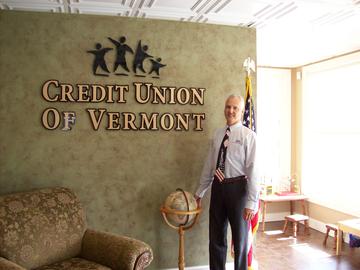
Brian Fogg
Fogg said that not only does the credit union’s business model itself lead to lower operating costs, but the staffing model as well.
“Go to a bank or credit union branch and most front-line staff are just empowered to basically cash a check and do a withdrawal, not much else,” said Fogg. “Our front-line staff here have spacious work areas. They do ACH processing, debit card processing, IRA processing, run loans, disperse loans—a lot of different things, many of which are done in the back offices of most credit unions.”
That has allowed CU of Vermont to be more efficient, said Fogg, leading to a 2.23% operating expense ratio.
“And that lower operating cost goes back to members in lower loan rates and higher deposit rates,” added Fogg.
No Slowdown Ahead
Fogg sees no signs of growth slowing at his credit union—with assets climbing by more than 25% since 2012—but acknowledged the plight of many small CUs.
“I empathize with my colleagues,” said Fogg, recognizing the compliance and revenue pressures facing small shops. “It can be very difficult for small credit unions, and the CFPB and NCUA make it more difficult every day. But you have to have a passion for what you are doing, the desire to fight, and you have to like being on that roller coaster ride—you may go up and down, and you are never quite sure what is around the next bend. I like working in that environment.
“I just think that some small credit unions need to take a hard look at their business model and determine what business they are in,” concluded Fogg. “And a lot of people still think it’s about the teller line and drive through and cashing checks. That is great service, but lending pays the bills. Contrary to what a number of people think, I believe if things are done properly, the small credit union has a bright future indeed.”