

By Ray Birch
WASHINGTON—With Russell Vought shutting down CFPB operations within 36 hours after being named acting director of the Bureau, what lies ahead for credit unions?
Washington analysts say the biggest issue credit unions, and all financial institutions, face now is uncertainty—and that uncertainty could be costly.
“If the CFPB is done away with, we have the states stepping in to fill that void,” pointed out Defense Credit Union Council Chief Advocacy Officer Jason Stverak. “There's a heck of a lot of difference between the regulatory footprint the North Dakota state legislature wants to put in place versus what the California state legislature wants to put in place. The concern I have is that this is going to play out over a long period of time. It is interesting to note we have pushed for the changing of the CFPB’s appropriations process. And if that would have happened, if there were more Congressional oversight and control now, there might be a stronger defense against what is currently happening.
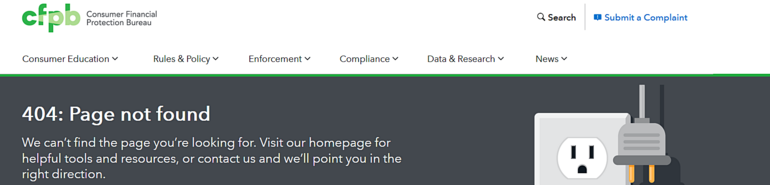
Screenshot of what appeared Monday on CFPB's website.
Stverak said it will be interesting to watch all this play out.

Jason Stverak
As CUToday.info reported, last week when Treasury Secretary Scott Bessent was named acting CFPB director, he mandated a suspension of a wide range of activities at the agency. And among those activities halted is the imposing of the $5 OD cap for financial institutions over $10 billion in assets. And then Vought, who stepped in for Bessent, notified the Federal Reserve the CFPB will not be taking its next draw of unappropriated funding because it is not ‘reasonably necessary’ to carry out its duties. In addition to many of Vought’s moves, the CFPB has been ordered to cease all supervision and examination activity and cease all stakeholder engagement. Bureau employes have been sent home and the agency’s website, apparently, has been shut down.
Not The End
“This is not the end of this,” Stverak said. “I'm going to call it a marathon, because this is a very large and impactful agency that is very much supported by the Democrats, both in the House and the Senate—and especially by Senate Banking Committee Ranking Member Elizabeth Warren. This is going to take a while and we will likely see some of these issues ending up in court.”
Stverak said many people are just waiting for some clarity.
“Hopefully that comes out in the next 24 to 72 hours so that credit unions and all financial institutions know what rules and regulations are in place, so they can serve members and their customers without worrying about crossing into some regulatory gray zone they can get into trouble with at no fault of their own,” he said.
America’s Credit Unions Chief Advocacy Officer Carrie Hunt emphasized it is never good when no rules of the road exist.
“And not understanding what the rule of law is,” she said. “This creates so much uncertainty that I think ultimately it could lead paralysis…Having certainty is incredibly important, and it's important for our financial markets. It's important for our financial institutions to understand what they need to do on a daily basis. There is certainly a lot up in the air relative to the CFPB.”
Dodd-Frank Still In Effect

Carrie Hunt
Hunt reminded Dodd-Frank rules are still in effect.
“So, all of the consumer laws that the credit unions have to comply with and follow. Even if the CFPB were closed, that does not mean credit unions don't have to comply with consumer laws, as we know,” said Hunt, reminding that NCUA examines CUs for compliance to consumer laws. “But having this much uncertainly is a concern to us at America's Credit Unions. Clearly, our members need to know the rules of the road.”
Hunt added ACU has been clear about changes being needed at the CFPB, such as changing the agency’s funding process and moving to a commission rather than a single-director structure.
Brandy Bruyere, partner at Honigman, LLP, noted that much of Dodd-Frank can be enforced by state attorneys general.
“Rohit Chopra and the then-general counsel of the CFPB published a law journal article about this shortly before the change in administration,” she said. “The Bureau also put out a roadmap of how states could improve their laws to protect consumers. Meanwhile, many of the regulations that the CFPB is tasked with enforcing have a civil liability provision allowing consumers to sue. This includes the Truth in Lending Act/Regulation Z and Electronic Funds Transfer Act/Regulation E.”
In other words, Bruyere said, a shuttered CFPB does not mean credit unions are free to just not follow these laws.
Enforcement Through Other Channels

Brandy Bruyere
“As they can be enforced through other channels,” she said. “Unless the CFPB is going to pick up its rule-writing pens to deregulate, requirements will remain as they are and noncompliance would create litigation risk and possible state-level enforcement in some jurisdictions.”
Bruyere said some states may step in and implement their own laws/regulations to strengthen consumer protections with financial services, should the CFPB cease to function from an enforcement perspective.
“The banking regulators and NCUA will still have examination authority to review for compliance and address these risks from a safety and soundness perspective,” she explained. “Finally, federal regulators can look back several years for compliance violations, so, current noncompliance can come back to impact you later.”
News outlets are reporting the CFPB employees union has filed suit asking a court to find the ordered freeze on supervision and enforcement work is unlawful, and enjoin Vought from other attempts to stop this kind of work.
“So, this will continue to develop,” Bruyere said.