

By Ray Birch
HARRISBURG, Penn.—One CU recently found a way to stop a card cracking ring from targeting its members—it engaged in a sting operation with local police to capture two of the crooks.
Pennsylvania State Employees CU worked with the Penbrook (Pennsylvania) Police Department on the sting that landed Jermaine Carr, 21, and
Antwaine Tindal, 20, in jail. Before they were caught, the crooks had allegedly worked with six PSECU members to collect more than $22,000.
But it was the sixth member the crooks enlisted who allegedly confessed to working with the criminals, leading to the sting and the arrests.
PSECU CEO Greg Smith explained that the credit union had recently become aware of five suspicious stolen card reports from members. Smith said the $4.8-billion CU suspected the cases might be card cracking.
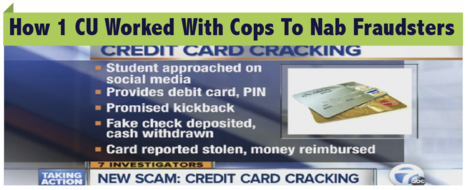
“Card cracking” is a ruse that fools young adults into handing over debit card numbers, including their PIN numbers, as part of an easy-money scheme. The criminals typically contact the young adult via social media, ask if they can use the person’s account to cash a check, and then promise the victim a cut of the money they deposit. However, the fraudster deposits only fake checks and then quickly drains the victim’s account.
Member Confesses
In the case of the sixth member who ended up working with PSECU to catch the thieves, Carr allegedly told a woman he worked for an "international transfer company" called HiFX, and that if she allowed him to place a check for $7,000 into her PSECU account, he would pay her $4,000. After exchanging text messages, the woman eventually sent Carr the numbers on her PSECU debit card and her PIN number. Carr allegedly then deposited $3,400 into her account with a check. Carr then allegedly withdrew money and purchased money orders totaling $5990.59 without the member’s permission.
When the member contacted the credit union about the incident, she lied and said her card had been stolen, Smith explained. She filed a lost card report seeking reimbursement for the theft.
Smith said what took place is a classic case of card cracking, where fraudsters use Facebook to recruit account holders to become part of the scheme. Smith said that when the credit union spoke with this sixth member, they discussed the possibility the member may have given the crooks her card data.
“That led to her eventually breaking down and admitting to being a part of the scam,” said Smith. “That’s when we approached the police about the last incident and the five others we suspected were part of this card cracking ring. The police then asked us if we wanted to set up a sting.”
Facebook Post
The member explained to PSECU and police that she had contacted the crooks via a Facebook ad that asked if people wanted to make money. Smith said the police, posing as a PSECU member, answered the ad.
“Police then set up a rendezvous at a local restaurant,” explained Smith.
Both Carr and Tindale are alleged to have arrived at the restaurant as scheduled, but quickly drove away, Smith explained.
“I think they may have spotted a police car nearby and got spooked,” Smith said.
Authorities pulled the car over, but after briefly stopping the alleged thieves, they sped off. A chase ensued and the alleged fraudsters eventually crashed their car into another vehicle and then ran on foot. They were apprehended shortly afterward.
Losses from the accounts totaled $22,367.99.
Smith acknowledged that PSECU views these members as willing participants in a scam, more so than victims.

Greg Smith, PSECU
Kicked Out Of CU
Often members who participate in card cracking scams are expelled from PSECU, and sometimes prosecuted, Smith explained.
“If the member does not repay the stolen money, PSECU must use other efforts to collect the funds,” said Smith, who noted that the credit unions will pursue reimbursement from the member through law enforcement and if necessary through the legal system. “We take a very dim view of members stealing from other members.”
Smith believes that card cracking rings target CUs that serve college campuses—PSECU works closely with 30 schools in Pennsylvania—as students often are looking for ways to make fast money. He said card cracking rings also like FIs that have same-day funds availability policies.
“And we are not going to change our funds availability policies because of these crooks,” said Smith. “As do many credit unions, we have members who live paycheck to paycheck. It would be unfair to the rest of our 430,000-plus members to make our funds availability policies more restrictive. They should not have to pay for the sins of a few.”
What credit unions can do, insisted Smith, is communicate more effectively about these card cracking instances, both to members and to other credit unions.
“No credit union likes to admit they have been taken advantage of, but the more credit unions are made aware of these crimes, the better we all will be at stopping them,” said Smith.
Educate Members
Educating members about the crime is even more important, stressed Smith.
“We write about card cracking in almost every one of our newsletters,” said Smith. “That information is also on our website. We tell members how the scam works and to be wary of easy-money offers. We also let them know that if members willingly turn over their card credentials to thieves, that they are party to the crime. The best way to defeat these fraudsters is to make your members aware of these kinds of crimes.”
Smith suspects that the latest card cracking efforts are driven from a fraud ring operating out of New York City. Tindale and Carr are from New York, court records indicate. PSECU has had a few bouts with card cracking rings in recent years, acknowledged Smith, who does not think this crime is subsiding. CUToday.info recently reported that a security expert said card cracking has actually picked up in the last few months.
Smith does not disagree.
“I can certainly tell you that from what we have seen that this type of crime is not slowing down,” he said.