

Editor’s Note: Aug. 7, 2023 marks the 25-year anniversary of a two-year battle in Congress to get the Credit Union Membership Act not just introduced, but passed. It was a historic fight that led to an even more historic change for America’s credit unions, which were deeply threatened by banker lawsuits and court decisions that had gone against FCUs and how NCUA had interpreted field of membership rules.
To mark the event a quarter-century later, CUToday.info is publishing a week of coverage featuring new reporting as well as a synopsis of reporting originally published as part of the 20th anniversary in which those close to that fight shared their recollections of the time and their insights into how it changed credit unions.
WASHINGTON–Twenty-five years ago this week the world for credit unions in the United States changed in a fundamental and existential way.
On Aug. 7, 1998, President Bill Clinton signed into law the Credit Union Membership Access Act—better known as HR 1151--the culmination of the most intense advocacy effort in the history of America’s federal credit unions—with plenty of support from state charters, as well--which just two years earlier were facing the very real possibility of being unable to expand their fields of membership and perhaps even expel some members.
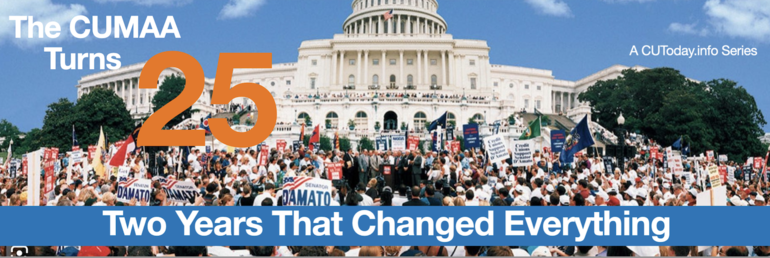
The passage of the bill was no slam dunk, as credit unions overcame an underfunded and disorganized effort at its beginnings, while the legislation itself would get out of a House Committee by just one vote.
The president’s signature marked the end of eight years of lawsuits that included a stunning loss in the Supreme Court, and a final two years of hard work, desperation, and intense grassroots and member engagement, all combined with a level of creativity and effort unlike anything that had ever been experienced in the U.S. credit union community. And it marked the beginning of a completely new, foreign and often uncomfortable operating landscape, embraced by some CUs and pushed away by others.
A Week of Highlights
This week CUToday.info will feature highlights, interviews, recollections and more from the week that changed credit unions forever.
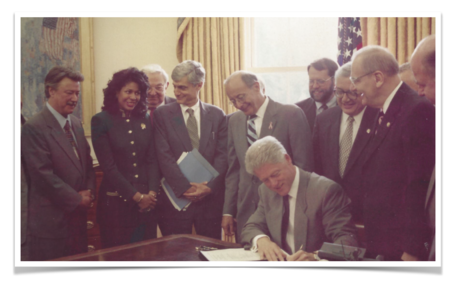
President Clinton signs HR 1151 into law on Aug. 7, 1998.
During a formal signing ceremony inside the Oval Office, surrounded by supportive members of Congress and the administration, as well as a select group of credit union leaders, Clinton signed a bill that for everything else it included—including some banker-inserted language credit unions were forced to swallow and which would come back to haunt–-really all came down to a single letter: “s.”
And it had all begun with a small town banker just eight years earlier who had no idea where it would all lead.
A Banker Files Suit
In 1990, the then president of First National Bank & Trust in North Carolina, Jim Culbertson, filed a lawsuit against what was then called AT&T Family FCU (now Truliant FCU) alleging it had violated the Federal Credit Union Act by expanding to serve non-AT&T-related businesses and opening a branch in Asheboro, N.C. Eventually, the state bankers association, several other banks and the American Bankers Association signed on as plaintiffs, and NCUA replaced the credit union as the defendant.
Assuming they would ultimately prevail in the courts, the nation’s credit unions were slow to respond and almost dismissive, initially downplaying the threat even as court dockets in other states began to see similar suits filed by bankers, while some state regulators moved to put similar limits on growth by state charters as they waited for the legal issues to be settled.
Winding Through Courts
What became known as the AT&T Family case worked its way through the courts for eight years before the Supreme Court stunned credit unions by announcing on Feb. 25, 1998 that it had ruled 5-4 against NCUA–and credit unions–on the issue of field of membership.
By coincidence, CUNA was hosting its GAC at the time of the court decision, and its announcement stunned and silenced a huge GAC crowd, with many responding in fear and even anger that credit unions were about to see their end.
Marc Schaefer, the now retired CEO of Truliant FCU, shared an excellent recollection of events of the time with CUToday.info here.
What the Court Said
The Supreme Court majority opinion, written by Justice Clarence Thomas, found that in 1982 the NCUA had misinterpreted Section 109 of the Federal Credit Union Act.
Section 109 stated that ''Federal credit union membership shall be limited to groups having a common bond of occupation or association, or to groups within a well-defined neighborhood, community, or rural district.''
Thomas had been joined in his opinion by Chief Justice William Rehnquist and justices Anthony Kennedy, Ruth Bader Ginsberg, and Antonin Scalia.
Months earlier, when credit unions (represented by the Justice Department) had made their arguments before the highest court they had been represented by John Roberts, who today is chief justice.
A Realization
Long before the Supreme Court decision, however, many in credit unions had realized what was ultimately needed was an legislative fix to the Federal Credit Union Act of 1934 that would allow credit unions to serve multiple groups and even communities, evolving from one common “bond” to groups sharing multiple bonds.
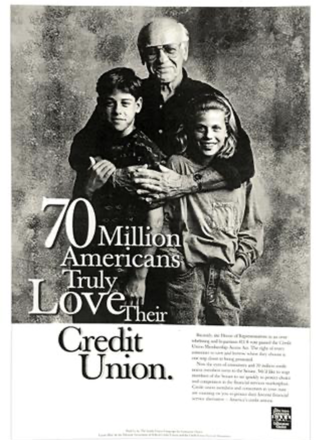
In response, the Credit Union Membership Access Act was formally introduced on March 20, 1997, co-sponsored by Rep. Paul Kanjorski (D-PA) and Steven LaTourette (R-OH). The legislation would get a major boost when then Speaker of the House Newt Gingrich (R-GA), thanks to advocacy work by the then Georgia league, announced before a GAC audience that he would depart from tradition in which Speakers typically do not add their names to bills and would line up in support of HR 1151. A GAC crowd rose to its feet and roared its approval.
Forced to Come Together
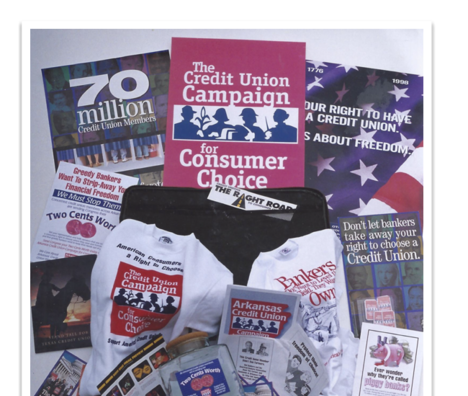
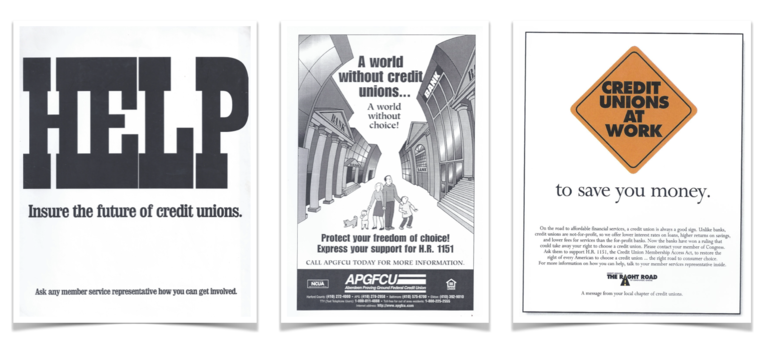
Initially, CUNA and NAFCU pursued their own course with separate initiatives aimed at the public, credit union members and members of Congress, before finally recognizing that the odds against them were already long and to stand any chance of succeeding they would need to work together. That joint effort became known as the Credit Union Campaign for Consumer Choice, chaired by CUNA Mutual’s Larry Blanchard, and it would spawn unprecedented imagination and vision from within the credit union community.
After a landslide vote in Congress (411-8 in the House, 92-6 in the Senate) in favor of HR 1151 (current CUNA CEO Jim Nussle was an Iowa congressman at the time who did not sign on as a co-sponsor but did vote in favor of the legislation), the bill was sent to Clinton to sign. Once the president did so, the Federal Credit Union Act was updated to allow credit unions to consider “groups” of common bonds, and NCUA began to broaden its interpretation of the “fields” credit unions could serve, leading to today’s broad FOMs, some of which are national.
The result would be the wide-open FOMs many credit unions have today and resulting growth, with hundreds of CUs now north of $1 billion in assets.
Gathered in the Oval Office
Gathered in the Oval Office a quarter century ago to watch the president sign the bill were, among others:
- Dan Mica. The former member of Congress was CEO of CUNA from 1996-2011.
- Carol Aranjo. In 1998, Aranjo was CEO of D. Edward Wells Credit Union in Massachusetts and active in the National Federation of CDCUs. Ten years later Aranjo was sentenced to four-and-a-half-years in prison for embezzlement and other charges. The credit union had to be liquidated.
- Edward “Buck” Levins. Levins was CEO of Robins FCU in Georgia and had been active in the Campaign for Consumer Choice, where he did significant fundraising. CUNA named its Buck Levins Award in his honor to recognize those whose efforts in political advocacy have been deemed extraordinary.
- Yolanda Wheat, a member of the NCUA board from 1996-2001.
- Rep. John LaFalce (D-NY), who was the ranking member of the House Financial Services Committee. He served in Congress from 1975-2003.
- Robert Rubin. Rubin was Treasury secretary under Clinton from 1995-1999.
- Richard Carnell. Carnell was assistant secretary of the Treasury for Financial Institutions from 1993-1999. Carnell was reportedly the force for getting the 7% capital requirement–also known as Prompt Corrective Action (PCA)–inserted into HR 1151 as a condition for getting the Administration to support the bill. The bankers had pushed for the PCA provisions, as well as the 12.25% cap on credit union member business loans that would haunt CUs in the decades to follow.
The ste
- Rep. George Brown, Jr. (D-CA). Brown was a strong credit union supporter in Congress. He died just a year later in July of 1999.
- Rep. Bruce Vento (D-MN). Vento was a key supporter of credit unions who served on the House Financial Services. Vento served in Congress from 1977 until his death in 2000.
- Rep. Jim Leach. A three-decade member of Congress as a Republican from Iowa, Leach was a strong credit union proponent who chaired the House Committee on Banking and Financial Services from 1995–2001. He lost his bid for re-election in 1996.
- Sen. Alfonse D’Amato. A Democratic senator from New York from 1981-1999, D’Amato was a key player for credit unions in helping to shepherd the legislation through Congress.
- Rep. Steven Latourette and Rep. Paul Kanjorski. LaTourette, a Republican from Northern Ohio in Congress from 1995-2013, and Kanjorksi, a Democrat representing Pennsylvania from 1985-2011, were instrumental in passage of the Credit Union Membership Access Act. LaTourette and Kanjorski were co-sponsors on the bill in Congress and were active in recruiting others to join them as co-sponsors. Both representatives appeared at numerous credit union events in the run-up to the vote on the bill. Both Kanjorski and LaTourette were honored with the Herb Wegner Award from the National Credit Union Foundation in 1998. LaTourette died in 2016.
- Jim Guretzky. Guretzky was the chair of NAFCU and president of SAC FCU (now Cobalt CU) in Omaha, Neb.
- Dennis Dollar. A member of the NCUA board from 1997-2004, Dollar served as chairman for the final three years of his term. Today he leads Dollar Associates in Birmingham, Ala.
- Norm D’Amours. NCUA Chairman from 1993 to 2000, D’Amours had served as a Democrat in the House of Representatives representing New Hampshire from 1975-1985.
- Larry Blanchard. Larry Blanchard had been brought in from CUNA Mutual Group to lead the joint CUNA/NAFCU Campaign for Consumer Choice.
- Ken Robinson. The president of NAFCU from 1984 until retiring in 2000, the former Marine Corps Major General died in January of 2016.
- Tom Griffiths of the Iowa CU League.
Profiles of Those Who Were There
CUToday.info had earlier published profiles of many of the key players in the fight to pass HR 1151, including their memories of the fight and some interesting insights and experiences. The individuals profiled include: