


Michael Moebs, Moebs $ervices
LAKE FOREST, Ill.—When it comes to offering prepaid cards, credit unions are ahead of banks.
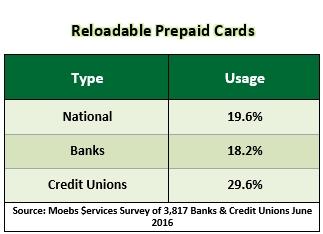
A new study from Moebs $ervices shows that 29.6% of CUs offer reloadable prepaid, compared with only 18.2% of banks.
The appeal of prepaid reloadable is growing quickly among consumers who see the product as a means to replace checking accounts, avoid fees like overdrafts, and protect larger deposits from fraud.
“Those leading the reloadable prepaid card bandwagon are credit unions, Walmart, AMEX, and Chase,” noted Michael Moebs, economist and CEO of Moebs $ervices, referring to data from a prepaid study of more than 3,800 banks and credit unions, which Moebs said is the largest-ever prepaid report.
Who's Performing?
The Moebs study shows that Walmart, AMEX and Chase are “outperforming their competition in order to lead the market,” Moebs said. “In each case these large issuers have different goals. Walmart wants a reduction in the interchange they pay others and use reloadable prepaid to do this. AMEX needs more interchange to offset the loss of Costco and travelers check business. Chase uses reloadable prepaid for compliance purposes to show regulators they do go to the underbanked and unbanked, plus they receive interchange.”
Moebs pointed out that reloadable prepaid is not just a service for the medium-size and large credit unions.
“Interestingly, when you break the credit unions up by asset size, even the smallest group offers reloadable prepaid—21.6% of the time,” he said.
Looking only at banks, the larger institutions are in the prepaid game more often.
“The larger banks get the more they offer a reloadable prepaid,” said Moebs. “Financial institutions over $50 billion in assets offer a reloadable prepaid card 34.5% of the time. Whereas, the smaller banks offer them only 15.5% of the time.”
Leading Prepaid Cities
Geographically, the Midwest leads in offering reloadable prepaid at 26.1%, with the East offering them the least at only 9.7%. Breaking down the data by market size, small cities and rural areas lead at 21.3% and 21.2%, respectively. Large cities, surprisingly said Moebs, only offer reloadable prepaid 6.6% of the time, with Minneapolis and St. Louis leading the way.
The main advantage to FIs in offering the reloadable prepaid, said Moebs, is the interchange revenue that can be generated. In addition to the income potential, reloadable prepaid cards typically can be offered and maintained with a lower expense structure and lower risk costs, he said.
“For the consumer, having no overdrafts is a reassuring feature and a valuable alternative to traditional checking,” said Moebs. “The reloadable prepaid card reaches those consumers who do not want a traditional checking account or worry of overdrawing and paying the penalty fees. Students and the underbanked are the big users of reloadable prepaid,” according to Moebs.
The Consumer Financial Protection Bureau has proposed new rules on the reloadable prepaid card under the Electronic Fund Transfer Act (Reg E) and the Truth-In-Lending Act (Reg Z).
“While much of the proposed rule extends comprehensive protections from Reg E to reloadable prepaid cards, the chief element is moving reloadable prepaid overdrafts from Truth-In-Savings to Truth-In-Lending,” said Moebs. “As the CFPB promotes, the majority of financial institutions do not allow overdrafts on the reloadable prepaid card to avoid the rigorous process of conforming to TIL.”
Prepaid's Future
Reloadable prepaid has reached just over 11 billion in transaction volume.
“This is predicted to rise about 70%, or over 19 billion in volume, by 2020,” said Moebs. “The reloadable prepaid card transaction volume is a key piece to the future of checking accounts.”