

LAS VEGAS–Executives from some of the largest banks in the country have offered credit unions insights into their thinking around what’s ahead in fintech, how they choose to invest and where, what’s really the hardest part of implementation (it’s not the technology), and why fintech is “on sale right now.”
The viewpoints were shared during the Fintech Meetup event here, which has attracted several thousand people (including credit unions) from more than a thousand companies to discuss all things fintech.
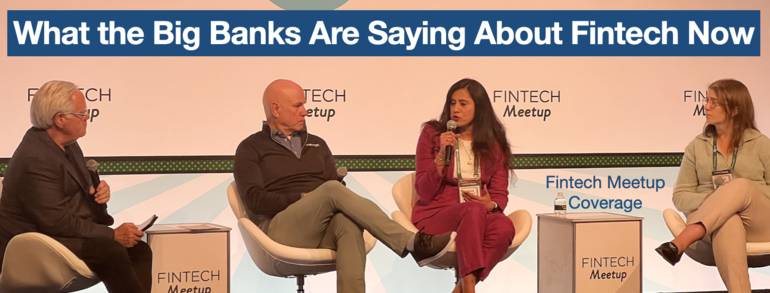
Participating in a Q&A on what they are doing and have planned were Kate Luft, head of segments and products--U.S. retail bank with Citi; Lipsa Goswamy, CIO and head of consumer banking and payments technology with Wells Fargo; and Dion Lisle, director of corporate ventures with Huntington National Bank. The session was moderated by Jim Marous of the Financial Brand.
Here is some of what the bank executives had to say, including tips and strategies from which credit union leaders might benefit.
Marous: Everyone is attempting to digitally transform to catch up to customer expectations. Every organization seems to have a major mission with its partnerships. Why are you building these?
Luft: We look to answer the question of where can we drive value for clients. That is our biggest mission in delivering with excellence. In thinking about partnership, it’s about how to you drive efficiencies, improve the onboarding process, protect from fraud, for example. It’s about can we partner to do things that are more complementary to our product offering where we are not the strongest provide, which is about value.
Goswamy: It’s about building capabilities out for our customers, thinking about their future needs, thinking about what financial tools we can provide customers.
Lipsa Goswamy
Lisle: I will admit I was a little cynical at first about our bank’s ‘people first’ message, but that is what we want to be—a people-powered digital bank. That is our tagine and it is what we work toward.
Marous: A lot of organizations use fintech firms as an innovation arm. As you look to partner, what gaps are you looking to fill?
Lisle. We look at our capabilities map. We want to plug the holes where we are not capable. The first thing I did at the bank was a payments acquisition. We didn’t have the expertise in-house; we had to acquire it. Sometimes we partner, sometimes we evaluate and walk away when the culture doesn’t fit.
Marous: Most organizations are trying to implement something that might take too long. Banking traditionally isn’t the fastest to go from shopping for a vendor to finding the vendor to collaborating. How fast does Wells implement and what do you do to speed up?
Goswamy: When we are working with fintech partners we are looking for capabilities. There are many fintechs we invest in, as well. So, we are somewhat more intimate and familiar with what they bring to the table. That definitely helps. One example is how we are reimagining how we think about identify verification, which is something that is always evolving.
Partnering with fintechs that help us with that capability has been a prime example. We have been with them from the start.
It can take anywhere from six months to a year. We look at capabilities. The partners that are more conscious to the things we are looking for in risk and compliance, security and scalability, that helps us to move faster.
Marous: When you implement a new idea, where does that partnership originate? With the product organization? From the bottom up?
Luft: At Citi, it comes from the front line and from the product organization. We have capabilities on our mobile application for employees called Tell Us, so they can give us ideas. We work with our venture arm, our branch teams, our digital teams, and really take a step back to look at what are the problems we are trying to solve.
We look for the opportunities that we shouldn’t be building ourselves. We listen and apply product roadmap and listen to client needs. But it starts with everyone who interacts with our clients.
Marous: From this event alone we know there are thousands upon thousands of partners to potentially collaborate with. How do you narrow that down?
Luft: For us there is such a such collaboration with our venture partners. As a larger institution, scale is important for us. (The potential partner doesn’t) have to have scale right now, but scalability is really important. We have 25 million clients who interact with Citi alone just digitally. It does sometimes take out players from the consideration set. We will partner with our VC arm and say, ‘They have a great idea. How do we invest in them and partner early and help scale?’
Dion Lisle at Fintech Meetup
Marous: Who is around the table at the front end to make sure the implementation goes as planned?
Lisle: One thing we look at with fintechs is architecture. Is your system capable of connecting with ours? We’re not agile yet but we’re working toward it. We have technology at the table, of course, but we start with the business unit and it’s always driven by a business need.
What gap are they trying to fill? From that we look then at what are the steps. How do you do it faster? You don’t. I prefer compliance not be at the table, but we try to include them. About 72 hours ago I would have said no to having compliance at the table, but something last weekend changed my mind. They are definitely partners.
Marous: Where does compliance fit at Wells Fargo and who is at your table.
Goswamy: For us, we get risk and compliance involved at the start. Otherwise, we are dealing with a lot of cycles where we are answering questions and going back and forth. Getting compliance involved has helped to move things faster. We may go slower upfront, but it helps us to move faster. So, it’s slow to go fast.
Marous: When implementing a digital solution from a third party, many times it’s a concern, and it’s mostly unsaid, that this solution may either change or replace my position. That’s the reality. As bankers we’re not really good in that change mentality. How do you make it so these people realize they are going to be part of the solution, no matter what?
Goswamy: Being a technologist, there is always the age-old question of buy vs. build and it’s a healthy debate. But we have to realize we have core capabilities and we have areas where we need help.
To me, it’s about the leadership you have at that table and the culture you bring. If you have a culture of curiosity and answering the why’s, that helps. We’re not going to take six months to build something that already exists. As long as people are not insecure about their jobs and willing to take a step forward, there is always something new in the marketplace that has to be learned.
I think it also gives team members the ability to learn and build skillsets for their own resumes. I am happy if they are more skilled than they were yesterday. It’s about driving that kind of culture in the environment.
Lisle: Has anyone ever done an RPA project and not had a reduction in headcount as a result? I think you need to address it head on. We’re going to do an RPA and some of you aren’t going to survive it.
Luft: There are some things that if you ask our front line they don’t want to do. Things that are not automated and that don’t add value, such as KYC. We have introduced new roles in the branches by taking out some of the inefficient processes in the branch.
Marous: How do you manage not messing up this up in the back office?
Luft: I have been at Citi for 15 years and the momentum for simplification and innovation is the strongest I have ever seen it. Where we are on digital deposit acquisition (has changed). Digital deposits will be 30% of our balances. A lot of it has been about simplifying more of our product sets and less around the providers. A lot of it has been how can we make it easier for depositors to access the products? A lot was based on client feedback.
Marous: It’s not all apple pie and roses. There are challenges. We are learning as we go. If there is a challenge in implementing third-party solutions, what is the challenge you continue to try to solve for?
Lisle: The hardest part of innovating is implementation; it’s not the technology. Implementation starts with the contract. That’s the hardest thing to do. The front-end administration, finance, legal. A lot of fintechs come out of meetings wide eyed; they had no idea what they were getting into (in partnering with a bank). The technology is comparatively easy.
Kate Luft at Fintech Meetup
Goswamy: It’s similar. The technology part is secondary to us. It has evolved. It’s not about buzzwords. We all understand where we are headed. What’s really important to us is our expectations for scale, for security.
Luft: Scalability is really important because of all the investment we put in upfront with our partners. We do look for partners not just with scalability, but also with some depth, for where there is potential for deepening that relationship with that partner. What is that next product? What is their roadmap?
Marous: All of this is really hard for midsize organizations. The largest and the smallest are having the easiest time implementing new ideas. As a midsize organization you could have management that’s been together for 30 years, since they were management trainees.
Lisle: Someone asked me once, what would you recommend in any corporate venture? My answer is make sure you have a CEO who gets it and is onboard and who leans in.
Marous: Let’s talk about the elephant in the room. In the last week to 10 days, the marketplace has changed dramatically. What is the impact on innovation in general?
Lisle: From our bank’s perspective, we were encouraged to double-down. We look at it as fintech is on sale right now. Now is a great time to innovate. The smart banks are going to innovate more now than ever.
Goswamy: I see it the same way. Microeconomic events are going to happen. Innovation continues. We do have problems to solve for. I don’t see that going away.
Luft: Ditto. Now is the time more than ever to collaborate and innovate.