

ORLANDO, Fla.–Girls and women who are raised to be “perfect” and who are being held back in their lives and careers as a result, must learn to instead be “brave,” according to one person whose own life and accomplishments are a metaphor for the success to be had in taking on that difficult transition.
Reshma Saujani shared with women (and men) meeting here three steps they can take to become brave, even if the culture surrounding them and their life experiences discourage taking any of the steps.
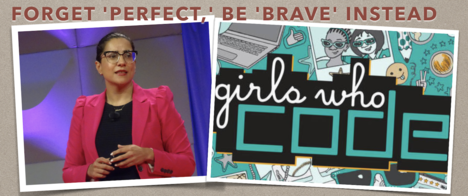
Saujani is the founder of Girls Who Code, which she launched in 2012 to teach girls from third through 12thgrade computer programming, robotics and web design. The goal is to increase the number of women in computer science—a number that has actually been shrinking—and it includes after-school clubs, summer immersion programs and other initiatives. Over the past 12 years more than 185,000 girls have participated in Girls Who Code, including 35,000 who have now graduated from college with computer science degrees.
And it’s all come about only after Saujani put perfection aside in favor of bravery.
Saujani, who admitted she wasn’t particularly gifted at math as a child and does not know how to code herself, acknowledged before CUNA’s America’s Credit Union Conference here she may seem to be the most unlikely of people to launch a program around computer coding skills. And yet she stressed to her audience that is exactly her point when it comes to the culture around the aspirations of girls and women–it requires “bravery” to make such a leap, even as subtle and not so subtle signals in American culture discourage females from ever becoming brave.
The Lesson from Parents
The daughter of refugees who arrived from India in 1973 as trained engineers, the family arrived in Chicago in January unprepared for winter but prepared to take on the challenges. Neither parent found work as engineers. Instead, her father would find work as a machinist, while her mother sold cosmetics.
“Every night, no matter how tired he was, my father would set me on his lap and read to me about Dr. King, Mahatma Gandi, Eleanor Roosevelt,” said Saujani. “I knew from the time I was a little girl what I wanted to do with my life, and that was to change the country.”
Encouraged by her father to pursue one of three careers–doctor, lawyer, engineer–in life in order to get ahead, Saujani dutifully attended graduate school and then law school, becoming an attorney and picking up $300,000 in student debt in the process.
She moved to New York and spent 10 years working in financial services –“but not at a credit union, so the opposite of public service,” she joked.
“It was a job I hated and life I didn’t want,” Saujani related. “I was miserable. A friend of mine said, ‘Just quit.’ I thought, ‘Wow, I can do this. But instead of going to get a real job I decided I was going to be a politician.”
Saujani entered the New York primary as a Democrat and the first Indian-American woman to run for Congress, challenging 18-year incumbent Rep. Carolyn Maloney. She was trounced, spending $1.4-million to get 1,200 votes. Saujani described herself at the time as both lost and broke.
‘It Pissed Me Off’
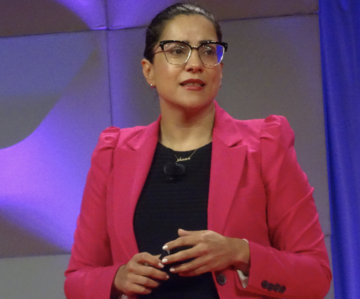
Reshma Saujani speaking to CUNA's ACUC in Orlando.
“I was humiliated. I had pissed off everyone in the Democratic establishment for not waiting my turn, and I had no contingency plan,” she said. “When I woke up the next morning, the first thing I thought was, ‘Oh my God, I’m not broken.’ I had thought for so long that if I tried something and it didn’t work out, it would literally break me. It was that revelation that gave me the courage to start Girls Who Code.”
Saujani said she had noticed during her campaign that when she toured high school computer labs she saw rooms full of boys without a girl in sight, “and it pissed me off.”
Equally disturbing, she said, was learning that in 1995 the percentage of women in the computing workforce was 37%, while today it’s 25% and by 2025 it will be 22%. It’s a trend that’s occurring even though technology’s role in everyday life only continues to grow, and employers are desperate for computer engineers.
“What’s the solution to the talent shortage? It’s women,” said Saujani. “The problem is women are not represented in this field, yet the world’s first programmer was a woman. Technology is changing everything about how we live and work, but women are not included. It’s a huge problem for our economy and for our families.”
Why the decline in women in computer sciences?
Saujani said the biggest reason is culture, which she said has played a “huge role” in turning girls off to technology.
“What happened in the 1980s that led to the shift is the personal computer,” she said. “Boys got computers to play with. Girls got Barbie Dolls that said, ‘I hate math. Let’s go shopping.’ In the 1980s you saw the birth of the bro-grammer.”
But there’s an even bigger and more harmful issue at play, according to Saujani, and it effects girls and women far beyond just one career path.
Five Million Views
“The other thing that has happened is I believe we raise our girls to be perfect and we raise our boys to be brave,” said Saujani, who shared a video showing how young boys and young girls differ in their response to the same scenario, and shared her observations on the messages sent to boys and girls in a TED Talk that has been viewed more than five-million times and which can be viewed here.
“Because we raise boys to be brave, bravery become second nature. They ask for promotions that aren’t deserved and launch risky startups,” said Saujani. “But girls don’t even try. In striving for perfection, girls don’t try. You see women will only apply for a job if they meet 100% of the qualifications. For men, it’s 60%. Women are twice as likely to suffer from anxiety than men.”
“I think the solution to this is bravery. Bravery is the anecdote to perfection. Bravery is joy,” she told the meeting. “Failing that election gave me the courage to start Girls Who Code on a topic I didn’t have any experience in. Everything should have led me not to start.
A Problem to Solve
Saujani began with 20 girls as part of her upstart program. Now more than 185,000 have participated, 85% of whom go on to major or minor in computer science. Girls Who Code programs take place everywhere from homeless shelters to private schools, she said.

Reshma Saujani during TED Talk.
“This is a problem we can absolutely solve. For me, if I didn't learn how to be brave, not perfect, I would hot have had the courage to start this organization,” Saujani said. “What I have seen is the power of bravery to make change. I see it in my students every day.
“I believe the girls of America will save us, will lead us, will heal us,” she continued. “If we want more compassion and humanity in our society, we not only have to teach girls to code, we have to teach them to be brave, not perfect. Everyone has a role to play.”
Saujani said culture must change its messages to young girls that they can’t do certain things and can’t innovate. “We have to vigorously fight that,” she said.
Three Steps to Take
To fight the vigorous fight and practice bravery every day, Saujani urged women, especially, to do three things:
1. Practice Imperfection
“For women, you cannot be brave if you’re tired. You have to put yourself first, not last. That has to change,” Saujani said. “Bravery is like a muscle; you have to exercise it. And it’s like weight loss; you will fall off the wagon. For parents with daughters, let them tinker. When the toilet is broken, take them to fix it. If they suck at gymnastics, don’t pull them out and put them into something else, let them suck at gymnastics. If we are not able to be brave and practice at imperfection, they will just follow us.”
Saujani gave each woman in attendance a task: send an email with a typo in it.
“I know that when you send an email with a mistake, you’ll be thinking, ‘I made a mistake. I’m an idiot. I’m going to be fired.' That will all be in your head in 10 seconds. All this time you spend on perfecting your behavior, it’s a waste of time.”

For the men in attendance, Saujani urged them to think about their roles in encouraging women to achieve perfection. "If you find yourself penalizing women for things you don’t penalize men for, catch yourself,” she recommended.
2. Do Something You Suck At
“Every man in this room does something he sucks at—golf, tennis—but you enjoy it. It’s fun. It’s exhilarating. You’re not judging yourself,” said Saujani. “For most women we don’t do that. We won’t even go to a spinning class until we get in shape, even though the whole point of the class is to get in shape. From about eight years old we very much confuse the things we’re good at with the things we like. We stay in relationships that aren’t good, but they work.”
At age 43, shared Saujani, she began taking surfing lessons even though she isn’t a very good swimmer. “It’s awesome. It’s what it feels like to be alive. We forget what it feels like to be alive and put ourselves into situations where we feel joy,” Saujani said.
3. Just Start
Saujani said the start of Girls Who Code was simple. She bought the URL for $1.99, and then she told people about it, “and before I knew it I had to start the movement.”
“What I would love for everybody in this room to do is to just start,” she said. “Take one step toward your dream or aspiration, and don’t talk yourself out of it. I think we are in this powerful moment right now, as women, as dads, as moms, to really shift and shape things. It means unlearning so many things we have been taught at the youngest of ages.”