

SAN DIEGO–The transformation coming in automobiles—which could even include the elimination of vehicle financing as it’s currently known—should have credit unions giving a lot of thought to a new business model, according to one analyst involved in Google’s development of driverless vehicles.
That transformation, which will be here much sooner than many expect, said Larry Burns, the former corporate VP of R&D at General Motors, could mean credit unions repositioning themselves as “mobility unions.” Or it could mean being shut out of a market that is currently the bread-and-butter of credit union lending.
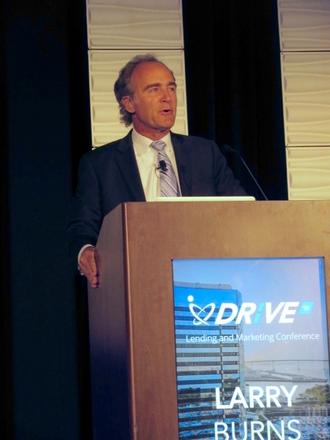
Larry Burns speaking to CU Direct meeting.
Noting that very little really changed in the basic automobile model from the time Karl Benz invented the first gasoline-powered car in 1886 through today, traditional manufacturers and lenders have created an entrenched business model that is ripe for disruption, said Burns in remarks to CU Direct’s DRIVE16 Conference here.
Already, said Burns, debate has begun over whether Millennials and the generations that follow them will have the same love affairs with automobiles as did previous generations. Using his own daughters as an example, he said the answer is pretty clearly that they will not as ride-sharing services grow in popularity and driverless vehicles start to crest the horizon.
The future DNA of automobiles, said Burns, will include electrical drives, electric motors, diverse energy sources, electronic and digital controls, connection and coordination, shared vehicles, driverless vehicles and tailored vehicles.
“It’s a combination of technologies and innovative business models that are converging at the same time. And when you combine all this you really have an opportunity for transformation,” he said.
Burns isn’t just an outside looking in. He was at GM when it partnered with Carnegie Melon University to enter the competition sponsored by Defense Advanced Research Projects Agency (DARPA) competition offering a $2-million prize for a driverless vehicle that could be the first to drive 60 miles in an urban setting with out an accident. His team won that competition, and Google subsequently hired 15 of the engineers involved in the project.
Google, with which Burns has worked since 2010, is now a major player in driverless vehicle development.
“Google now has 1.5 million miles of learning and they are getting very, very close” to introducing a driverless vehicle for the masses, he said. How close? It may be available as early as 2018.
What Vehicles Will Look Like
Those vehicles will be small, perhaps even with two wheels, and far more efficient. Most people will not own vehicles; instead they will simply summon one using an app.
“It allows you to really get at the Achilles heel of the industry, and that is the mass of the vehicle,” said Burns. “Eighty-five percent of the trips we make are one- to two-person trips, but most of us drive around in cars for six to eight people. Seventy-five percent of the trips we make are eight miles or less, but the range of cars is 300 to 400 miles. The point is our cars are really over-specified for the kinds of trips we make.”
All of that brings the market to what Burns called “tailored.”
“I believe the vehicle of the future is going to be something you wear, not drive.”
The historical business model of transportation, of which credit unions are an integral part, has been about selling vehicles, gasoline, insurance and financing. The new model, said Burns, is about selling miles, trips and experiences. The question for credit unions is where do they fit in that model? Many companies, such as Google and Apple as well as the traditional manufacturers, are all racing to carve out a place in that model, and for good reason. As Burns noted, “Americans travel three-trillion miles per year. If you can make one penny per mile, you make $30 billion. So it’s a very, very exciting business opportunity.”
Future of Transportation
The future of transportation will be sorted out in two dimensions, according to Burns:
1. No driver in the loop
2. Driver is still in the loop
“A driverless vehicle cost less than a comparable person-driven vehicle,” suggested Burns. “The parts added might cost less than the parts removed. Tailored vehicles could have less materials and fewer parts than personally owned vehicles and can also be shared.”
The Google vehicles, for instance, have no steering wheel or pedals.
“I think it’s important that you deeply understand what is possible,” Burns told credit unions. “There is new technology, new business models, opportunities and threats. The only people who really know what’s possible are developing the cutting edge technologies. You also have to get in front of the inevitable. This is not going to play out in some nice, tidy way. It’s going to happen, and when it does it’s going to happen like gangbusters.”
Burns cautioned credit unions not to think of this as a “2025 or 2030 journey,” but instead as a “2018 journey.” That means strategies need to be questioned, and perhaps new partners identified, he said.
Mobility Union?
“Can the ‘credit union’ business model apply to a ‘mobility union?’ Could you imagine going into a community and pulling together people who want to invest in a fleet of vehicles they want to share, like gated communities or impoverished communities?” asked Burns. “I think you have skills and experiences that could be really really relevant if you expand beyond the financing experience.”
Ultimately, said Burns, credit unions must apply the Golden Rule of Strategy: “Do unto yourself before others do unto you.”