

By Ray Birch
LAKE FOREST, Ill.—The war for deposits is only going to get tougher this year, one new study is predicting.
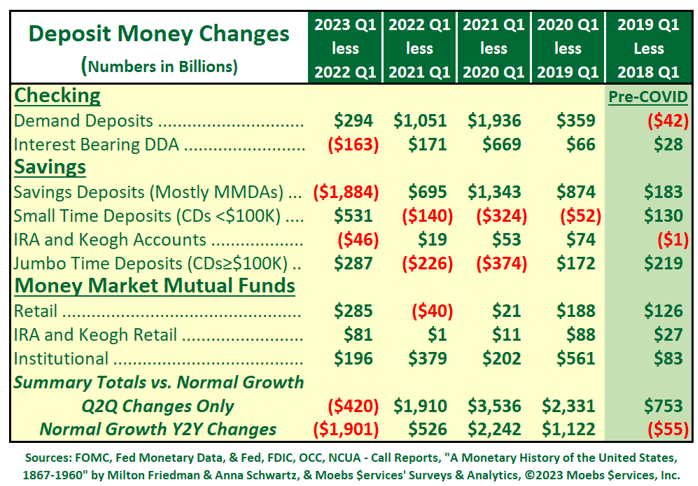
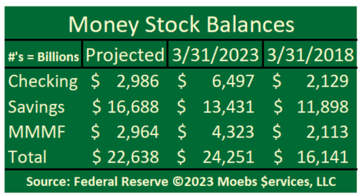
At the end of March, overall deposits within the financial services industry had fallen by $420 billion, year over year, a significant decline approaching what was seen 13 years ago during the last financial crisis, according to data compiled by Moebs $ervices.
“This decline is well above normal and approaches what happened in the Great Recession,” said Michael Moebs, chair and economist at the company.

Moebs said the downward deposit trend requires all financial institutions to pay very close attention to their “survival equity”—and that includes possibly cutting back on lending.
What’s Most Important
“As I stated a month ago, given what is happening with deposits, consumer confidence in banks dipping following the failures, and digital money movement, survival equity is more important than capital,” said Moebs.
Moebs defines survival equity, in simple terms, as the amount of the reserve less losses on investments, the FI has to pay depositors off.
“Taking survival equity and dividing by a common denominator—i.e. assets—is a good measure for people to understand,” Moebs said.
The Fed’s Role
In addition to consumers needing to tap savings to cover rising costs, Moebs said another driver, in part, of the steep deposit decline has been moves by the Federal Reserve to sell more securities, depleting deposits.
“As a result of the banking crisis, savers to investors are seeking higher rates. Money market mutual funds offer the highest rates, thus reducing deposits at banks, credit unions, thrifts, and fintechs,” said Moebs. “With less money available due to Fed sales, bond market yields have soared, driving down the value of financial institution investments and thus shrinking survival equity. The bottom line is FIs cannot gather sufficient deposits without curtailing lending. Any FI with a loan to share ratio above the norm of 73%, and with survival equity of less than 10%, is in a very risky position—and it gets worse as bond yields increase.”
Moebs reminded the Federal Open Market Committee at its last meeting maintained the target range for the federal funds rate at 5% to 5.25%, while continuing the process of significantly reducing securities holdings.
“Fed Chair Powell remarked at a speech in Madrid in June that ‘significant’ means $1.4 trillion sales by the Fed since St. Patrick’s Day in 2022, or $285 billion a quarter for 15 months,” said Moebs. “The Fed reduces money supply by selling securities.”
Checking Sees a Rebound
Meanwhile, for the first time since 2018 checking is returning to normal growth levels with less change between non-interest and interest checking, the Moebs $ervices report shows.
Savings deposits, mainly money market deposit accounts, are falling led by consumers who are spending. Retirement accounts are not a high priority for the consumer or small business, Moebs said, and for the first time CDs have shown significant increases since COVID began.
The overall deposit money winners are money market mutual funds (MMMFs), especially MMMF retail, which rose substantially by yearend, March 31, the stu

Michael Moebs
dy shows.
Why Loans Aren’t Growing
The Fed’s Consumer Credit G19 report released July 10 shows overall outstanding credit steady at $4.78 trillion, or no growth, and the overall flow of funds showing a decrease of $31.5 billion for the first time since Q1 2020.
“This is affirmation loans are not growing due to scarcity of funds as the Fed reduces money supply,” concluded Moebs. “Powell will sell at least $855 billion more securities by yearend 2023 and probably increase rates at least once. The significant impact will be the sale of securities, not interest changes. This will make deposits scarce. FIs cannot expect to keep pace with interest rate increases on deposits without damaging the bottom line. Lending will decline. Recession looms?”