

FARMERS BRANCH, Texas–As Dick Ensweiler retires from the Cornerstone Credit Union League, he does so having traveled one of the greatest distances of anyone ever associated with the movement.
It isn’t physical distance—although there’s been plenty—but instead a journey of knowledge, lessons learned and insights gained.
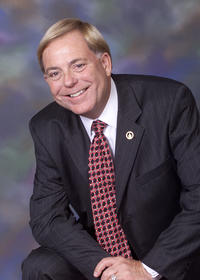
Dick Ensweiler
As the Cornerstone league, which serves credit unions in Texas, Arkansas and Oklahoma, hosts its annual conference this week, it will be introducing a new CEO, Caroline Willard, formerly of CO-OP Financial Services. It will also mark the exit for Ensweiler, who has spent more than 50 years in credit unions, beginning with a job at a place he knew nothing about in Milwaukee, Wis.
“I had no idea what a credit union was,” recalled Ensweiler, referring to a summer job he held while in college at the then State Central Credit Union.
“The CEO said finish college and your military commitment and then come back here and we’ll put together a training program for you and after two years you’ll need to move along,” said Ensweiler. “I did everything: teller, bookkeeper, collector. Later, when Harley Davidson Credit Union was looking for a treasurer/manager, I got the job. And there I learned all about credit unions. I had no idea where all that would lead.”
Although that management trainee job paid “ridiculously below par,” for Ensweiler it has led to some remarkable accomplishments.
Ensweiler would spend three years at Harley Davidson Credit Union, which at the time had just $250,000 and aspired to join what was once considered a mark of a “dream” in credit unions: $1-million in assets. “It was very hands on and I learned a lot,” Ensweiler said. “I was engrossed in it, but my personality is not one to sit behind a desk. I want to get out, I want to lead in a different way.”
That desire would lead him to a field position with the Michigan Credit Union League (which he admits to being reluctant to take because he had just been elected as an officer in the local league chapter, which was a “big deal”) and then to the Minnesota league, where he became CEO, the Illinois league (as CEO), CUNA Mutual Group as SVP of corporate relations and in 1995 to the Texas Credit Union League. The Texas league would eventually merge with leagues in Oklahoma and Arkansas to form the Cornerstone league.
Help in 'Understanding'
“Forty-five years later, I still remember those lessons and why credit unions do what they do,” said Ensweiler. “As a CEO I was looking for help from the league, I was looking for best practices. (CU experience) really, really has helped me. I never just go to a chapter meeting. I always try to get there early and call on a credit union or two and stay afterward and talk to people. All that interaction has really helped me to understand them.”
Over those 45 years Ensweiler has also played a distinct role in sharing lessons, as well. He has been chairman of CUNA, the former U.S. Central, the American Association of Credit Union Leagues, served on the boards of the Credit Union Museum and Credit Union House, and as a trustee for his alma mater, Lakeland College. He earned designations as a Certified Credit Union Executive, Certified Association Executive, and Credit Union Development Educator (CUDE).
He was honored by the World Council of Credit Unions with the WOCCU Ambassador Award in 2008 and Distinguished Service Award in 2015, the Network of Latino Credit Unions and Professionals (NLCUP) with the Leadership & Vision Award in 2010, inducted into the Illinois CU League Hall of Fame in 2007, and named by the National Credit Union Foundation as a 2010 recipient of the Herb Wegner Individual Achievement Award.
Questions & Answers
In a Q&A with CUToday.info, below, Ensweiler shares his thoughts and experiences on trade associations, how expectations have changed, and why being involved with CUs in other countries brings great perspective.
CUToday.info: What does it take to be an association leader?
Ensweiler: That is a process that is not a fit for all that many people. I was speaking with (retired American Airlines CU CEO) John Tippets recently and he said, ‘I know we didn’t always agree, but when we didn’t we still got along.’ If anything helped me it’s my demeanor. I don’t stay PO’d at people. I respect that they come from a different place. It’s easy for me, and not everyone is wired that way.
CUToday.info: How have the expectations credit unions have of their leagues changed?
Ensweiler: When I was a credit union CEO, I was looking for operational advice, for better ways of doing things, for lending forms. That has changed significantly. Credit unions still want training, but they also want help with good public relations, and advocacy. Regulatory and legislative assistance has become huge.”
CUToday.info: How do you learn how to become a lobbyist on behalf of CUs?
Ensweiler: When I became CEO of the Minnesota league, we did not have a lobbyist or a budget for a lobbyist. We were about four miles from the capitol, so I was the lobbyist. I was 30 years old and quite green. There were bills coming up in the legislature, including one allowing share drafts. I was alone on the Hill and I had to learn the lobbying process in a baptism by fire. I had no mentor.
What I learned was you need to think like a legislator. They come from many different backgrounds, and very few from financial institutions and almost no one comes with any credit union experience. There is no way these people can be experts on everything. The role of the lobbyist is to be the trusted source. You don’t bend the truth or disparage the other side. If you do that, when there is legislation that affects you, they know they can come to you and you will be reliable source.
CUToday.info: How have the demands on leagues changed, and can standalone leagues continue to exist?
Ensweiler: The number of credit unions is shrinking, but their expectations of their associations are not. It is more and more difficult to meet all of their needs. There are going to be ways for leagues to be more efficient, and one of those ways is by working together.
I used to have a philosophy that my job as CEO was to serve the member. But that has changed. I have come to understand that my job is to understand what credit unions want and to provide the resources to the front-line people so they can meet their needs. It’s a huge change.
CUToday.info: Can small credit unions continue to exist?
Ensweiler: That is also more and more of a challenge, too. Electronic services are pricy, and yet I still see some small credit unions doing some amazing things. We just had (in the Cornerstone offices) the CEO of a credit union that he has led from $12 million to $21 million in assets. They’ve added more services and are so dynamic. You can do it with the right people in place. I’m very confident that the small credit union can survive, but it must have leadership. My fear is that at many credit unions the board and the management have just become complacent.
CUToday.info: Everywhere you go someone is talking about the need to tell the “credit union story.” What is the CU story?
Ensweiler: I have a saying I like: with every action and interaction a credit union has no other purpose than to serve the member. To serve the member, we have to listen to their stories and, just as importantly, understand what they are saying. It’s not about selling a member a product or meeting weekly goals. Our approach with the public and with legislators then has to be to relate those stories and how we are helping members time after time after time. We have an advantage: for credit unions, it’s not about getting in and out quickly with the member and doing transactions.
CUToday.info: Why have you gotten involved in various World Council initiatives?
Ensweiler: I have had the opportunity to work along people in Mexico, Jamaica, and Brazil. I’ve gotten to see the different cultures. And it really drives home how lucky we are in the U.S. This has been a very, very valuable lesson.
We developed a partnership with Caja Popular Mexicana, which had 333 branches and they weren’t connected electronically. They stayed in touch physically. When we went to Leon, Mexico, to meet with them, they took us to meet the CEO and he asked me about eight questions. The first one was, “Why are you here?” So, I knew there was some sensitivity there. I said, “We can help each other by partnering.” He then asked, “What do you expect to get out of this?” He asked that same question in eight different ways. What he did not want to hear was “I’m from America and I’m here to help.” I said that we thought we could provide some operational assistance, and that we could use their help in reaching out to Hispanics. We focused on the common language that we’re both credit union guys. It really helped to gain perspective.
In October 2016, I spoke to a group of credit unions in Rwanda. Afterward, I talked to the people, and their focus is so different from ours now. Today, CEOs (of U.S. CUs) talk about balance sheets and technology and compliance. But these African credit unions just wanted to focus on helping people. We can’t lose that perspective; we are here for a special reason.
CUToday.info: What are your plans now?
Ensweiler: I’m just coming off some surgery that didn’t go well and left me at home for eight-and-a-half weeks. It was miserable. When I sat home I had no projects. I was extremely bored. What I learned was I’m not going to sit around in retirement. I have three grandchildren, six, eight and 10, who are going to see a lot more of grandpa. (Wife Judy and I) live on a lake and will be doing some more fishing. Our golf games suck, so we’re going to be doing more of that. We are going to travel. I will be part of a team from WOCCU that will be traveling to Ukraine later this year. The one thing I won’t be doing is becoming a consultant and doing planning sessions.