MADISON, Wis.–The leaders of credit union movements in three countries offered insights on what they see as an advantageous business model that cuts costs, improves digital and other services to members, and allows smaller and midsize CUs to provide offerings they otherwise couldn’t.
And even though it’s not a model that is much practiced in the United States, the three proponents suggested the advantages are hard to argue with.

Sharing their experiences with using common branding, back office and technology platforms in which nearly every credit union in their respective countries is on board during a World Council of Credit Unions webinar were Joao Tavares, CEO of Sicredi in Brazil; Pawel Pelc, coordinator of the Regional Credit Union Center in Poland, and Choonsung Daniel Eo, IT Service Support Manager with the National Credit Union Federation of Korea in South Korea.
Here’s a look at what each had to say:
Brazil: ‘National & Local’
In Brazil, where credit unions operate under a strong national brand and centralized umbrella and where CUs are the only financial services provider in some 216 different markets, Tavares said 2020 was a “very important” year as it accelerated Sicredi’s transition to a digital environment.
Joao Tavares speaking to WOCCU webinar.
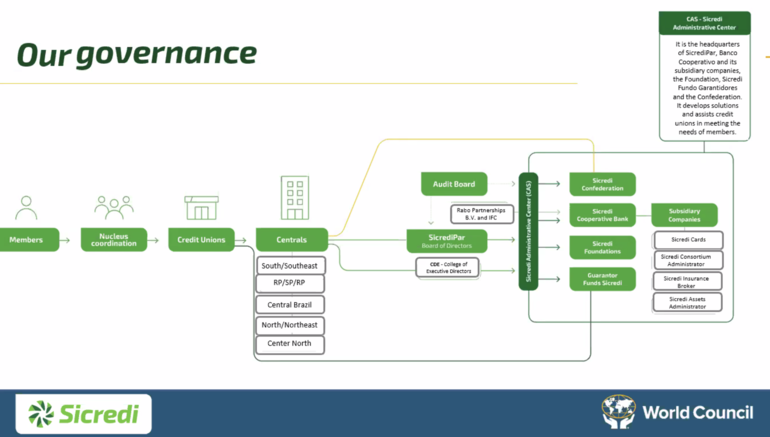
There are 108 credit unions that are part of Sicredi. All use similar office branding as well as common back office services. A theme that underpins its operations is that credit unions are both “national and local,” Tavares explained.
Tavares noted all credit unions in Brazil use the same systems, and all members use the same mobile apps, home banking solutions, etc. Doing so, he said, allows credit unions together to invest in and use solutions that would be very expensive for any single credit union to invest in on its own.
That includes the use of artificial intelligence technology, he added.
Like credit unions in the United States, Tavares related how over a one-week period in 2020 Sicredi CUs transferred nearly 30,000 people out of branches and offices to work-from-home environments, which presented a great challenge to its IT department. The transition was like “war time,” he said.
WhatsApp is Platform
Sicredi uses WhatsApp as the core technology for communicating with its members. Tavares said once employees were working from home and tech and security issues were adequately addressed, the next step was to increase the capacity of its mobile solutions.
“We had to change our model in just one or two weeks,” said Tavares. “The use of our mobile channels increased 40% in the first month of the pandemic. It was a great effort; we had to use new technologies and new ways of doing things. We had to change our call centers and help our members to use our services and Internet banking.”
Tavares emphasized that the pandemic may have changed the world in many ways, but it has not changed the core function of credit unions.
“We understand the environment has changed but our business has not,” he said. “People were very confused over how to deal with their financial institutions. We tried to keep it simple and to help people to understand. The other challenge we faced was to ensure access to our members to the programs the Brazilian government was offering to help people. There were three or four programs focused on helping small and medium-size companies to keep jobs. Sicredi was one of the first FIs to provide access to these kinds of loans. It increased our presence and importance in the medium and small business markets.”
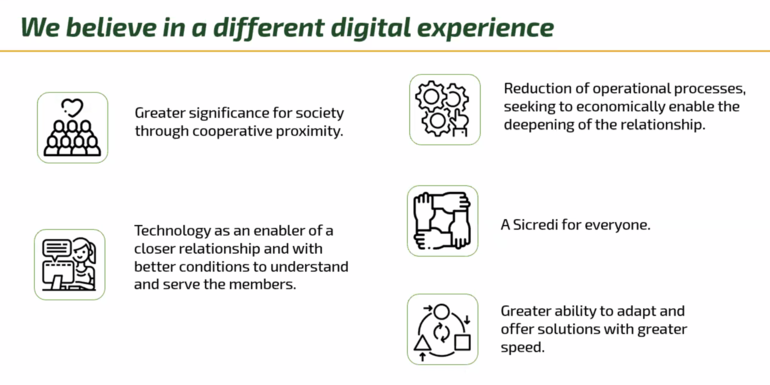
According to Tavares, the “ever-increasing search for convenience” has put a premium on digitization.
“The uniqueness of cooperativism is maintaining proximity while expanding the relationship channels,” said Tavares.
To achieve that, beginning in 2017 Sicredi built its strategy around three pillars, he said: Organizational culture, transformation of processes and digital solutions.
“It is more important to transform our processes than to just utilize the processes,” Tavares said. “We need to use everything the digital world can bring to us to make life easier for our members. We started in 2017; I don’t know when we will finish, because everything has changed.”
Reaching Youth
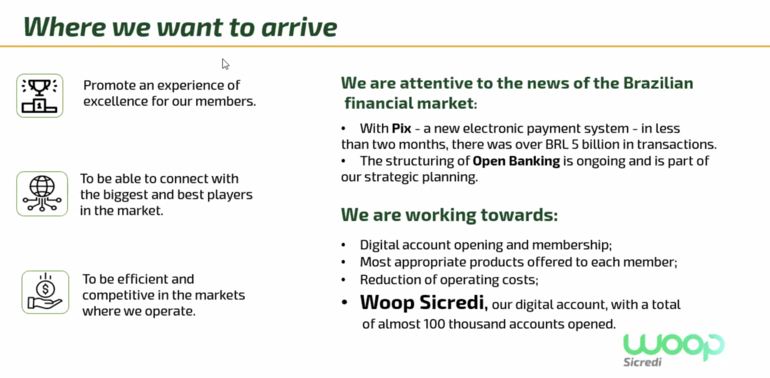
In addition to its other initiatives, Sicredi has also launched a campaign aimed at attracting younger members, including via a new solution called Pix. The initiative is outlined in the graphic, below.
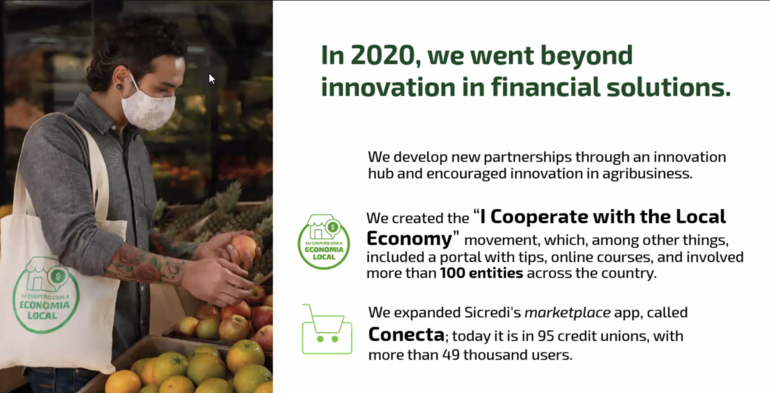
All of Sicredi’s efforts, said Tavares, are about a theme he touched on throughout his remarks: “Our systemic strength is directed towards bringing impactful solutions for local economies.”
Poland: Meeting The Needs of Contemporary Society
Like Brazil, Poland’s relatively new credit union movement—it took root and grew again following the fall of communism—uses a common back office service model.
In Poland’s case, services are offered via the Regional Credit Union Center, which was established with the assistance of the World Council of Credit Unions. The Center is led by Pawel Pelc.
Pawel Pec speaking to WOCCU meeting.
According to Pelc, Poland’s CU system is based on diversified membership with various types of bonds between members and multi-branch organizational structuring offering a wide range of various services.
He said the model is characterized by a high ability of adaptation to changeable market conditions and by economic efficiency.
“It provides answers to the needs of contemporary society,” said Pelc. “Thanks so the standardization of documentation and procedures, consumers’ interest are appropriately protected, and the activities of credit unions are pursued in a unified, safe manner and according of the rule of law.”
Full Range of Offerings
While the country’s movement is only a few decades old, Poland’s CUs provide full range of products, including mortgage lending and insurance services and investment products.
Like Brazil, Poland’s CUs also operate under similar branding, with the credit unions using a common name, Skok, joined by an individual brand name.
According to Pelc, the country’s primary trade group, the National Association of Cooperative Savings & Credit Unions (NASSCU), seeks to:
- Ensure the financial stability of credit unions
- Provide financial support to credit unions from the funds of the stabilization fund
- Provide control over credit unions to ensure the safety of their savings
- Ensure compliance of CU activities with the provisions of the law
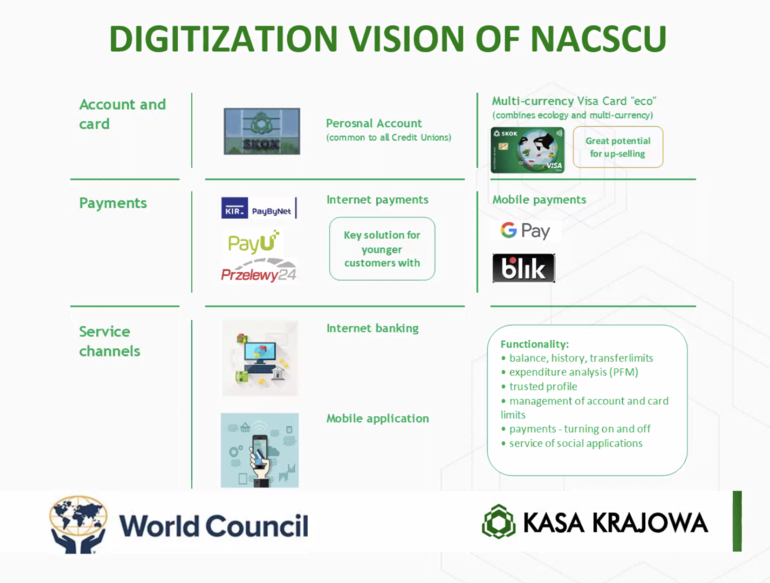
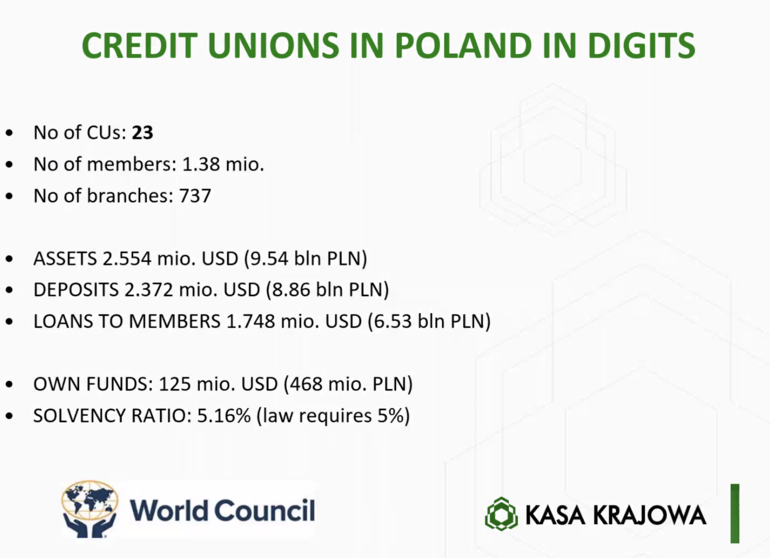
Pelc outlined Poland’s approach to digitization, which is outlined in the graphic below.
Requirements to Participate
From participating in the country’s shared platform, the benefits include, according to Pelc:
- NACSCU is responsible for development of the stands and service and documentation by CUs, as well as the standards for CU IT systems
- NACSCU can be payment agent and credit card issuer for credit union members, but the credit union is not obliged to use NACSCU services
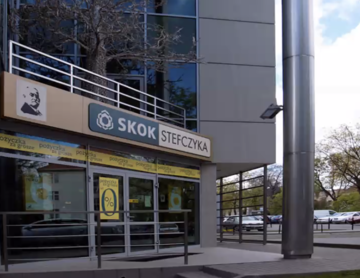
A credit union in Poland.
- Draft agreements related to services offered by NACSCU to credit unions shall be accepted by FSA
- NACSCU has agreements with the National Bank of Poland, National Clearing Chamber, and Visa
- Main IT systems used by CUs are developed especially for credit unions by Aplitt, Ltd.
Shared Services
Services available through the shared platform include mobile banking, Internet banking, membership acquisition, service of workstations, administration of telecommunications and hardware.
The benefits, added Pelc, are the unification of digital tools and services, digital and technological solidarity, lower purchase and service costs, and full access to digital technology for small credit unions.
The Goals
Pelc said NACSCU’s development strategy goals 2020-22 include:
- Digitization and development of electronic services to provide simple and clear financial services
- Revitalization of the idea of credit unions and the cooperative nature of the activity
- Redefining the function of NACSCU to better and more fully meet the expectations addressed by it to the cooperative savings and credit unions.
Korea: ‘Mutual Prosperity for Local Communities’
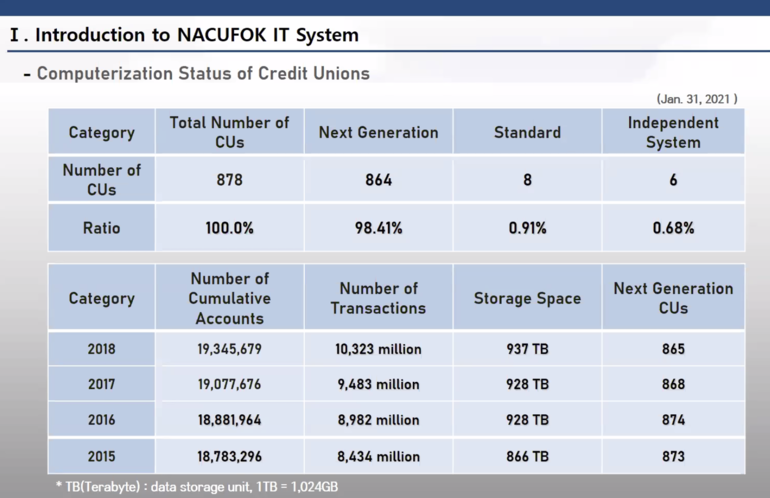
In South Korea, of the country’s 878 credit unions, 98% are running on a next generation core banking system that is managed by the country’s trade association, known by the abbreviation NACUFOK.
Choonsung Daniel Eo, IT service support manager with
NACUFOK, walked his audience through the country’s data processing system, capabilities and facilities, but said the vision is about “creating people-centric ‘Digital Human’ credit unions to enhance the CU membership value and to support sustained improvement in business performance.”
According to Eo, that includes providing user-oriented digital services, building a CU-specific digital solution, and designing a digital transformation that incorporates the characteristics of credit unions by being community based, cooperative, and member centered.
The country has also sought to build out a common solution that is able to respond to changes in the digital environment, such as open banking and the three data acts, while further narrowing the digital gap with other institutions, he said.
Credit unions may pick and choose the services provided by NACUFOK, Eo explained, noting each operates under different circumstances. NACUFOK also handles each CU’s general ledger.
Identifying Marketing Opportunities
One unique aspect of its approach, he said, is that the central association uses financial data collected from each credit union in assembling statistics and identifying marketing opportunities.
Choongsun Daniel Eo speaking to WOCCU meeting.
The linked platform, said Eo, provides both NACUFOK and credit unions the opportunity for mutual aid.
Among the IT services provided are online banking, telebanking, card terminals, mobile banking and other services.
Eo said another advantage of working together cooperatively is credit unions can gather information on the user experience and environment and then add improvements for not just members but also the back office.
Moreover, he said South Korea’s credit unions have been able to build a credit union-specific digital business model for “mutual prosperity with local communities.