

NEW YORK–An economic forecaster with a 96% accuracy rate is predicting a rather mild economic turndown in 2020, before a rebound, another slightly deeper recession in 2023, and then a strong and robust remainder of the decade.
Longer term, it’s basically good news if you’re a Baby Boomer, not so good news if you’re a Millennial or among the generations that follow. And much like real estate, there will be big differences depending on location, with some states in spirals of negative growth from which they are unlikely to emerge, which will affect credit unions.
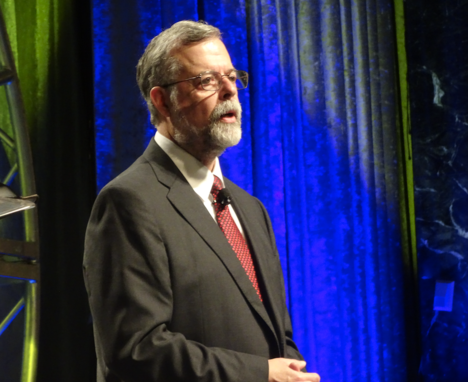
Alan Beaulieu speaking to Finance Council meeting in New York City.
Alan Beaulieu, senior analyst/ president/ principal with the Institute for Trend Research, offered a generally rosy picture of the next decade in remarks to the CUNA Finance Council here. Longer term? Perhaps not so rosy.
“A lot of things are going right,” said Beaulieu. “The whole nation is going to sag, and it will have a noticeable effect as we get into late 2019 and 2020, and then it will be sunshine and roses on the other side.”
Beaulieu said the U.S. economy hit its peak of growth in 2018 and is now in a slow, steady economic decline he predicts will reach its nadir by Q1 of 2020 and perhaps “bleed into Q2. And then we’re going to come out just fine.”
Rate of Change Analysis
Beaulieu is an advocate of using what he calls a “powerful management tool,” the Rate of Change Analysis. Rate of Change Analysis uses both a three-month and 12-month moving total to reveal trend lines. That analysis shows the economy has “slowed dramatically,” said Beaulieu.
The Rate of Change Analysis is affected by four factors, according to Beaulieu: the economy, a specific industry event, a Black Swan event, or leadership made a mistake.
“Rate of Change will allow you to see which it is,” said Beaulieu, noting it also helps reveal a bigger picture. “Picture 2009, a terrible time in the U.S. economy, the world was going to end. But the Rate of Change showed things were going to get better. When you can see the future you can make better decisions.”
Beaulieu told the Finance Council meeting, which is primarily attended by CFOs, the U.S. economy is currently at the top of the business cycle and they should prepare for an increase in nonperforming loans as the economy slows and members have “more difficulty meeting their obligations.”
The Role of Exports & Tariffs
With exports currently 8% of U.S. GDP, a strong dollar has leveled off the growth rate for exports, and President Trump’s tariffs are also affecting markets, which some credit unions will need to especially watch, he said.
How long will tariffs last? “I don’t know,” joked Beaulieu. “They are just a tweet away.”
On the other hand, a credit union serving a membership that benefits from government spending is likely to see continued growth, said Beaulieu.
Looking Out Further
Beaulieu said his firm views the 1920s as a good model for the 2020s. “We are going to see lots of wealth created in the 2020s. You are going to prosper, your businesses are going to prosper,” he said. “It’s going to be a fun decade after all. But as happened in the 1920s, a big recession is coming, and the next one is coming in 2022. It will impact your members. Your delinquencies will skyrocket. And then out the other side and life is going to be kind of fun. Inflation will pick up and we will see increased spreads.
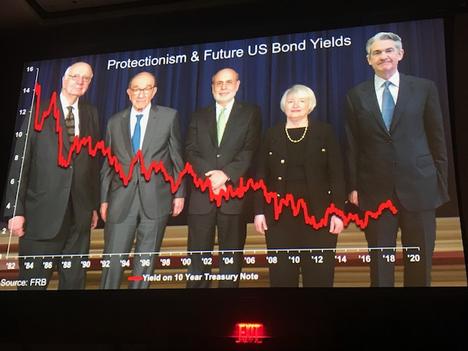
Alan Beaulieu shared chart showing how rates correspond to height of prior and current Fed chairs.
“There will also be a cultural change, as we saw in the 1920s. In the 2020s we’re going to see Millennials leaving the cities and going to suburbia. They are going to want houses and cars. Baby Boomers will lose our economic and political position. Millennials are going to rule. They are going to move into the White House.”
Looking to the latter half of the 2020s, Beaulieu expects to see higher inflation and increased labor costs. “I think you are going to find yourself in the late 2020s in an early 1980s type of scenario in terms of interest rates,” he said. “Overall you are going to like it and you are going to prosper.”
Also in the Forecast
Here are some of Beaulieu’s other predictions and observations:
The Federal Deficit
The Federal Deficit is a time bomb that’s getting little attention, and the attention it is getting from some is wrong. Beaulieu noted interest payments on the deficit this year will amount to $476 billion, and by 2023 the amount spent on interest will be equal to what the U.S. spends on defense. “For any Millennials in the room, this is our gift to you,” said Beaulieu, offering some dark humor. “We are leaving you a huge debt. Baby Boomers need to die. We need a war that is only old people. If a Millennial asks a Baby Boomer how they are doing, the don’t want to hear ‘well.’”
Eventually, said Beaulieu, the deficit will “explode.”
“In the near term you’re going to hear a lot about Modern Monetary Theory, or MMT, being put forth by some. It’s theoretical work and has no basis in reality. MMT says you can print and borrow as much money as you want and it will be fine, don’t worry about it. The problem is in the history of mankind is it’s never worked. If it did, North Korea would be South Korea. The problem is you are devaluing your currency to pay your debt, so investors are going to want to be paid more in interest to invest in your debt. MMT assumes a stupid investor who doesn’t have options. We have $23 trillion in federal debt and eventually it needs to be dealt with.”
The U.S. States
Credit unions in states with declining populations have tough days ahead, according to Beaulieu, pointing to California, New York, Illinois, Louisiana, Massachusetts, and New Jersey. “Who’s going to be a member and an employee? It’s going to have a negative economic impact unless there are dramatic changes.”
Among those dramatic changes: immigration. When immigration is added, all states but three (West Virginia, Mississippi and Vermont) see at least some population growth.
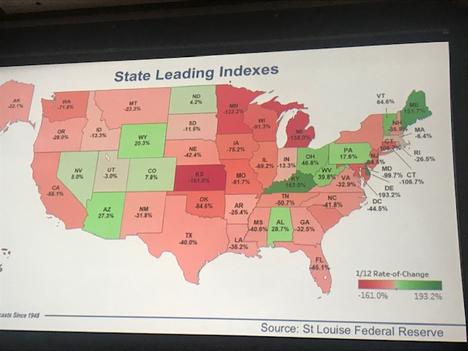
“It tells you your next members are likely to be immigrants, and you need to be addressing that and perhaps even targeting that. This is the land of opportunity for you.”
Student Debt
Speaking as an economist, Beaulieu urged any parents at the conference to not pay off their kids’ student debt. “You’ll improve their cash flow, but you’re not going to increase any wealth for them,” he advised. “Instead, take the money and give it to them so they can buy a house, not a condo. And as they buy a house now, mortgage rates are going to go up as will the value of the house and the land. Their wages will go up and they will be able to pay off student loans and you’re going to find out it’s going to be paid off by the government, anyway. Give them the gift of a home.”
Bursting Your Bubble
Any credit union using Rate of Change analysis is likely feeling pretty optimistic, according to Beaulieu, but… “When you look at credit unions’ consumer credit outstanding, it looks like you’ll be loaning more and more money. And if you look at charge-offs, your 3/12 is smaller than the 12/12. I’m thinking you’re feeling pretty good about life right now and are enjoying it. But remember, you are at the top of the business cycle, so you shouldn’t be sleeping well because things are about to change.”
An Economic Bellwether
Retail sales are a great bellwether of economic activity, said Beaulieu, pointing to a first quarter 2019 seasonal decline he said is similar to 2015 and the steepest since 2009. “On a deflated basis, rate of growth is 1.9%. Whenever that number is below 2.5%, we get very nervous at the Institute for Trend Research. This is two-thirds of the U.S. economy and it shows it’s coming offline. Consumers are spending less on homes and automobiles, and this is going to impact you. Beware of the next nine months; it’s not going to be what you think it is.”
Homes & Autos
While noting it’s largely a local issue, overall home sales are slowing, said Beaulieu, who expects the same for vehicle sales.
The ‘Desperate’ Fed
Beaulieu said the Fed is “desperate” to raise rates, but will not do so this year, and also won’t lower them next year, as they “don’t want to be seen bowing to White House pressure.” He added, “We have a whole generation that has never seen rates rise. The question is when?” He expects rates to rise in 2022.
Artificial Intelligence
A consistent concern raised at CU meetings, Beaulieu was asked about the risk to jobs and the economy from artificial intelligence. “You have much bigger things to worry about than AI. The likelihood of you being affected by that is slim,” said Beaulieu, adding the caveat that his prediction is dependent upon one’s age. “If you are a Millennial, you should worry.”
Social Security
Beaulieu said the nation’s Social Security is on track to go bankrupt by in 2032-33. “As it goes bankrupt, millions of Americans who need Social Security to live are going to find their paychecks much smaller. It’s going to put a crunch on senior citizens, and if they are members they are going to be coming to you for help. It will also have a negative impact on the deficit, because more borrowing will be needed to fund it. It’s going to have a serious impact on the quality of people’s lives. It’s not a good picture. The cure is to have taxes go up some, not a lot, and have the wage go up some, and extend the working age for Gen Xers a few years and for Millennials for a lot of years.”
Immigration
A shrinking population—as most Americans are having fewer children—does not bode well for the future, he said. “We need more kids. Without immigration, the U.S. becomes Illinois.”