

By Ray Birch
PLANO, Texas—Despite media attention on a potential recession—intensified by slightly negative growth reported in Q1 2025—credit unions shouldn’t be alarmed, says one economist, who offers a clear rationale behind this perspective.
“Despite what you might have heard from the media, real GDP growth and the current economic profile do not support a recessionary outlook,” said Brian Truner, president and chief economist at Meridian Economics, citing his company’s Recession Index. “The slightly negative growth reported during Q1 is a result of a 5.1% decline in federal government spending as the Administration transitions away from waste. Our study indicates that core GDP actually advanced between 3.6% to 4.5% during the first quarter of 2025.”
Turner noted that GDP is comprised of consumer spending, government spending, private domestic investment and net exports.
“If you look at what has been released, you’ll notice that the pace of government spending has exceeded consumer spending for nine of the previous ten quarters as the federal government injected over $5 trillion into the economy. This has significantly boosted the GDP results, particularly between 2022-2024,” Turner said.
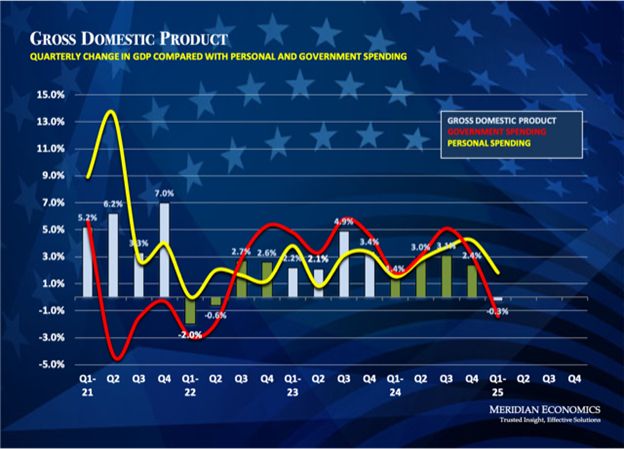
With the significant pace of federal spending over the past three years—even post-COVID recovery—that injection into the economy has elevated the overall GDP while understating the level of core GDP—consumer spending, domestic investment and some element of net exports, Turner explained.
“So, when excluding federal government spending, you’ll see that the actual level of core GDP has not been reported over the past three years,” Turner said. “Our preliminary assessment reflects that while the reported average overall GDP between 2022-2024 was +2.6%, the average core GDP—excluding the impact of federal government sending—has been closer to +0.6%, with three incidents of negative quarterly growth.”
In fact, during the first quarter of 2025, the Bureau of Economic Analysis reported overall GDP contracted by 0.3%, Turner said.
“But that included a 5.1% reduction in government spending as the Trump Administration enacted its reduction effort through DOGE and other policy developments,” continued Turner. “So, this assesses the growth in core GDP to actually be between +3.6% to +4.3%.”
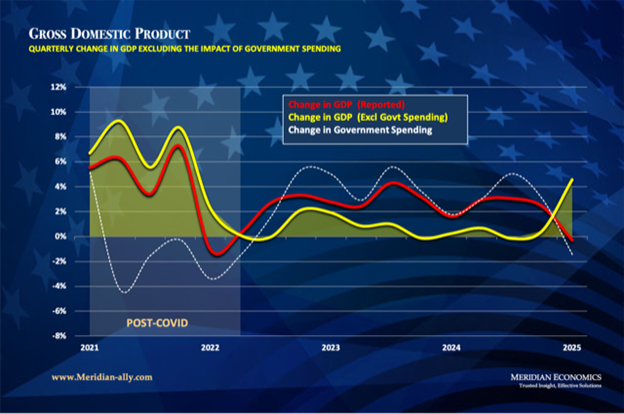
Turner proposed that over time, the new economy, monetary and trade policies will eventually transition the U.S. economy away from a service-based economy, returning manufacturing and services back to the U.S. that have been lost overseas over the past 50 years, remedying the significant trade deficit from both imports and exports.
“Lastly, our reliance on imported resources, manufacturing and services has created a great security risk in today’s global environment that could have the potential of seriously exposing the U.S. should major conflicts open across the globe,” he said. “We already have seen the major impact of goods and services available resulting from the COVID virus, but also experienced how resources were further restricted by disruption in supply chain and transportation.”
Just as the U.S. economy’s profile shifted between 1900-1945 to an industrial/manufacturing economy, to a service-based economy from 1965 to 2024, Turner said the country is now seeing the beginning of a new transition back to U.S.-based manufacturing and service-based economy.
“This will take a few years to accomplish and the transition will show interesting statistical figures only because they will be based on old economic milestones,” he said. “But it will be most beneficial to long-term economic prosperity.”