

FT. LAUDERDALE, Fla.–No credit union employee should ever bring their boss the same problem twice. Instead, they should be readily able to check a “solutions document” that shows how that problem was resolved.
That was just one recommendation by a former Marine here who shared lessons learned in change management with a group of people who often feel they are on a different kind of front lines themselves: HR executives.
Speaking on “Leadership from the Front Lines: Influencing Excellence Through Performance,” Shawn Rhodes, an expert in change management and performance with Florida-based Shoshin Consulting, told the CUNA HR, Training and Development Council that the ultimate success of credit unions comes down to responding to “pivot points,” and that HR executives can be pivotal in that process.
“As I speak with credit union leaders across the country, it’s not the changes over the course of decades or months that lead to ruin, it’s those changes that happen quickly,” he said. “It’s those changes that happen in a short timeframe that cause members to leave. Those are pivot points, and If you can’t pivot, you’ve got a problem.”
15 Minutes to Live
At age 19 Rhodes enlisted in the Marine Corps and was eventually assigned to a role that involved being part journalist, part student of how the Marines were dealing with change. In the Spring of 2004 he was serving in Fallujah, Iraq, as the Marines fought one of the biggest assaults and insurgencies of the Iraq War. At one point a commander shouted at him that he needed to grab his gear and get to a truck as he had “15 minutes to live.”
“Imagine hearing those words at 19. You’ve barely been alive for 15 minutes,” Rhodes said. “You go to load up in that truck not knowing what else to do. You hear that dozens of armed insurgents are headed in your direction and you are outgunned and outmanned. I don’t want you to find yourself in that situation in your credit union where you also find yourselves outgunned and outmanned.”
To keep HR executives from being in that position, he shared what he said “hyper-effective” organizations, including the military, are doing. And the most effective organizations, he said, recognize the value of human resources.
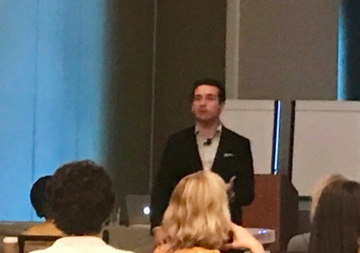
Shawn Rhodes speaking to CUNA HR TD Council meeting in Ft. Lauderdale.
“HR gets a bad rap in this area,” said Rhodes. “You are responsible for training people on executing on your credit union’s strategy. You can get the best board and be the best credit union and have the best locations in the best places, if you fail at what you are doing in HR your credit union fails. You have to understand how to translate that strategy into ways to get results.”
Lessons from Foot Patrols
As his example of how human resources should work, Rhodes shared what took place on the average foot patrol as Marines fanned out across Fallujah and other Iraqi cities.
“The plan changes every time,” he explained. “There is a saying in the military that ‘a plan will only last until the enemy gets involved.’ I expected the Marines would be doing all the smart things like checking that their radios were working before they headed out. Instead, they were giving their people goals, very specific goals called a finish line. They taught me that if you want to see performance increase, you need to prepare to cross that finish line before the race even begins.”
Having a clear goal is great, Rhodes said, right up until a CU’s staff needs to make changes. In the Marines, he said, permission is given to change the plan in order to reach that finish line.
Three Elements of a Finish Line
According to Rhodes, there are three elements to a “great finish line”:
- Precision. “People need to know exactly what needs to be done in the time that goal is to be achieved. Give your people the freedom to change the plan but if they don’t have a plan the goal isn’t going to be achieved.”
- Profitable. “Every Marine needed to know how risking their lives was going to contribute to succeeding in their overall mission. So, in your branches, down to the teller at the window, they need to know how on this shift they are affecting the goals and how they are contributing to still being around in five years. Without it, there is a high probability that they are just doing busy work.”
- Purpose. “Every goal in the Marines is on-purpose; there is some sort of emotional challenge that these Marines can get behind. You can’t order someone to do something for too long before they figure out there are better ways. So how are you gathering information. You are recognizing ‘Shining Stars’–don’t wait until once a year to do that. It’s much more important to do that once a week. (Employees) need to have it every single day before they come on shift.”
Rhodes said that as the Marines set off on foot patrol their core belief was their training would make the difference. “They believed their performance would never rise above their training,” he said. “Training for high performing teams not something that happened once a month or once a week; it happened every day.”
Rhodes told the HR meeting that issue is critical because he has repeatedly heard from human resources executives that new hires, particularly Millennials, simply don’t seem to understand what it is the credit union is doing, never buy into it and, as a result, retention has become a big problem. The resolution, suggested Rhodes, is to be found in ensuring each employee understands how he or she is contributing to the larger goals of the credit unions and, specifically, to helping members.
Solutions Should Not Be Kept Secret
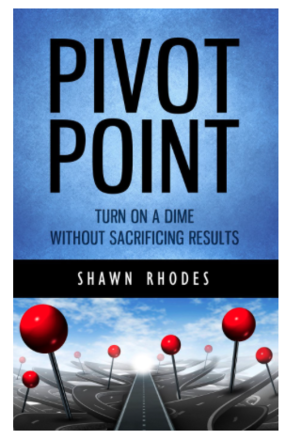
Shawn Rhodes' book, Pivot Point.
“What are YOUR risks at the credit union?” asked Rhodes. “With your team, once you have that finish line, take the time with your people to assess what risks might be that could get in the way of reaching the finish line. It can be simple stuff, but just having the awareness of the issues that stand in the way of your goals can help you to prepare for that.”
Solutions, stressed Rhodes, are not to be kept secret
“You are learning things at your branches every single day from your high performers,” he said. “It may just be one person in one location doing one thing that could benefit every person in every location. If you take the time to ask them what is the best solution you’ve come up with this week–and you don’t have to implement every one–first, your people will feel heard, and second, you will gather a lot of good ideas.”
“The interesting thing about solutions is they go both ways,” Rhodes continued. “Map them out the same way you do risks and involve your people. Map out all of the different resources you might have. How do we find success if any of the challenges happen? What has worked sometime, but not others? What are some things you’d like to try?”
Never the Same Problem Twice
All of that prep work, he said, is so that if change happens the credit union can not only pivot but leverage the change as a “springboard.”
It’s critical, he added, that organizations not “sidestep” challenges.
“If you ever encounter an issue, your job as an HR professional is to tackle problems head-on, not sidestep them. You have to empower tellers and branch managers to solve their own problems and then report back to you on the success, that creates a performance loop like you won’t believe. How many people get repeat problems in the credit union? (All hands were raised.) I tell my people you can never bring me the same problem twice. You need to create a solutions document and keep it up to date and make it available to everyone. It is powerful and will save you so much time.”
The End of the Mission
At the end of a mission in Iraq, the Marines didn’t drop their packs and look to rest. Instead, there was a session in accountability that began with the mission leader.
Accountability, said Rhodes, includes the basic model for a task:
1. Who
2. Will Do What. (That’s where a lot of goals end, but…”
3. By When
And there is one more question, said Rhodes, that is the “moneymaker.”
4. How will we know? You all have resources sitting on someone’s computer at the credit union and it keeps sitting there because it’s never shared. If there are one or two pieces of valuable information, why wouldn’t you want to share that?”
Those questions and the timeline need to be available to everyone, said Rhodes, so that in the event change happens and the person to whom the task has been assigned is unable to complete it, another member of the team can “keep the train on the tracks.”
What Made You Successful Up Until Now Will Not Keep You There
Rhodes told the meeting, “If you don’t pivot with your market, your credit union is going to become outdated.”
To keep that from happening, he recommended credit unions use the same strategy as used by the Marines when returning from a patrol.
“The branch manager, for instance, has to call themselves on the carpet. What that does is it allows everyone else to say if the boss can do it, I can do it. They can say, ‘I could have dealt with this member better, and here is how I am going to fix it and by when.’ Even if you have a great quarter or great year, don’t just celebrate, take time to ask why you were successful.”
And as for that “15 minutes” that Rhodes was told he had to live, it turned out he was being tested by a superior officer who wanted to see how he would pivot when things changed.