

ALEXANDRIA, Va.–When Debbie Matz steps down as chairman of the National Credit Union Administration on April 30, it will bring to a conclusion a chairmanship that will have seen perhaps more change and flux than the term of any other NCUA chairman.
When Matz joined the board in August of 2009, America’s credit unions were on their heels, with record number of Americans out of work and a backbone of much of the economy and balance sheets—housing–broken.
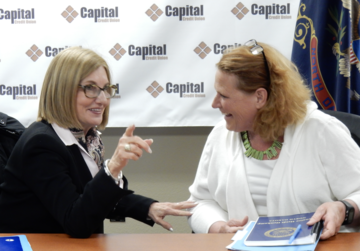
In Bismarck, N.D., NCUA Chairman Debbie Matz and U.S. Sen. Heidi Heitkamp share perspectives after a roundtable meeting at Capital Credit Union.
Two corporate credit unions had already been placed into conservatorship when Matz moved into the chairman’s office at 1775 Duke St. in Alexandria, Va., and she would oversee the conservatorship of three more. Those issues would consume nearly all the agency’s time and attention for several years. In the years between that time and today, when overall industry numbers are robust and more than 105 million Americans report credit union membership, Matz’s term—the first time anyone has ever returned for a second stint on the board—has included the debut of “corporate assessments,” litigation against Wall Street that has recovered billions of dollars (with 13 lawsuits still pending), an Office of Small Credit Union Initiatives that has sought to bring resources to small CUs even as they are disappearing, efforts to provide greater regulatory relief, and new tensions with a fellow board member who has openly questioned and criticized many of the board’s decisions.
While Matz has been chairman there have been moves welcomed by the credit union community, such as expanded member business lending and field of membership rules, and moves blasted by that same community, such as its decision to not yet move to an 18-month exam schedule, and its budget, which credit unions fund and which has increased each year Matz has been chairman.
Matz told CUToday.info that with less than a month remaining in the job, she has done a bit of reflection, but she remains very busy with a host of issues still before the agency, including the new FOM and MBL rules. All of that is a long way from where she began, according to Matz.
$50 Billion in Toxic Assets
“When I came in our goal was just to stop the hemorrhaging. People were in denial, and some are still in denial, that the system was about to collapse,” said Matz. “There were approximately $50 billion in toxic assets in the corporates. The retail side of the industry was just as bad, but it was less visible because we couldn’t discuss that. That was a major initiative right off the bat.”
In remarks to CUNA’s GAC earlier this year, Matz said, “Back then, we were working around the clock to prevent the collapse of the credit union system. And while you might not know this, the outcome was really in doubt. “During that pivotal summer of 2009, I asked NCUA staff to compile a list of credit unions rated CAMEL 4 and 5. When I saw the list, I couldn’t believe my eyes. Hundreds and hundreds of credit unions were teetering on the brink of failure – and 14 of those credit unions had assets over a billion dollars.”
Matz said she is aware there will always be critics who believe the agency was too hasty in placing WesCorp, U.S. Central, Southwest Corporate and two others into conservatorship, believing that with Treasury’s backing, all would have eventually recovered.
“Maybe (the critics) did not realize it was as dire as it was,” said Matz. “Two corporate conservatorships had occurred before I got here. I know (the prior board members) looked at every other possibility and did a great deal of soul searching. I’m on my way out, so I have no reason to exaggerate. It is interesting to me that so many people were angry about the steps we took.”
Matz said she has absolutely no doubt NCUA had no choice but to handle the corporate credit union crisis in the way it did, and she has no 20/20 hindsight regrets.
The response to that crisis remains part of the credit union fabric in 2016 beyond just the outstanding borrowings that credit unions owe the Treasury, or the litigation against Wall Street banks over mortgage-backed securities. It put into motion a regulatory environment that critics, including the trade associations, have called an over-reaction, but which Matz said has been necessary to strengthen the regulatory framework.
“The rules and regulations had not been updated in some time,” said Matz, adding it was also necessary to shore up the National Credit Union Share Insurance Fund. “The objective was to be current, not to be more burdensome.”
When Matz was nominated as chairman by a new president in 2009 it marked the first time in the agency’s history that someone returned for a second term. Matz served on the board from 2002-2005 after being appointed by President George W. Bush. During her time away from the board, Matz, who during the Clinton Administration had been Deputy Assistant Secretary for Administration in the Department of Agriculture, was EVP/COO at Andrews FCU. As chairman, Matz said she brought with her some lessons learned from that first term on the NCUA board.
“The first time I was on the board we had the PALS seminars. I really felt that engaging with the industry was something they appreciated, and just as important, it was an opportunity for me to listen to them,” said Matz. “I have carried that forward as chairman. We have had 19 town halls, plus many industry webinars. I felt really good about being able to talk to people directly and being able to listen to them.”
During her initial term on the NCUA board Matz was the minority board member as a Democrat, with fellow board members Dennis Dollar and Joann Johnson being the Republican appointees.
“I was in the minority…but I felt we had a good bipartisan, working relationship,” said Matz. “And then Michael Fryzel was chairman and then I—I’m sure he wasn’t thrilled about that—but we worked together well.”
During that time Matz said her great concern was concentration risk in corporate credit unions, which led Matz to vote against a corporate rule in 2002. The rule passed 2-1.
“I felt there should be limits, which is why I voted against that. That became a priority when I became chair,” said Matz.
Matz’s priorities as chairman, as reflected by the agency during her term leading it, have obviously met significant pushback from credit unions and their trade groups, not to mention Congress. Matz’s fundamental view of that relationship? It comes with the territory.
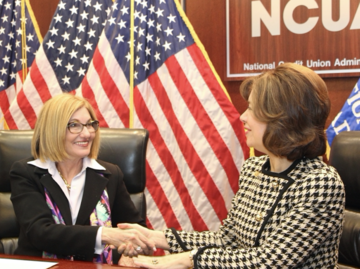
NCUA Chairman Debbie Matz and SBA Administrator Maria Contreras-Sweet enter a formal partnership between the agencies.
“There will always be tensions between the regulator and the regulated,” said Matz “I have always tried to listen. If I hear from a number of people about an issue I will look into it. And in a number of cases we were doing things that were making things more burdensome than they needed to be. We can learn from the stakeholders. It’s one of the reasons I never said no to a speaking engagement if it fit my schedule. They run the credit unions. Often, it’s the processes and procedures that trip credit unions up, not the regulations.”
For approximately the past year, a different set of processes and procedures—those inside the agency for setting its budget and making other decisions—have been the focus of criticism from trade groups that have been demanding more “transparency.”
“(Transparency) is the new buzzword and it means different things to different people,” said Matz. “I feel the agency is extremely transparent, more so than any other financial regulator. Our entire budget is available online.”
The question of “transparency,” said Matz, who is the eighth person to serve as NCUA chairman since the agency went to a three-member board, is part of that larger issue she had mentioned earlier, the tension between the regulated and the regulator.
“As much as I respect the trade groups, they have their job to do and we have ours,” said Matz, a native of New York who early in her career worked on Capitol Hill. “I learned pretty quickly that even if you do exactly what they want the next day there will be an issue that is just as important. The MBL rule is a good example. The ink was not dry and the next day it was about the 18-month exam. So you have to take all that with a grain of salt. I appreciate that they have a job to do. It is a respectful relationship. It’s a constant drumbeat. Our job is to listen to them, not to do everything they ask.
Matz believes the all the complaints about over-regulation are belied by the fact the credit union industry, overall, is performing well, performance she credited to “credit union management.”
In the last two years of Matz’s term as chair there has been a considerable flourish in new, more liberal regulations around long-time limits on credit unions, including field of membership, risk-based capital and member business lending. In public remarks and during NCUA board meetings, Matz has referred to 2015 as “The year of regulatory relief.”
Why did that year have to wait until 2015?
“We were waiting to get the safety and soundness rules behind us,” said Matz. “The risk-based capital rule was very complex. We needed to get it right and it took a lot of staff time and energy. We couldn’t move on to some of the other things we had on the shelf until we got the safety and soundness regulations in place.”
Matz said there were similar concerns around member business lending rules.
“There was always a lot of concern in the agency that if a credit union doesn’t do (MBLs) well it will lead to failures,” said Matz. “But there were a lot of credit unions doing a lot of MBLs with a record of doing them well. I felt it was time for more credit union boards and managers to make more decisions for credit unions on MBLs.”
A 'Sea Change'
Matz called the new MBL rules a “sea change” at NCUA that require significant training to get examiners “comfortable” with business lending.
Examiner comfort with member business loans is part of a larger question about NCUA and its capability to deal with more sophisticated operations and practices within the largest of credit unions.
“That’s an important question,” said Matz. “It’s incumbent upon NCUA to be ahead of the curve. NCUA does not want to hold credit unions back from (offering new services and taking on new members). But we wanted to ensure our own infrastructure was updated. It was archaic. That’s why we created ONES (Office of National Examinations and Supervision) for the credit unions that are larger than $10 billion. It takes a different skill set and sophisticated examiners.”

Chairman Debbie Matz participates in opening ceremonies for The Finest FCU at New York City Hall.
Credit union leaders, meanwhile, have argued they have developed their own set of sophisticated skills, and as a result don’t need to be examined annually, and have called for an 18-month exam cycle. And while NCUA board member Mark McWatters said one week prior to Matz speaking with CUToday.info that he has heard no real discussion of the issue inside the agency, Matz said, “I think the staff here and the other board members are amenable to that. But I’ve said many times, with the depth and breadth of regulatory relief we have provided, it is not prudent to then examine less frequently. We will see failures.”
Matz said it’s often the very same people advocating for less frequent exams and who accuse the agency of being too “meddlesome” are often the very first to argue it is NCUA’s fault any time there is a failure.
But there have been plenty of failures, especially among smaller credit unions, with many of those failures brought about by embezzlements and fraud. Why has the agency missed so frauds inside credit unions?
“We have spent a great deal of time discussing this issue,” said Matz. “I have a soft spot for small credit unions and have tried very hard to help them to grow and to survive. Having said that, small credit unions often lack internal controls and some supervisory committees aren’t doing their jobs. We have provided more and more fraud training, but we’re not criminal investigators. We have trained to look for the red flags. If we wanted to be aggressive we could require small credit unions to get an outside opinion audit, but in many cases the expense (is beyond their means).”
Instead, said Matz, the decision has been made to put resources where the risk is to the insurance fund–larger credit unions–while at the same time shortening the time spent onsite at smaller credit unions.
“If there is fraud it might imperil the small credit union but it is not going to imperil the insurance fund in the way a failure of a large credit union would,” said Matz. “It’s really a cost/benefit analysis.”
Members Perform A Cost/Benefit Analysis
Many members have done cost/benefit analyses of their own, and have opted against joining or have even left smaller credit unions that aren’t able to provide services available from other providers. Some critics—especially among small credit unions themselves—have even suggested NCUA wants to shut down small credit unions in order to reduce expenses. Matz counters by noting she created NCUA’s Office of Small Credit Union Initiatives, and she remains hopeful for the future of small CUs—as well as pragmatic.
“Small credit unions can continue to survive, but they are definitely challenged to modernize and deliver to members what they want,” said Matz. “If they are not growing and attracting young people, then they have no future. But we have had several hundred grow (in assets so they no longer qualify as part of OSCUI). There are a lot of voluntary mergers, and those are not necessarily bad. OSCUI has worked hard to identify the credit unions that can prosper.”
Matz’s Year of Regulatory Relief has been in part overshadowed by a year of board tension, as Matz and the newest NCUA board member, Mark McWatters, have frequently and publicly clashed over numerous issues. Matz said it isn’t an issue she wants to discuss.
“I don’t want to get into it. He has his philosophy and I have mine. We do get along personally,” Matz said.
The disagreements with McWatters are not the reason she has chosen to step down, Matz said.
“My term expired a year ago. I felt we had accomplished just about everything I had set out to accomplish,” she said. “The agency and credit unions are in great shape and I just felt it was time to go.”
That isn’t to say Matz isn’t leaving without a few regrets. When asked what she wasn’t able to get done, Matz responded, “The FOM rule. I’m disappointed not to be able to see it to completion.”
Matz said she is similarly disappointed that the board never moved a proposal on supplemental capital.
“Every time we thought we near the finish line, the goal posts would move,” said Matz. “It was very sophisticated.”
What The Future Might Hold
Given the recent GAO report, along with ongoing pressures in Congress to reduce federal expenses, the question can be asked whether Matz might be among the last NCUA chairmen, as the agency could one day be merged out of existence. But Matz said there will be plenty of other chairmen in the years to come.
“I do think the NCUA will remain an independent regulator for the foreseeable future,” said Matz. “There is an appreciation that credit unions are different from banks and they require a different regulator. I also do not believe there is any compulsion in Congress to tackle that.”
But what about credit unions themselves? There were approximately 7,800 credit unions when Matz was named chairman; today, seven years, later, there are fewer than 6,500.
“The system is strong,” said Matz. “The numbers indicate credit unions are doing remarkably well, especially compared to where we were in 2009. If credit unions can continue to innovate, and especially if they can attract younger members, they will survive. It’s sort of circular. This starts at the board level. Boards need to be younger and more diverse in order to attract younger and more diverse members.”