

LAKE FOREST, Ill.—Credit unions and banks have “blinked” in response Ally Bank’s move to eliminate its overdraft fee, according to a leading OD expert, who expects many more financial institutions will soon follow, with most reducing their price rather than eliminating the charge.
These decisions will not only appease consumer groups and policymakers that have been calling calling for changes in overdraft charges, but also help protect banks and credit unions from overdraft lawsuits, says Michael Moebs, economist and CEO at Moebs $ervices, an economic research firm.
When Ally Bank announced its move in May, Moebs told CUToday.info the bank’s decision could have a big effect on the overdraft market, but only if other institutions “blinked.”
“And now they have,” Moebs said. “And many more credit unions and banks will follow. The dominoes are beginning to fall.”

As CUToday.info reported, several financial institutions have followed Ally’s lead—and retail giant Walmart, as well—to markedly reduce or eliminate their overdraft fee.
Power Financial Credit Union in Pembroke Pines, Fla., just announced it is eliminating its charge. Recently, $1.3-billion WEOKIE Credit Union, Oklahoma City, Okla., reduced its NSF charge by nearly 50%, cutting the fee to $15 per occurrence from $27.50. Earlier, Madison, Wis.-based UWCU reduced its overdraft fee to $5. Digital-first Alliant Credit Union in Chicago eliminated its OD charge shortly after Ally’s move, as did Westerra Credit Union in Denver, which made its decision in late summer. Marine Credit Union, La Crosse, Wis., allows members to reduce their overdraft costs via a monthly subscription service..
Why Google Made Move
Moebs also pointed out that PNC Bank has introduced new software that allows users to select how charges will affect overdrawn accounts as well as extend grace periods in the process. He further believes Google’s decision to exit the checking market was based on overdrafts.
“The decision by Google to drop the introduction of the Plex checking account and not to enter the transaction account arena further emphasizes the move to a lower overdraft price. Google’s decision was based on the current high OD fee,” stated Moebs.
As he has in the past, Moebs emphasized the decision to cut overdrafts well below the $30 median national price will bring financial institutions more overdraft revenue. Moebs $ervices studies have shown cutting the overdraft price to below $20 adds significant volume—therefore more business and net revenue.
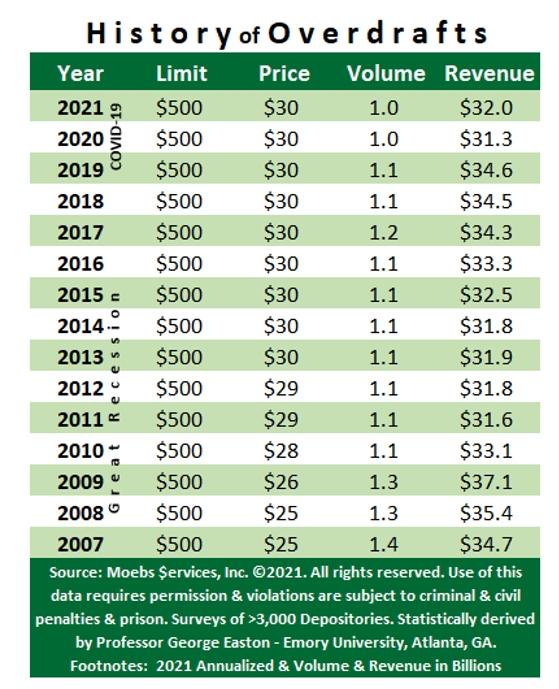
“When a financial institution drops its overdraft charge below $20, the OD then is treated as a mistake, not a penalty,” said Moebs. “This is very important. The overdraft charge is then seen as a service for an account-holder, an affordable short-term credit, as opposed to a penalty.”
A Difference in the Courts
That perspective, stated Moebs, makes a big difference in the eyes of class-action lawsuit attorneys and courts.
“Moebs $ervices has worked with many credit unions and banks that have been hit with class-action overdraft lawsuits,” explained Moebs. “From what we have learned, if you drop your price below $20, the lawyers won’t touch you. They won’t even look at you. And a few class-action attorneys who have attempted litigation found the judges, too, won’t hear the case and the suit is dismissed.”
As CUToday.info has reported, the wave of overdraft lawsuits in recent years target not only high-price overdrafts, but overdraft contract and policy language that is unclear.
It has not just been Ally’s move drawing the attention of financial institutions across the nation, emphasized Moebs, but the decision by Walmart to cut its overdraft fee its Money Card account to $15 turned many heads, he said.
“Walmart is everywhere—5,342 U.S. stores open seven days a week—and almost every credit union has Walmart locations in their areas,” said Moebs, adding that Money Card is truly a checking account. “Credit unions are seeing Walmart’s move and they know the retailer is out to steal their checking business.”

Michael Moebs
A ‘Brilliant’ Move
Not only is cutting the overdraft charge important, so, too, raising the dollar limit, he said.
“The OD limit has been stuck at $500 since the Great Recession,” said Moebs. “$500 doesn’t even come close to covering auto and housing costs for a month.
“That is what Alliant Credit Union has done,” continued Moebs. “They eliminated their overdraft fee and raised their limit to $1,000. That pricing is brilliant. It encourages greater usage for members who need the service.”
Moebs noted if other financial institutions had not followed Ally, overdraft pricing would not be undergoing such a significant change.
“All this bodes well for the future of financial institutions and overdraft revenue, and it will also help keep banks and credit unions out of the courts,” stated Moebs. “The (average) fee is below $20—it’s at $15 now thanks to Walmart. This is sound pricing and will bring the credit unions more revenue. Typically, when a credit union drops its OD fee to less than $20 it will double its business in 18 months. That is what we’ve seen over the years with over 1,000 banks, thrifts, and credit unions.”
More Than $30 Billion in Revenue
As for overdraft revenue levels, which dipped early in the pandemic, they are coming back—up by 36% since falling due to COVID-19 in the first quarter of 2021.
“We're going to see overall financial institution overdraft revenue stay in the $30- to $40 billion range for at least this decade, and exceed $40 billion a year by 2030,” Moebs said.