

RALEIGH, N.C.–A major and fundamental disagreement over risk-based lending at the nation’s second-largest credit union has gone public in this state and moved beyond whether or not it’s a fair and necessary way to price loans, with the CU’s current CEO and a well-known former CEO exchanging numerous barbs in local media and on a blog.
The issue—which is fundamental to the philosophy of credit unions--has resulted in three challengers for board seats recently ousting three incumbents, with that same former CEO predicting that unless changes are made, current board members will lose their seats, as well.

As CUToday.info has been reporting, at the core of the dispute at the $50-billion State Employees’ Credit Union is its move earlier this year to begin risk-pricing its auto loans, with plans to expand risk-based pricing to all of its lending in November. The current CEO, Leigh Brady, said the lack of attractive rates for A tier borrowers had driven members with the highest credit scores to turn to other lenders for more than $50 billion in loans.
“The facts are the facts. There is nothing I can do about data,” said Brady.
But former CEO Jim Blaine is equally adamant about a data point of his own: “A flat-rate model is a better business model, and SECU demonstrates that you can be the most successful credit union financially in the country. Look at the numbers.”
A Long-Time Tradition
SECU, which has more than 2.7-million members and is a visible presence across the Tarheel State, had been a proud, long-time holdout when it came to moving to risk-based pricing its loans under its two former CEOs, the well-known and outspoken Blaine—who retired in 2016 and who shared his thoughts at that time here--and his successor, Mike Lord. While leading the credit union Blaine—who was named CEO at age 30 and who oversaw growth from $50 million in assets to $33 billion--spoke often on the issue at CU meetings and in CU publications, including CUToday.info, where he emphasized his belief that treating all members equally was a core philosophical tenet for credit unions. Lord, a three-decade veteran of SECU, maintained that policy position.
When Lord retired in 2021, SECU looked outside the credit union to hire Jim Hayes as CEO, and Hayes began to make a number of changes to the tradition-bound SECU, and that included moving to the risk-based pricing model, which drew the attention of local media here.
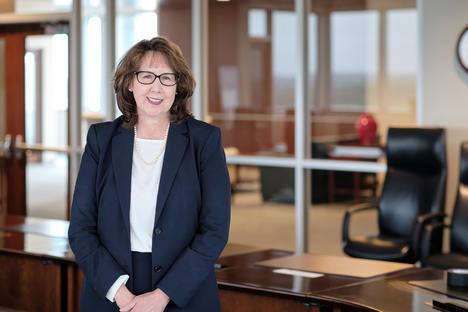
Leigh Brady, CEO of SECU.
Not Welcomed By All
The decision was not welcomed by everyone, and in June of this year Hayes exited State Employees’ to become CEO of the $2.8-billion State Employees Credit Union in Virginia. He was succeeded by long-time SECU employee Leigh Brady, who had been serving as COO.
Brady and Blaine have now found their opposing points of view featured in local media reports, trade press and the credit union’s recent annual meeting at which more than 1,000 people were on hand, with more than 30 members going to the microphones to voice various concerns, including over risk-based lending. But what motivated those members to do so is yet another point of disagreement.
In addition, Blaine has a popular blog at www.secujustasking.com in which he pulls few punches, including publishing text message exchanges and referring to Brady by name.
The dirty laundry being aired goes beyond just the issue of risk-based pricing, and includes board election procedures, communications between the two CEOs, and even where the board holds its meetings.
Some of the commentary is tongue-in-cheek, while other commentary is direct and not intended to be funny.
‘Does Not Play Fair’
In terms of the coverage SECU has received in local and trade media, Brady, who has stated that Jim Blaine “does not play fair,” said her primary objective is to let “readers know there is often more to a story than maybe is represented.”
She said Blaine is not speaking for the membership, and that her own efforts to “correct misinformation” on his blog have not been successful. Having worked under Blaine for 20 years, she said she has not been surprised, although she said she was “shocked” by some of the “name-calling and bullying.”
“It’s not professional and that’s no way to act in terms of being a former CEO,” said Brady, who said she no longer pays attention to the blog.
Both Blaine and Brady shared email exchanges with CUToday.info they said support their points.
The Great Divide
The divide between the the two sides of the issue is steep, and below CUToday.info has endeavored to give each side a chance to share their views and respond to some of the statements that have been made.
‘Misinformation Being Spread’
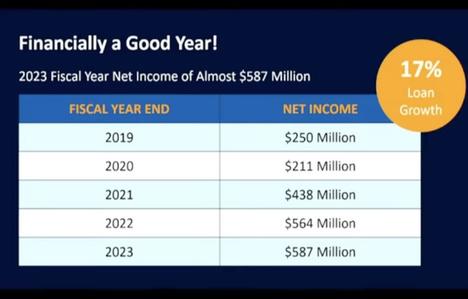
A slide from presentation made by Leigh Brady during SECU annual meeting.
Brady told CUToday.info her chief concern is the issue of “misinformation” spread among the membership and community, specifically that SECU could simply give its A-tier lending rate to everyone. That would result in a financial hit to SECU, said Brady.
“Underwriting is still underwriting. The underwriting is, can you afford the loan, can you afford to pay back the loan?” said Brady. “Previously our rate was based on things like the term or the loan to value and there was some risk involved. But now we have added credit score into that model and that is the big issue in all of this. And that is what we had to do because we know we are losing those A and high B borrowers. They are not coming to us.”
In an earlier interview with Business North Carolina while he was still CEO, Hayes had said that just 10% of SECU members with A and B credit were using it for loans, and that SECU would need to price loans more competitively for A-tier members.
In remarks to both CUToday.info and during SECU’s recent annual meeting, Brady said from July 1, 2021 to June 30, 2022 SECU members borrowed $54 billion, but $41.8 billion of that was borrowed from a lender other than SECU, and of that more than 70% was high credit tier members who had taken their business elsewhere.
“I can point to numerous membership surveys we have done over the years,” said Brady, "and the one thing we know is that members are searching for rates.”
A Different View on Rates
Blaine agrees the issue is about rate, just not the rate for A-borrowers. Instead, he said it’s about the rate charged to members in lower tiers, further stating it’s a question of “fairness” and that SECU has used its model successfully for “generations.”
“The model at SECU that has been so successful is the flat-rate model,” said Blaine.

Jim Blaine
Blaine said the charts shared by Brady during the annual meeting related to the credit union’s profitability over the last half-decade only reinforce his point, as the data points represent performance that took place under the flat-rate pricing model.
Blaine believes there is “no compelling economic data” to suggest it doesn’t work.
As for the question of why this is not a matter for the board as representatives of the members, Blaine responded by saying “half the members are being overcharged for their loans under the risk-based model. (SECU has) raised the rates on C paper, D and E paper.”
A ‘Gross Misstatement’
What about the argument that $40 billion in loans have gone to other lenders?
“I think that’s a gross misstatement,” said Blaine. “Here’s the way I view it…Over 85 years (SECU) has always been in the black every year, and the only time the credit union hasn’t grown was the last two years. Every other year under the flat rate model they have attracted members and deposits. I will give them a little space on the pandemic, as it created all kinds of uncertainty.”
But prior to the pandemic, the rate that SECU charged was the A rate and it was available to every member.
‘You Can Always Find a Better Rate’
“You can always find a better rate, because SECU would post its rate and if you went into a car dealer they knew what our rate was,” Blaine continued. “They would say, ‘Well, they’re charging you six, we’ll give you 5.99.’ The member might take it. But, if so, the credit union had done its job. It had set the level. Just because it wasn’t on SECU’s books doesn’t mean we lost anything. The member won.”
Blaine described the current SECU position as a “corporate view,” that if a “loan isn’t on our balance sheet, then we are losing. Well, ‘we’re’ is not the corporation; ‘we’re’ is the member, and in the example I just gave SECU had the A paper rate. SECU was known as having the best rates on both lending and savings in the state. Again, an A paper member could always beat that rate. Once you post that rate, car dealers and other institutions can game you, because they can set that rate wherever they want. But by setting the benchmark, it gave the A paper the ability to negotiate.”
Capturing All the Tiers
The result of the A tier, flat-rate pricing, said Blaine, is SECU captured all the other tiers of loans from B to E, because the credit union had the best rate and “they will flock to you. The difference they got, 6% vs. 16%, was life-changing for those folks.”
Being Pummeled
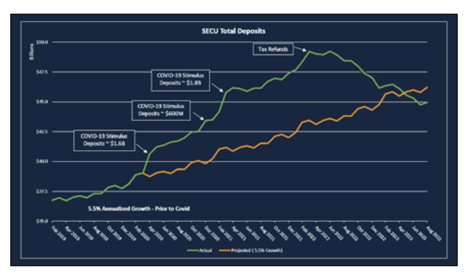
Brady said SECU has also been “pummeled” by Blaine for the outflow of deposits, but she said it’s due to a challenge facing many credit unions—the inability to match or beat some of the high deposit rates being offered in the market, especially on money markets.
“He thinks it’s OK to for us to lose the A tier borrower. It’s not. You have to have a balanced portfolio. You can’t be a lender that is not balanced. You have to take into account delinquencies and all of those things,” said Brady.
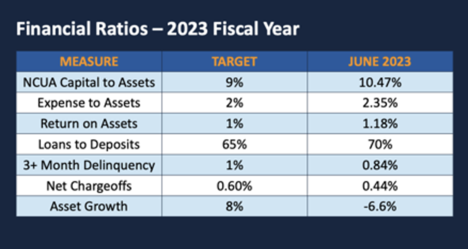
Brady said in December of 2021 SECU’s loan-to-share ratio declined to 53%. She said the highest the ratio has been in the last 15 years is 78%, and it has now returned to the 70% range in part due to the reduced member deposits.
As for the decision to move away from the flat-rate model, Brady said SECU has moved cautiously.
“The board just wanted to dip their toe into it and see what happens. We didn’t just want to do a broad, ‘Everything is moving to this’,” said Brady.
Response to New Pricing
SECU began risk-based pricing with auto loans on March 1, and Brady said the credit union saw an increase of more than 80% in lending to A-tier borrowers from February through August of this year.
It now has tiers in place for A, B, C, D and E credit.
“If you look at our spread from an A to a D, it’s only a 4.5% spread.
“We have a totally different model for pricing than we had before,” said Brady. “Before, we offered everyone the same rate, and it was a B- to a C rate for everybody. Now it is based on the risk in the portfolio.”
SECU will be rolling out the risk-based pricing across its broader loan product line on Nov. 1.
‘No Financial Necessity’
Again, Blaine says he sees “no financial necessity” for expanding the risk-based pricing model across the SECU portfolio.
“A paper people aside, there’s no question SECU had the best rates for B, C, D, E members, and they are 80% of borrowers,” he said.
What about risk?

Jim Blaine's blog.
The former CEO said that through the period prior to the pandemic, the credit union’s 5300s will show it historically had a very low loan-loss ratio, averaging around 25 basis points and never going higher than 50.
“So, the risk was priced in. There are ways other than charging borrowers to mitigate that risk,” he said. “And SECU knew how to do it. They did it by talking to folks and asking, ‘Why is there a blemish on your credit record? If they are a drunk or a drug dealer or just ‘sorry,’ as we say in the South, then you didn’t make the loan. But if they had lost their job or had a temporary setback and had always paid before, you made the loan and you had a loyal borrower for life. These are real-life situations. Everybody who has a 620 credit score is not a bad person. It’s guilty until proven innocent--the country is supposed to work the other way, in my opinion. Look at the losses. The risks were mitigated.”
‘A Good Question’
When asked why she believes Blaine doesn’t agree with the need for SECU to evolve and change its lending policies, Brady responded, “It’s a very good question. I don’t know that he cares. Blaine built it this way, he likes it this way, and in his mind it should always be this way. He called it ‘race-based lending.’ To me, that’s a very racist comment, because what you are saying is that people of color don’t pay their bills. This has nothing to do with race here. We have low-income folks with stellar credit. And we have high-income earners who have horrible credit. It’s all based on you pay your bills.”
‘Orchestrated Pushback’
Initially, after SECU announced plans to implement the tier-based pricing, Brady said there was some pushback, but she said even that was “orchestrated” by Jim Blaine.
“Risk-based pricing was not an easy decision for our board at all,” said Brady. “But the numbers on (the loans that were) leaving the organization, and that 53% loan-to-deposit ratio forced the board to take a hard look at what our strategy was in the lending arena and that we needed to make some changes. They explored it for months and months and months before a decision was made. It’s tough; it’s not an easy task because it is a big switch from where we were.”
Brady said that while a joke is often made that consumers can now apply loans “in their pajamas at two in the morning,” it’s nothing to joke about when it’s a credit union member who did so and who went to another lender due to a better rate being offered.
Taking the Show on the Road
Brady, who was named CEO on July 1, said soon after moving into the top post she traveled across the state with the credit union’s senior leadership team for a series of “road shows” to meet with the Advisory Boards SECU has in place.
Those Advisory Boards are a unique creature in credit unions, as SECU has one in place for each of its 275 branches. There are as many as 12 members on each Advisory Board, with SECU saying on its website it has approximately 3,240 volunteers in total serving on Member Advisory Boards across all 100 North Carolina counties.
“It gave me a chance to meet folks and to highlight our strategic plan and the progress made there, and to do Q&A sessions with our local advisory boards. We went to six different cities, and I think I had two questions on tier-based pricing; that was it,” said Brady. “Blaine purports to be speaking for the membership, but the ones who are following him are the retirees of SECU. This is not the general membership.”
What Everything Boils Down To
It was during the annual meeting where Brady said the “misinformation” was especially apparent.
“I will tell you the one thing it boils down to is tier-based pricing. It was comment after comment on tier based pricing,” said Brady. “But the comments were from SECU retirees; it’s not Joe or Jane Member.”
She said many of those members who rose up are older and “just want things to be the way they have always been. The fact is the world has changed; it has changed drastically.”
Brady said consumers have become accustomed to seeing tier-based pricing on loans from most lenders.
“There are a lot of our volunteers who are very happy, because now they can come back to SECU for their auto loan and they couldn’t before.”
Questions & The October Annual Meeting
The recent annual meeting and what occurred or didn’t occur has become another point of contention. During the meeting, held in Greensboro, N.C., dozens of members stood up and took to the microphones to make statements or ask questions of the board. That much everyone agrees on. The disagreement is over whether the members asking those questions were doing so on their own or whether they were put up to it.
A video of the meeting can be viewed here. The member questions began at the 1:29:50 point.
“…Let me be clear on that group of members; 28 of those 32 were SECU retirees,” said Brady. “These were members where Blaine gave them a sheet of paper and said ‘You read this.’ And gave the next one a sheet of paper and said, ‘Now you read this.’ They were holding papers where Blaine gave them talking points. And they were supposed to stand up during the comment section and read their comments.”
Brady said she knows for a fact that is what occurred.
“I sat there and watched them reading these things,” she continued. “One of them read something about HB 410, which is the (North Carolina) credit union statute that we have been wanting to modernize. We are one of the credit unions that is in agreement with that being modernized.”
‘Battle Over Fairness’
Blaine strongly denies having written the statements read by members during the annual meeting, saying they were the words of the “many distinguished” members who made them.
What is taking place, he said, is a “battle over fairness at the credit union and control by the membership.”
And it’s a battle, he said, that is going to play out in the make-up of the board, which he predicts will eventually be voted out.
As CUToday.info reported, three challengers recently defeated three incumbents in their bid to be reelected to the SECU board, something that is a rarity in credit unions.
Brady said she knows one of the challengers who recently won a seat on the board—Michael Clements, who had served on the SECU Foundation board. She said she has met Barbara Perkins, but does not know her, nor has she met the third winner, Chuck Stone.
“The one thing I hang my hat on is that everyone who applies and goes through that whole process desires for this organization to be a better organization,” said Brady. “I’m confident that they will now see a lot that they were maybe not privy to before, and they will completely understand the strategy of the organization.”
Changing Requirements
But even before those challengers won their seats, the issue of what it is required at SECU to run for the board had become another point of disagreement.
Brady said one of the members who rose up and spoke during the annual meeting complained about the requirement that a member gather 500 member signatures over 10 days in order to become an outside candidate for the board.
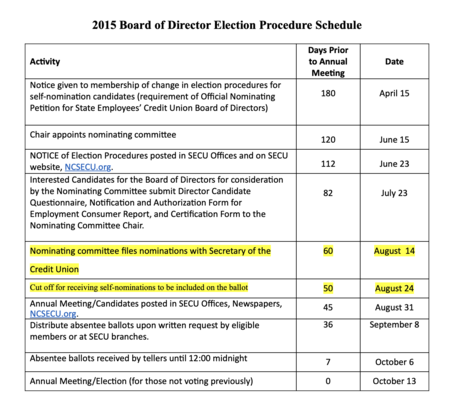
“She said that was unreasonable,” said Brady. “And do you know when that was put in? In 2015, when Blaine was CEO. About 1,000 people in the room were led to believe that the board put that in, and that’s not true.”
But Blaine said that statement is only partially true, as the real issue isn’t the number of signatures required but the time allotted to gather them. He said it’s a change he had nothing to do with.
Editor's Note: Following the initial publication of this report, SECU provided the graphic at right (with highlighting by SECU) related to the timetable of changes in board election procedures.
Some Truth, But…
Blaine confirmed that he was CEO around 2014 when certain election procedures were changed, including the move to require 500 signatures for a candidate to run.
“There is some truth in what they said. To me, it's reasonable and is standard practice. For a credit union of a certain size, I think it's reasonable to ask for signatures,” he told CUToday.info.
Blaine said it was a move by the board on April 11 of this year when Jim Hayes was CEO that is the issue, as they new rules “made it almost impossible for people to get signatures” for several reasons, including that in order to run a member first had to first be approved by the nominating committee.
Blaine said he believes all that should be required to run for a board seat is to be 18 years of age and to have the ability to get those required signatures over a more reasonable period of time.

The three incumbents who won seats on the SECU board, from left, Michael Clements, Barbara Perkins and Chuck Stone.
Creating ‘Distrust’
He said members this year were given approximately 10 days, four of which were over weekends, to get 500 signatures and turn them in.
The 500 signature requirement is the standard at federal credit unions.
Blaine believes the restrictions represent one of the decisions that is going to come back to haunt the SECU board. In addition, he said he believes changes made to the annual meeting format have also created “distrust.”
“I can’t prove this, but I promise you the employees voted those board members out. They had to get 500 signatures in 10 days, which is almost impossible. You don’t have the petition until Friday, July 25, and you had until Monday a week later to get it back,” he said. “They didn’t get 500, they got 5,000. There will be 100,000 next time! Once people start paying attention, and they have, it’s going to be massive. Five-thousand? That’s impossible, but they kept coming in.”
One Prediction for What’s Ahead
Looking forward, Brady said SECU is hopeful its new loan pricing will increase lending and create a more balanced loan portfolio. But that’s just one of the challenges the credit union faces, the CEO said.
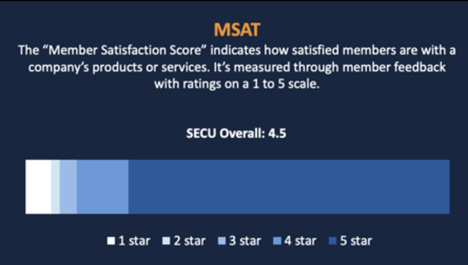
During annual meeting, Leigh Brady shared this slide showing satisfaction with SECU.
“Quite frankly, right now, it’s very difficult to maintain what we need to maintain,” Brady said. “We have a heck of a lot of work to do in the technology space. We are woefully behind on technology. We have some big things coming next year; we are going to redo our digital platform and our mobile app and be done by the end of next year. We are putting in a brand new loan servicing system that I’m hopeful will be in some time next summer. We just finished a wire system and a new contact center system this year, and I’m hoping the rest of the components can go in by the end of next year for the contact center, which will bring a little more voice authentication, features like that. And we are going to roll out a rewards card next year.”
And then there is another small task for the $50-billion SECU: it is looking to upgrade its core system.
“That is clearly not easy as there are only certain systems that can handle an institution our size. I am hoping we can make the determination of a vendor by the beginning of 2024,” said Brady.
The Fight for Deposits
In the shorter term, meanwhile, when it comes to deposit rates, Brady said, “I am trying right now to do everything I can to figure that out. I committed in my speech to doing that. It’s money market rates they want to go up. We have targeted right now the share term certificate side of things; that’s been our game plan just to stop the bleeding a little bit. On the money market accounts, we have about $16 to $17 billion in the money markets, and folks want us to increase that rate, for sure.”
Given the lending and the need to invest in so much new technology, Brady said SECU has been looking to cut expenses.
“I told our management team at our August meeting we need them to do more with less. We’re not the only credit union going through this,” said Brady, before noting, “A lot of this depends on what the Federal Reserve is going to do. If they would just lower rates we’d all be in better shape.”
Another View of the Future
For his part, when it comes to what’s ahead Blaine points to issues with a much shorter time horizon, saying he believes it would be good to have a “reasoned public discussion around” around what SECU is now saying about its move to risk-based pricing.
“That’s what the (2022) resolution asked the board to do. And what the board did was have what were later called ‘Fireside Chats’ with Advisory Board chairs. They did not allow dialogue or discussion; questions had to be submitted in advance; not all of the questions asked by some astute advisory boards were answered,” Blaine stated. “So, the board had the opportunity to have that discussion, throw out the numbers, let it be debated. That was what was hoped for. I don’t think there is that forum anymore for that kind of debate.”
Five Questions
How did the situation get to this point?
Blaine again points to the 2022 annual meeting during which he spoke up within what he called the “appropriate protocol.”
“I was encouraged to deliver…four or five questions about policies and goals that the credit union had.”
Blaine said the questions were related to:
- Risk-based lending
- Opening SECU’s membership
- Global or regional expansion
- Commercial lending
- The elimination of some longtime services, such as tax preparation for people of modest means
‘Legitimate’ Questions
Blaine said he believes all five questions were “legitimate” to ask and were asked in the proper forum, and that while most of those activities and changes were typical at other credit unions, they were not at SECU.
In the resolution offered at the annual meeting, Blaine said it wasn’t about making accusations, it was about asking for explanations.
“They were just kind of rolling these out without” without explanation, he said. “I think the board got defensive and they tried to control the conversation and I think it went downhill from there.”
The situation has gone so far downhill, Blaine suggested, that after the 2023 annual meeting “you can see what’s coming, and it’s not me. The writing on the wall is very clear. If they don’t do something reasonable and have an open discussion… Risk-based is the hot item, because the majority of members know they are being overcharged. And they know the board has not released accurate data. (The challengers have) three seats at the table now. (The data) will be released. It will be discussed. There will be four (board seats) up next time; that’s the majority.”
A Surprise
Blaine said he did not anticipate that all three challengers would win their seats; he thought the process would take two years.
“Every one of (the incumbents) lost even though they had the power of the organization and the marketing and all that. And risk-based lending was the key. Leigh’s first announcement was she was going to proceed with implementing risk-based pricing in every loan product. She gave the single finger salute to the entire membership. Wouldn’t you at least say, ‘Why don’t we pause and talk about this and explain ourselves better? Then we can proceed’.”
‘Time to Reconsider’
In the back and forth between the current CEO and the former CEO, Blaine said it’s “not the Leigh and Jim show.”
Instead, he said SECU must listen to its membership, saying the board election results indicate it’s time to reconsider.
“There is no need to roll out risk-based lending across all loan products. The question is, if you were a CEO and you and the board were slapped in the face, wouldn’t you reconsider and pause?
Pressing Ahead
Brady, who has been with SECU for 36 years, has vowed to press ahead, saying her range of experience at the credit union offers a lot of insight and that conditions have changed at both SECU and in the broader market. She noted she applied for the CEO post two years ago, but the board selected Jim Hayes.
“But during those two years I was the COO. I have served in a variety of roles through the years in the organization; operations was something that was missing for me and it did afford me the opportunity to learn that, and I’m better prepared overall. I have had a tremendous amount of support here. We have a really, really good team. I love the organization far too much not to try.”
Two Predictions
While saying he’d prefer to get back to “tending chickens and daffodils,” Blaine did offer a couple of predictions.
“If something doesn’t change, regardless of what Leigh or I say, well, you’ve never seen an entire clean sweep of (board) incumbents in your life…and that will happen again in October (2024); the board is going to be replaced. That’s not me doing that. That’s the membership voting and saying this is not right. That’s a fact.”
Another fact, said Blaine, is what’s going on at SECU is drawing the attention of another group: North Carolina’s powerful banking lobby.
“The banks are ready to jump. The banks are following this like a hawk. SECU is big enough that banks will make an example of SECU” for why the tax exemption is no longer necessary.
Just Because It’s Autumn Doesn’t Mean Falling for Schemes to Overcharge You for CU Industry News. Instead, Try This Crisp Offer
The biggest, best and freshest news reporting in credit unions remains free! Each morning CUToday.info delivers its daily Fresh Today news update offering the latest headlines and breaking news right to your email, with the easy-to-read headlines format allowing you to click on the stories that interest you most in order to learn more. So stop paying those bank-fee-like subscription prices from other so-called “news”” publications!
If you haven’t yet signed up for the new email solution on which CUToday.info has partnered with ResponseGenius, you can do so here. Signing up requires less than one minute of your time—and it’s free!
Please note that after signing up you may need to go to your Spam/Junk folder and mark the morning headlines email as safe. CUToday.info does not provide its list of readers and emails to outside parties, and we will not be contacting you to sell you an extended warranty or sending you any links so you may cash in on an inheritance you didn’t know was coming.
And did we mention it’s free?