MADISON, Wis.–The narrative around small credit unions too often emphasizes “weaknesses,” even though some have successfully unlocked the secrets to thriving and growing, according to a trio of experts who have spent the last few years researching the state of small CUs.
That research, conducted by Filene and CUNA Mutual, has found small credit unions that actually outperform the industry at large across many metrics, including ROA, and found that while scale can matter, it’s not the only determinant of performance.
And as one person observed, while they may not appear at conferences or be featured in media reports or TV ads, these CUs have demonstrated “boring is really exciting.”

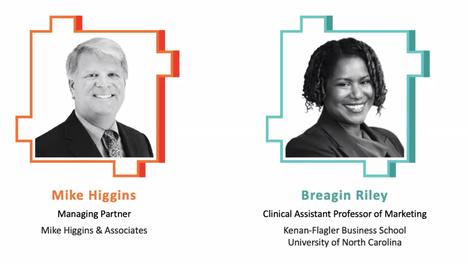
The research and the thriving credit unions were highlighted during a webinar hosted by Filene titled “Industry Collaboration and Secrets to Thriving.” The webinar featured Breagin Riley, clinical assistant professor of marketing with the Kenan-Flagler Business School at the University of North Carolina, and Mike Higgins, managing partner, Mike Higgins & Associates.
The discussion was moderated and led by Taylor Nelms, senior director, market insights and advisory services, with Filene. The webinar featured the extensive research CUNA Mutual Group and Filene have partnered on to identify why some small credit unions are thriving, in many cases with ROAs that would be the envy of billion-dollar credit unions.
This is part I of a two-part series in CUToday.info that will share highlights from the webinar and the research.
Wrong Narrative
One point touched on several times by Nelms is the “narrative around small CUs too often emphasizes their weaknesses.” Instead, he said, the research has sought to highlight those thriving small CUs with a much different narrative, and in this series, CUToday.info will feature a broad overview of what the research has found and then in part two, delve deeper into three smaller credit unions that are successfully growing and serving members.
“The pressures in the operating environment and the broader macroeconomic environment have been mounting,” acknowledged Nelms. “We're operating in an uncertain environment. There's accelerating competition, obviously shifting expectations in terms of how to access financial services digitally or on your mobile, and in financial services specifically there's a high degree of product commoditization, which really leads to difficulty differentiating. We're seeing increasingly transactional relationships as consumers seek out the best price for particular products and services.”
Leaders at credit unions of all sizes are questioning where they can find growth in this environment, which is why Filene and CUNA Mutual reported they decided to take a “different tack” and focus on those CUs that have indeed found ways to grow.
‘One of the Most Important Things’

Taylor Nelms
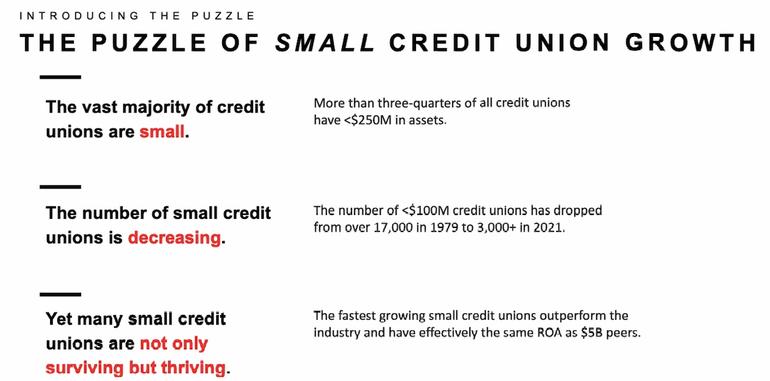
Over the past year Nelms explained that research has been unfolding, and it’s work he said is critical given that three-quarters of all credit unions in the United States are at $250-million in assets or below.
“We also know that the number of small credit unions is decreasing. That's no surprise,” said Nelms. “The number of credit unions with under $100 million in assets has dropped from over 17,000 in 1979 to just over 3,000 in 2021, and we know that many small credit unions are more vulnerable to merger than larger credit unions.
“And yet and I think this is one of the most important things that we've learned over the past year in this research,” he continued. “We know that many small credit unions are not just surviving and not just hanging on, but actually thriving, and we have a lot of data to back this up both quantitatively and qualitatively.
“We know that the fastest growing small credit unions in terms of member growth, but it also correlates with asset growth with loan growth, (and these CUs) actually outperform the industry at large across many metrics, including ROA,” Nelms stated. “In fact, when you compare the top quartile of high-performing small credit unions under $250 million in assets, they have about the same ROA as the peer group of $5 billion credit unions.”
The Objective
In researching these smaller CUs that are doing “exceptionally well,” Nelms said the objective was to uncover what they are doing differently, what they are doing strategically, and what can be applied to the industry at large.
To identify those CUs, more than a decade and a half of CU numbers were crunched, interviews were conducted and case studies developed.
“The result, we think, is a new approach to really understanding what it takes to achieve success as a small credit union with some very important lessons for all credit unions,” said Nelms. “I say success here very intentionally, because even though we started talking about growth, what we've learned about the success of thriving small credit unions is that growth may not be the starting place, it might actually be the outcome of a strong strategy and a focus on a broader, more comprehensive focus as a financial services provider.”
Five Puzzle Pieces

The University of North Carolina’s Breagin Riley said the research identified five puzzle pieces that are “are really critical to just figuring out what that different path to success is.”
“We acknowledge that each small credit union has its own path and has to figure out what that path is. It is really about figuring out, first of all, what is your identity in the market?” said Riley.
Other questions a CU must ask itself, she said, include:
- What market is a CU in and how competitive is it?
- What are members’ values?
- What do members need from their credit union?
- What other financial institution options do they have in the area?
- What is that unique thing a CU can add for members?
“When we think about the question of what does the actual market need from you, that becomes a question of your history,” according to Riley. “Where did you come from? What does your charter require of you? What is it that is evolving in the world that might be shifting to shape what your members will need from you in the future? And how can you set yourself up to be the credit union that that your members need you to be? How can you use that to acquire new members? How can you use that to manage the relationships that you currently have even better?”
In short, said Riley, smaller credit union can thrive by identifying where the market gaps are and then filling them. For the credit union, that includes asking itself whether it has the capability to serve the market, and identifying where investments may need to be made.
“For some of our credit unions the investment goes into the staff and into training, and for some of the other case studies we'll see that that investment goes into technology and partnering with other financial services providers to deliver the kinds of benefits that members need,” said Riley.
She said another “integral piece of this puzzle” is managing the two stakeholder groups: members and employees.
Additional Q’s
Other stakeholders include the competition and regulators. The questions a CU must ask itself for those constituencies include:
- What is it that they need to hear from you?
- How are you going to communicate your strategy to them in a way that makes sense and in a way that communicates the long-term vision and viability that you've been able to create for the credit union?
“When we think about that stakeholder relationship, it really is a relationship. Those regulators are not coming down to tell you what you need to do and what metrics you need to hit,” said Riley. “That's really a conversation where you lay out your story and say, ‘This is the need that we see, this is the path we think will help us serve this market well, to thrive, to do the things that our employees need us to do. This is what that will look like in the short term and we see that we might not look as good on paper for the next two years, but this is a long-term strategy.’ That really becomes about making those stakeholders your partners.”
The board must be involved, stressed Riley, and
it cannot function as a “rubber stamp” for management. Instead, it must include members who are thoughtful and whose social capital is going to help the CU better navigate the market, she said.
“These may be people who are willing to play the role of contrarian, people who are willing to involve themselves in simulations where things drastically change in the economic environment,” she explained. “Whatever that that is for you, the composition of your board needs to be one of a set of advisors who each brings something unique to the table that really helps you better drive as the organization.”
Not Getting Frustrated
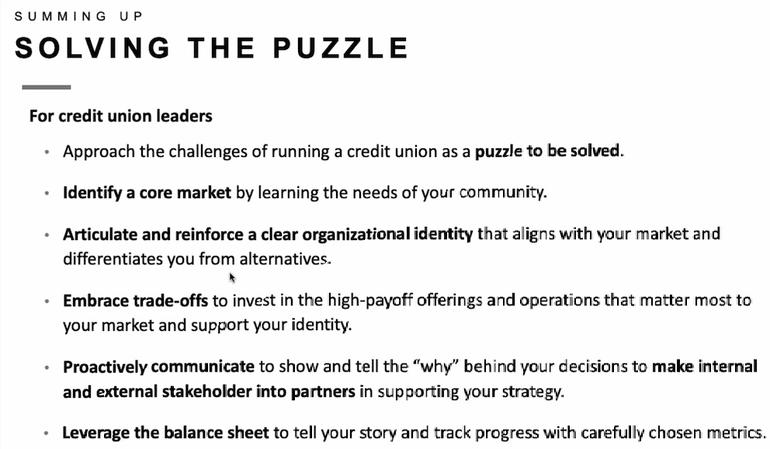
Nelms said a consistent theme in the research was leaders of successful small CUs who didn’t get “frustrated” over the challenges they face, but who instead see a puzzle to be solved.
“They were really proactive in their communication with both internal and external stakeholders, and in particular they sought to kind of tell the story of the why behind the trade-offs that they were making in their strategy,” he said. “That kind of culminated in a story on their balance sheets, where they (had) really carefully chosen metrics that aligned with their strategy.
Riley agreed, saying thriving small CUs are “creative” in terms of how they measure success.
“For some of the organizations they measured success and things like, ‘How well does our membership trust us with their money?’ because they recognized that within the group of members they serve there was a lot of distrust for financial institutions,” Riley said. “For another organization, they really measured success in terms of word of mouth. This was actually really exciting. At one point they got over the course of one weekend a large uptick in people inquiring about accounts at the credit union and they tried to figure out what happened. It turns out that it was all attributed to a Facebook group where people who qualify for membership were talking about their banking needs and somebody said, ‘You know, you really need to go check out the folks over at Iron Workers Credit Union. They really take care of you and they understand our lifestyle’.”
Additional Measures
Other measures deployed by some CUs, she added, include:
- How “delighted” members are with the credit union?
- How loyal are they?
- How good do they feel in making the CU their financial institution of choice?
- How much they could give back to the community?
- How do they make their community more sustainable so that everyone's lives are better?
“That question of success is really idiosyncratic. It depends on the institution itself and, of course, you can see some of that success on the balance sheet,” said Riley. “They were really creative in not just restricting themselves to the numerical, measurable things that you that are the standard metrics, but also thinking more holistically what's the impact that we're having in our members lives and in our communities lives?”
Upward Fixed Costs
In his analysis of the balance sheet, Higgins agreed there are different ways to measure success, but he also acknowledged, “At the end of the day you do need to be financially successful, because you are facing some headwinds. You've got what I call ‘an upward, fixed-cost industry,’ because every year our operating costs, no matter how thrifty we are, go up a little bit. Our biggest expenses outside of interest are credit-loss expenses and personnel; that's usually about half of our operating costs and we've got cost of living adjustments, we have to make to be sure we're retaining people and attracting people to come work for us. The cost of benefits is rising.”
One Main Theme
Higgins said there is no one “particular way” to a thriving balance sheet.
“I would say one of the main themes is that as long as you can stay relevant to your constituency or the market you're serving, that's a huge plus, and that goes back to the strategy and stakeholders and all the other parts of the puzzle that you were talking about, Higgins said. “Relevance trump's size or largesse as long as you can stay relevant. That's the key thing.”
Higgins said the Filene/CUNA Mutual research looked at approximately 3,000 credit unions over approximately 17 years’ of data, a period of time that encompassed the Great Recession, boom times, a period of low interest rates, the COVID era and a whole series of business cycles.
CUs in that data group were broken into two groups: those that started out between $10 million and $250 million in assets and outgrew the top-end threshold, and those that started out between $10 million-$250-million in assets and remained there (with the latter representing approximately 80%) of those CUs.
Importance of Being Relevant
“What were some of the things they did that were unique? Obviously, staying relevant in the market is one of them and the way we looked at that was through membership growth,” Higgins explained. “Are we holding on to our members, not losing them and hopefully gaining them? What we found between the two groups was an average of about 3% to 6% membership growth per year.”
In terms of benchmarks, Higgins said operating costs at these CUs were growing 5%-6.5% to 9.5% to 10% per year. That means each CU must ask itself what kind of growth it needs to offset those costs.
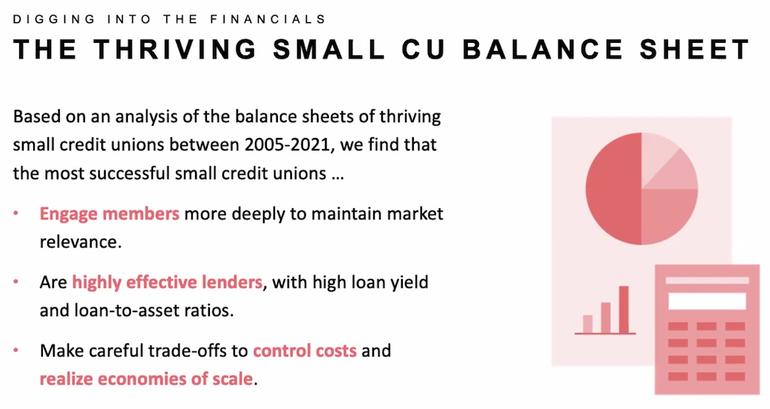
“When we start to look at the balance sheet, some of the characteristics were they were good at lending and they were good at lending without depleting their capital, meaning they could extend credit within a risk tolerance and manage to that very well,” he said of the thriving CUs. “The ones that were the most successful had a higher loan-to-asset ratio. So, if you think of all your assets, the more of them that are earning the loan yield—which is higher than we could earn as an investment—that's a good way to generate a higher ROA, because more of our assets are getting a higher rate of return. That provides some capital for us to support some growth and maybe invest in the cooperative a little bit.
It's Good to be ‘Boring’
“The other thing they were good at is core deposit growth,” he continued. “That’s really a sign of ‘Do we have that primary relationship with the member?’ And it's also important, because if you think of it like inventory, the organizations that have the lowest cost of goods—the lowest deposit costs—are going to stick around. They have a competitive advantage. It’s really not so much the scale that matters, it's the composition of the balance sheet. How much is loaned out? How much of it is filled with stable, low-cost funds that we can count on? The low-cost deposits are growing around 8% to 12% a year over that timeframe and loans are growing in the 6% to 10% range per year, so not explosive growth but it's steady. I like to say in this industry ‘boring is really exciting.’ Show me a steady growth rate somewhere between 5% to 6% on the low end and maybe 8% to 9% on the high end, and that's the most exciting thing in the world.”
‘Friendly’ NII
The thriving small CUs are also good at generating the “friendly type” of non-interest income, according to Higgins.
“Why? Because they're growing their membership and they're not running them off with the wrong type of fee or non-interest income,” he said.
These same small CUs are also “thrifty” and understand their size, Higgins stated, saying economy of scale isn’t the issue as much as generating a lot of “output given what their input is.”
Many of these CUs understand it’s often better to outsource certain functions.
The research found that among the “big gainer group” of small CUs there was an average of 87 basis points of ROA.
“I know a lot of larger credit unions that would probably be pretty pleased with that and even the smaller groups still maintained a good ROA. It was 60 basis points,” he said.
Some Lessons Learned
Nelms said the insights gained around the balance sheet reinforce some of the lessons learned in talking to the leaders of small credit union leaders.
“They put member engagement and service top of mind as they seek to maintain that market relevance,” Nelms said. “They're very effective lenders. We heard that over and over again. High loan yield, high loan to asset ratios, really making bets on high payoff products on the lending side that will drive profitability and sustainability. Those were the two most important.”