

LAS VEGAS–Credit unions that believe buy now, pay later (BNPL) solutions are victimizing consumers by trapping them in doubt may be surprised to learn BNPL providers believe it’s just the opposite—it’s card issuers like credit unions that are incentivizing their members to get in debt and stay there.
That much was apparent during a discussion of BNPL by a panel during the Money 20/20 conference. The BNPL company reps argued they have strong policies in place to discourage debt that can’t be repaid and suggested card issuers should do the same.
Speaking to the Money 20/20 meeting and offering their perspectives were Brendon Kensel of PrimaHealth Credit, Alex Naughton of Klarna, and Paige Fitzgerald of Block (which owns Afterpay, Cash App, Spiral, and TIDAL). The discussion was moderated by Ohad Samet of TrueML.
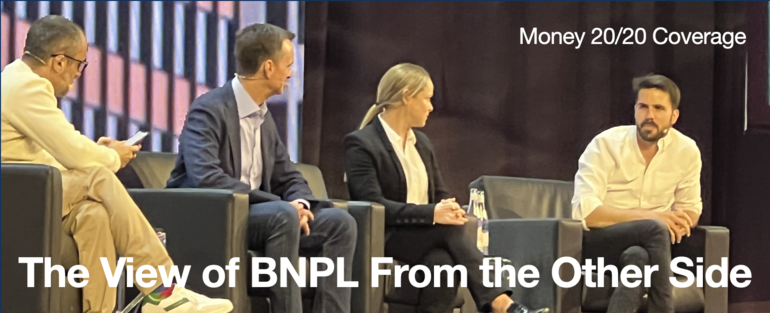
From left: Ohad Samet, Brendon Kensel, Paige Fitzgerald and Alex Naughton.
Here is what the panel had to say about BNPL, credit card practices, the future of regulation and more.
Samet: BNPL has grown tremendously. What is it? How is it different from traditional layaway and credit cards?
Naughton: I am based in the U.K. We have defined BNPL as short term, interest free credit. It is usually short-term financing and interest free or, in Klarna’s case, always interest free. It is quite different from traditional credit in many ways.
Fitzgerald: We think of budgeting as being really core to our customer base. We make crystal clear how much they owe and exactly when they owe it.
Kensel: In medical care, the traditional amount financed is $3,600. People need a little more time to make those payments affordable.
Samet: How vital is BNPL to ecommerce? What is the value proposition?
Fitzgerald: We have really seen BNPL take off in the United States and it has become mainstream because it resonates with customers, but also because the value proposition is so strong for our merchant partners. We deliver so many leads, and these are engaged, high intent customers. We increase average order size and conversion rates.
Kensel: In health care payment is so critical to drive acceptance. The average orthodontal fee is more than $5,000, for example. So, it’s critical.
Samet: Historically, say five years ago, BNPL was associated with a younger customer and with managing cash flow. Is that still true? Has there been a change in demographics?
Naughton: BNPL 1.0 might have been for the younger, digital-native consumer. Now, we are seeing a different type of consumer, usually in their 30s. They are digitally native but are also budget conscious. BNPL really fits in nicely to that. Maybe it used to be t-shirts and shoes (being purchased), but we are now seeing it across a multitude of services. At Klarna, BNPL is just a feature of what we do. People like the security, the convenience, the budgeting. Millennials are traditionally more digital savvy. But our fastest growing segment is 57-plus. The common thread is people looking for a consistent, transparent and responsible experience.
Fitzgerald: We see something similar at AfterPay. Our strongest, largest segment is female Millennials. During the pandemic, especially in the U.S., BNPL has become mainstream. And our fastest growing segment is also older now.
Samet: In last few years as BNPL came to forefront, the critical voices compare BNPL to credit cards and claim that people who use BNPL end up with more transactions, borrowing more, maybe they are confused over who they owe money to. What do you think of the comparison?
Kensel: In our environment, we are used to having patients using installment financing. Our perspective is the rate is the rate is the rate. It’s much better for the consumer to have a predictable rate, which is much better than a credit card.
Fitzgerald: BNPL delivers better consumer outcomes. The proof is in the data. Ninety-five percent of AfterPay transactions are paid on time, 98% do not incur a late fee. And over one-third of our customers make the majority of their payments early. We do soft credit checks and don’t impact their credit scores. It’s more positive than the traditional credit card.
Naughton: With traditional credit cards, you are incentivized to not pay it back (right away). There are more responsible ways to pay back. At Klarna, if you don’t pay us back you can’t borrow from us again. The traditional credit card is built around making sure certain populations do not pay back.
Fitzgerald: At AfterPay, if a customer misses one payment, they are prohibited from using our platform again. Customers start with a very low spending cap of $200 and can only increase that by having a track record of paying in full and paying on time.
Samet: With BNPL, the overall indebtedness is about 10% of what you see with a credit card. If someone gets in trouble on a credit card, they tend to run up a balance. You do not see that in buy now, pay later financing. (BNPL customers) pay off balances at a rate six times higher than credit card customers.
Fitzgerald: It’s important not to lose sight of how much customers are spending on credit cards. Customers in the U.S. spend $1,000 a year in credit card fees. Accenture said AfterPay saved customers $459 million in fees they would have paid if they had been transacting with a credit card instead of AfterPay.
Samet: What happens when consumers get into trouble? What are the protections? What about disputes? Identity theft?
Kensel: In health care, it’s a little bit different, because this is around clinical care. If someone is unhappy with the outcome, we are structured for a full or partial return. We rarely see financial disputes.
Fitzgerald: We don’t let our customers fall into revolving debt by carrying forward compounding balances month over month. We don’t charge compounded interest. The fees are fixed and static regardless of how long the customer takes to repay. It is designed to keep the customer from falling into ballooning debt, which is much different from credit cards.
Samet: What about helping consumers who fall behind beyond just limiting them from charging more?
Naughton: You try to be as transparent as possible as early as possible to make sure they are fully aware of everything. There are terms and conditions throughout the process to keep them from getting into trouble in the first place.
The second thing is making sure our underwriting is responsible. Klarna defaults are below 1%. But if someone does get in trouble, we don’t inundate them with fees and interest and try to make sure they can make that payment. You don’t just approve customers who shouldn’t be in this type of product and then wait for them to get into trouble.
The other big difference is we have a pay now product, and that is about 30%-40% of our volume.
Fitzgerald: We agree this is a multi-pronged approach. We work with customers on repayment plans in late (payment) cases. We will work with them to show they can potentially repay and regain access. We also have CashApp Pay, which launched in August 2021 and that allows customers to pay with their own money.
Samet: CashApp recently announced people can use it to pay merchants. Klarna just had a big launch. How are you thinking about this?
Fitzgerald: We view ourselves as developing a best in class shopping experience. It’s a two-sided marketplace. With the integration of AfterPay into Block, AfterPay now has access into 144,000 merchants. With CashApp we have 47-million active monthly customers, many of whom are hard to reach Millennial and Gen Z customers. Merchants look to AfterPay to connect them to these highly engaged customers. Now we have the opportunity to drive both sides of the network at scale.
Naughton: Klarna 2.0 is really about creating an ecosystem and connecting the customer and the merchants.
Samet: This is resonating with consumers, and it’s attracting a lot of attention, including from competitors. We are seeing PayPal, Apple come into this market. What does that look like? How do you think about differentiation?
Naughton: It’s a great challenge, but we fundamentally believe anything that is good for the consumer is great overall, and competition is good for the consumer. We believe we can adapt quickly to the consumer preferences. We feel great about where we sit in this space. Anytime Apple or comes into this market, great, it’s another opportunity for the consumer not to use (other types of financing).
Fitzgerald: We view these new entrants as validation. On the merchant side, we have scaled AfterPay and have a track record of delivering leads to merchants. Now, by combining CashApp’s 47-million active monthly customers with AfterPay’s 20-million active monthly customers, we have real scale. Now, It’s just a challenge of educating them about the value of BNPL.
Samet: What about regulation over the next two years when more regulatory attention comes to the product?
Fitzgerald: It’s important to note that BNPL and After Pay are regulated today. We are subject to key consumer protection laws, along with AML, debt credit reporting, and privacy, among others. We welcome opportunities to ensure there are fit-for-purpose consumer protections are in place and that providers are meeting high standards and delivering consumer value.
Naughton: I agree fit-for-purpose is key. As long as it works for the consumer. We don’t want regulation that benefits third party banks, and we are a bank by the way. Regulation is a good thing.
Fitzgerald: We want to make sure consumers who pay on time are rewarded for that payment history.